Ite advisory board
A practical guide to forming and leveraging an ITE advisory board for better industry insights and governance.
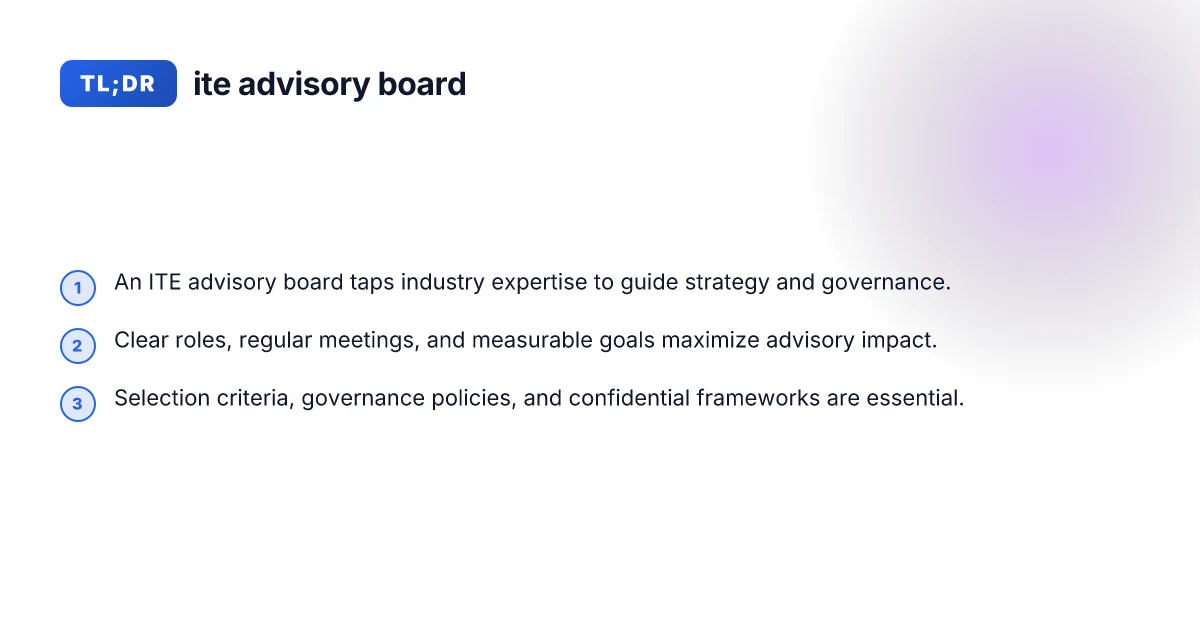
In today’s rapidly evolving tech and education landscape, an ITE advisory board can be a powerful accelerant for strategic clarity, stakeholder alignment, and accountability. Whether you’re an information technology enterprise, an Institute of Technical Excellence, or another organization with “ITE” in the name or focus, an advisory board helps you access seasoned perspectives without the formalities of a board of directors. This article outlines what an ITE advisory board is, who should serve on it, how to run it effectively, and best practices for getting tangible value from your investment.
What an ITE advisory board is vs. isn’t
| Aspect | Advisory board | Not advisory board | Internal committee | Directors (board) |
|---|---|---|---|---|
| Purpose | External guidance on ITE topics | Not offering external guidance | Internal decision body | Governing body for org |
| Stakeholders | Donors, users, experts | Employees only? not external | Internal staff | Shareholders/owners |
| Accountability | To the organization and stakeholders | No external accountability | To leadership | To shareholders/mission |
| Decision impact | Advisory recommendations | Limited influence | Can approve/advise | Legal fiduciary duty |
| Time horizon | Ongoing, long-term | Undefined | Fixed terms possible | Long-term strategic |
Compiled November 2026; check the provider's site for current details.
What an ITE advisory board is and isn’t
- An advisory board is a voluntary, non-governing body of external experts who provide strategic advice, industry insights, and connections.
- It does not have fiduciary duties, legal governance powers, or decision-making authority over day-to-day operations.
- Its value comes from independent perspectives, network access, and guidance on complex issues your organization faces.
Who benefits
- Leadership teams seeking broader market insight, risk awareness, and cross-sector ideas.
- Product, curriculum, or service development teams needing real-world validation.
- Fundraising, partnerships, and stakeholder engagement teams looking to establish credibility and networks.
What it isn’t
- It isn’t a surrogate for the board of directors, investor group, or internal committees.
- It isn’t a space for internal politics to dominate decision making.
- It isn’t a one-time checkbox. The board works best with ongoing engagement and clear expectations.
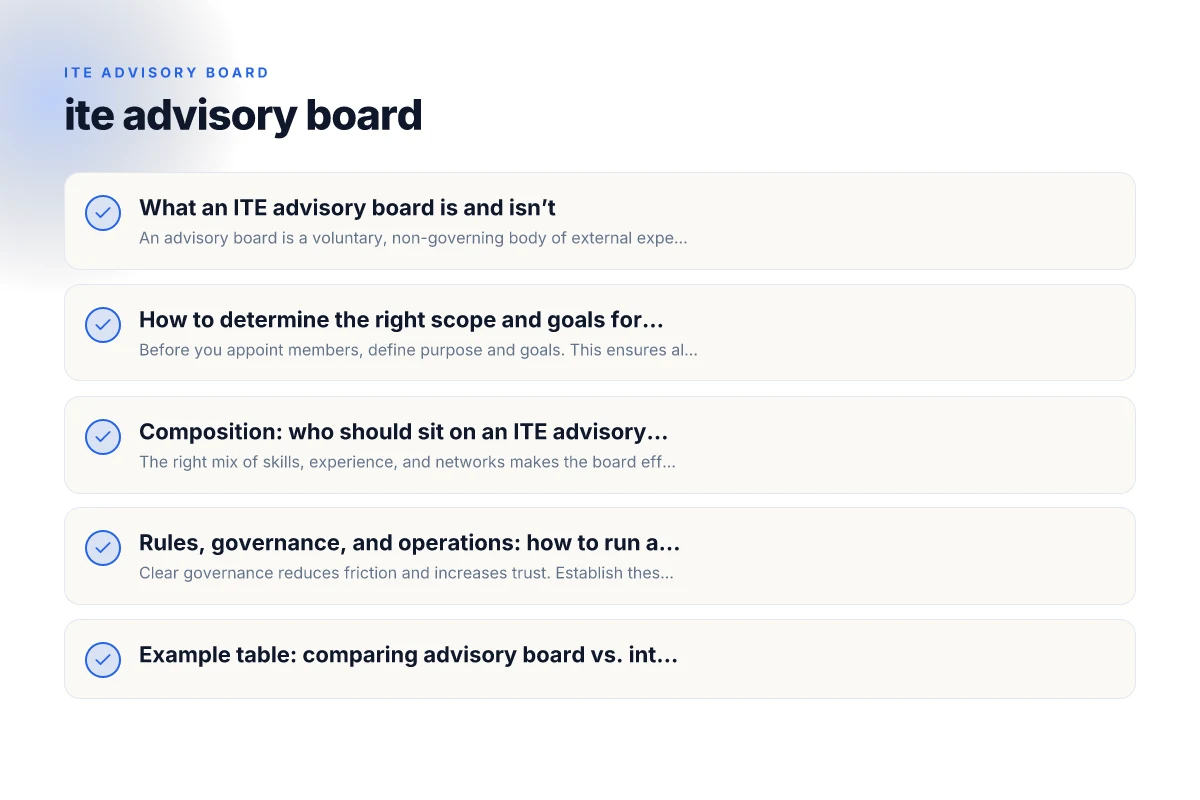
How to determine the right scope and goals for your ITE advisory board
Before you appoint members, define purpose and goals. This ensures alignment and strengthens accountability.
Clarify the mandate Information services request form
Strategic advice for product roadmap, market entry, or partnerships.
Governance and risk oversight support for major initiatives (cybersecurity, compliance, data privacy).
Thought leadership and credibility for fundraising or recruitment.
Set measurable objectives Incubation facilities: what they are, how they work, and why they matter
Number of strategic recommendations implemented per year.
Target introductions to X potential partners or customers.
Specific milestones tied to product launches or program expansions.
Align with long-term strategy Incubator facilities: what they are, how they work, and how to choose the right one
Map advisory topics to your 12- to 24-month plan.
Ensure the board’s expertise matches anticipated challenges (e.g., AI ethics, regulatory changes, supply chain resilience).
Define time commitments
Typical cadence: 4–6 meetings per year, plus ad hoc consultations. Icl advanced additives: a comprehensive guide to performance and applications
Expect 1–2 days of preparation per meeting and 2–4 hours of post-meeting follow-up.
Ensure compensation and honorariums are clear (if used) and compliant with policies.
Composition: who should sit on an ITE advisory board
The right mix of skills, experience, and networks makes the board effective. Consider these roles and criteria.
Profiles to include High performance computing hpc center
Industry practitioners with current hands-on experience in IT, education tech, or related sectors.
Experienced executives with governance or fundraising experience.
Academic or research leaders who bring rigor and fresh perspectives.
Customer or partner representatives who can articulate market needs. Hexagrid: What It Is, How It Works, and Why It Matters
Diversity and balance
Ensure a balance of function (tech, product, operations, risk), geography, and demographic diversity.
Seek candidates who challenge assumptions and foster constructive debate.
Selection criteria Ite co location center
Demonstrated strategic thinking and a track record of delivering results.
Strong networks that can translate into opportunities for your organization.
Commitment to the organization’s values, confidentiality, and board dynamics.
Availability and willingness to provide candid, constructive feedback. Ite innovative technology enterprises logo
Number and term lengths
A practical board typically ranges from 5 to 9 members.
Use staggered terms (e.g., 2- or 3-year terms) with an option to renew to maintain momentum while ensuring continuity.
Rules, governance, and operations: how to run an ITE advisory board effectively
Clear governance reduces friction and increases trust. Establish these core elements early. Ite leasing: everything you need to know about this finance option
Charter and operating principles
Purpose, scope, and decision-making boundaries.
Confidentiality and conflict-of-interest policies.
Meeting cadence, location formats (in-person or virtual), and minutes standards. Ite logo
Roles and responsibilities
Chair: leads meetings, maintains agenda, ensures follow-up on action items.
Secretary: records minutes, tracks progress against goals, manages documentation.
Members: provide candid insights, deliver on agreed commitments, maintain confidentiality. Ite mission community
Meeting structure
Pre-read materials: 7–10 days before meetings with context and decisions needed.
Agenda framework: strategic questions, risk flags, opportunities, and resource requests.
Action tracking: a transparent log of who is responsible for each task and due dates. Ite office: What It Is, How It Works, and Why It Matters for Your Workplace
Confidentiality and conflict management
Non-disclosure agreements or standard confidentiality clauses.
Clear rules for conflicts of interest, including recusal from certain discussions.
Advisor compensation and expenses
Decide whether to offer stipends, honorariums, or equity, and ensure compliance with policies and regulations.
Reimburse travel or incidental expenses with transparent expense reporting.
Evaluation and renewal
Annual self-assessments and board performance reviews.
Feedback loops for continuous improvement and to refresh the roster when needed.
Example table: comparing advisory board vs. internal committees vs. directors
| Characteristic | ITE Advisory Board | Internal Committees | Board of Directors |
|---|---|---|---|
| Purpose | Strategic guidance, networks | Operational governance, policy | Fiduciary governance, oversight |
| Decision authority | None (advice only) | Some authority depending on charter | Legal decision-making authority |
| Accountability | Report to leadership; outcomes tracked | Report to executives; often defined by charter | Shareholders or members; high accountability |
| Time commitment | Moderate to high; meetings 4–6x/yr | Variable; often ongoing | High; regular meetings & approvals |
| Compensation | Optional/variable | Typically staff time; sometimes stipends | Typically remuneration for directors |
| Confidentiality | High; sensitive strategic data | High; policy and internal data | High; fiduciary and sensitive information |
How to determine the right scope and goals for your ITE advisory board
| Dimension | Narrow scope | Moderate scope | Broad scope | No scope definition |
|---|---|---|---|---|
| Focus area | Specific topics | A few topics + process input | Multiple domains + strategy input | Vague areas |
| Goals clarity | One or two outcomes | 3–5 outcomes | Broad outcomes + KPIs | Unclear outcomes |
| Stakeholder input | External experts | Mix of experts and users | Wide set of stakeholders | Unknown stakeholders |
| Time horizon | Short-term deliverables | 1–2 year roadmap | Long-term strategic guidance | Unplanned timeline |
| Governance needs | Minimal | Some | Strong | None identified |
Compiled November 2026; check the provider's site for current details.
Best practices for engaging an ITE advisory board
To extract real value, cultivate a productive relationship between your organization and its advisers.
Provide context, not just problems
Share the strategic picture, including market trends, customer feedback, and competitive dynamics.
Offer concrete questions or decisions you need help with, rather than vague requests for feedback.
Encourage frank, constructive dialogue
Establish ground rules for candor and respectful disagreement.
Create a safe space where members can challenge assumptions without risk to their reputation.
Turn insights into action
Translate recommendations into a prioritized action plan with owners and dates.
Track progress and report back to the board on outcomes and learnings.
Foster ongoing engagement
Keep members engaged between meetings with brief updates, curated articles, or invitations to pilot programs.
Recognize contributions publicly when appropriate, while respecting confidentiality.
Leverage leverage points and networks
Ask for introductions to potential customers, partners, or investors.
Request advisory board members to speak at events to raise your organization’s profile.
Practical steps to get started
If you’re ready to establish or refresh an ITE advisory board, use this practical sequence:
- Define the mandate and success criteria
- Write a one-page charter outlining purpose, scope, and KPI targets.
- Set a measured timeline (e.g., 12–18 months) to assess impact.
- Design the composition
- Identify 5–9 candidates who fill gaps in expertise and bring diverse viewpoints.
- Prioritize commitment to strategic guidance and confidentiality.
- Draft governance documents
- Create an advisory board charter, conflict-of-interest policy, and meeting protocol.
- Develop a simple template for meeting minutes and action item tracking.
- Recruit and onboard
- Approach potential members with a clear value proposition and time commitment.
- Provide an onboarding package with the charter, recent strategic plans, and key metrics.
- Launch with a productive first meeting
- Start with a clear agenda focused on the top 2–3 strategic questions.
- End with actionable items, owners, and dates.
- Establish a rhythm of feedback and accountability
- Schedule quarterly updates on progress against the roadmap.
- Conduct an annual evaluation to decide on renewals or roster changes.
Composition: who should sit on an ITE advisory board
| Role type | Typical representation | Rationale | Size range | Term length | Engagement level |
|---|---|---|---|---|---|
| Subject matter experts | 3–5 external | Deep domain knowledge | 4–8 | 1–3 years | High |
| End-user representatives | 1–3 | Real-world insights | 2–4 | 1–2 years | Medium |
| Industry partners | 1–2 | Market perspective | 2–3 | 1–2 years | Medium |
| Independent facilitator | 1 | Process guidance | 1 | 1 year | Medium |
| Internal sponsor | 1–2 | Alignment with goals | 1–2 | As needed | Low |
Compiled November 2026; check the provider's site for current details.
Final recommendation
An ITE advisory board can be a powerful catalyst for strategic clarity, market access, and risk awareness when designed and managed thoughtfully. Start with a crisp charter, recruit a balanced mix of experts, and build a disciplined operating rhythm that translates advice into action. Regularly assess impact against defined goals, and don’t hesitate to refresh the roster to keep ideas fresh and aligned with evolving priorities. With clear governance, transparent processes, and committed participants, your ITE advisory board can become a trusted engine for growth and resilience.