Ite office: What It Is, How It Works, and Why It Matters for Your Workplace
An in-depth look at ite office, including what it is, use cases, and practical tips for implementation.
Introduction ite office represents a philosophy and set of practices designed to streamline how teams share data, coordinate tasks, and make decisions. The exact features can vary by vendor or internal team. The core idea remains the same: create a cohesive office environment where information flows smoothly, tools connect seamlessly, and work moves forward with less friction. In this article, we’ll unpack what ite office is, who should consider it, and how to implement it effectively in real-world settings.
Comparison at a glance — ite office vs. traditional document management
| Criterion | ite office | Traditional document management | Notes |
|---|---|---|---|
| — | — | — | — |
| Core focus | Collaborative docs | Recordkeeping only | ite office emphasizes collaboration |
| Real-time collaboration | Yes | No / Limited | Real-time editing available |
| Version control | Auto-tracked | Manual | Built-in version history |
| Access control granularity | Fine-grained | Coarse-grained | Ranges by user, role, doc |
| Audit trail | Supported | Basic | Detailed activity log |
| Offline access | Yes with sync | Often limited | Sync-enabled access |
| Searchability | Semantic search | Keyword search | Rich indexing in ite office |
| Integrations | Wide ecosystem | Limited | Connects to apps and tools |
| Adoption requirements | Moderate-change | Low-change | Training recommended |
| Compliance readiness | Supported | Basic | Depends on setup |
| Pricing signals | Subscription-based | Per-seat or license | Generally higher upfront potential |
Compiled November 2026; check the provider's site for current details.
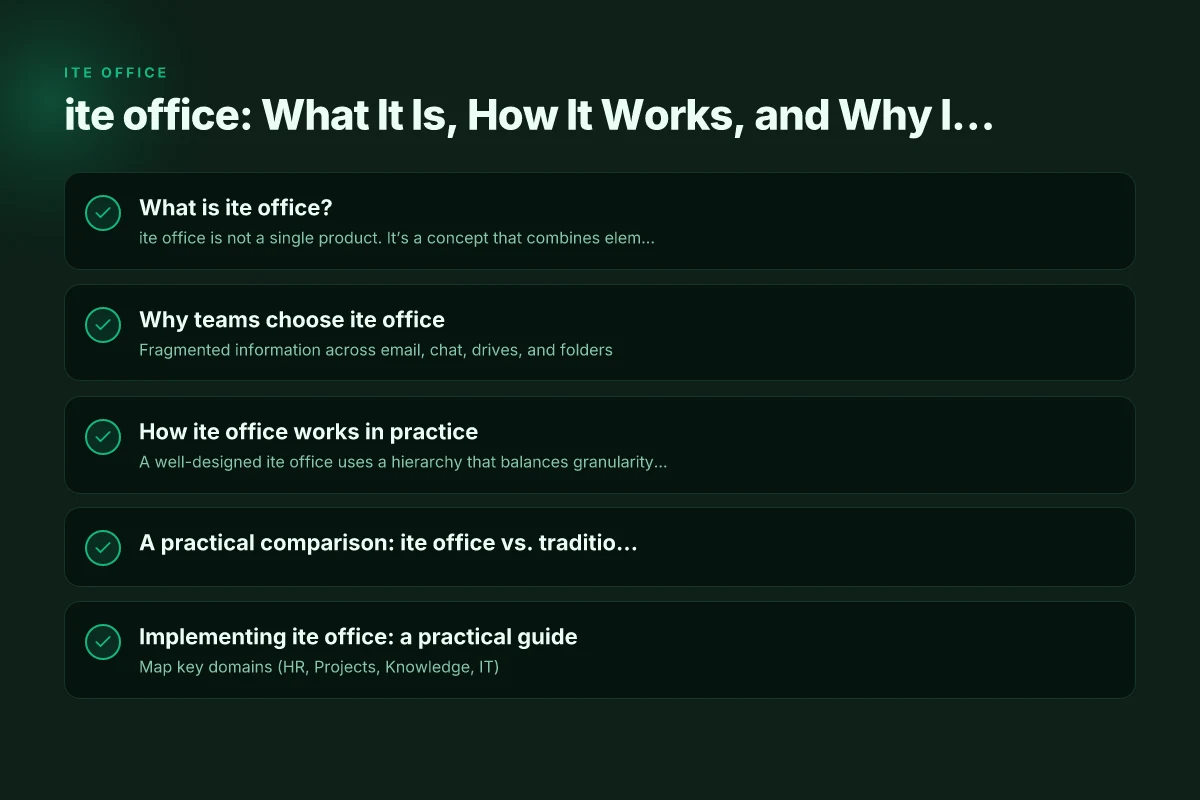
What is ite office?
Definition and scope
ite office is not a single product. It’s a concept that combines elements of content management, collaboration tooling, and process governance. At its heart, ite office aims to:
- centralize critical information so it’s easy to find
- connect people to the right actions at the right time
- automate repetitive tasks where possible
- support transparent decision-making with auditable traces
Core components
A typical ite office setup includes:
- an organized information architecture (documents, wikis, dashboards)
- collaboration spaces for teams and projects
- task and workflow management with status visibility
- integrations with key business apps (calendar, email, CRM, ERP)
- governance rules for access, retention, and data quality
Why teams choose ite office
Common pain points addressed
- Fragmented information across email, chat, drives, and folders
- Inefficient handoffs between teams and departments
- Difficulty tracking decision history and accountability
- Rework caused by outdated or contradictory data
Value propositions
- Faster onboarding: new members access a single source of truth
- Greater adaptability: teams can reconfigure spaces as needs change
- Improved compliance: consistent retention and access controls
- Measurable outcomes: dashboards and reports reveal progress and bottlenecks
How ite office works in practice
Information architecture
A well-designed ite office uses a hierarchy that balances granularity with usability:
- top-level spaces for departments or programs
- project-level workspaces for ongoing efforts
- standardized pages for policies, processes, and knowledge across teams
Processes and governance
- Access controls based on role and project membership
- Templates for recurring documents (meeting notes, decision logs, risk registers)
- Review cadences to ensure data stays fresh (quarterly audits, weekly health checks)
Collaboration patterns
- Real-time co-authoring for documents and playbooks
- Asynchronous updates via centralized dashboards
- Commenting and review trails to capture decisions
Practical comparison — ite office vs. traditional document management (by use case) Ite mission community
| Use case | ite office advantage | Traditional DM advantage | Ideal for |
|---|---|---|---|
| — | — | — | — |
| Cross-team project docs | Yes, real-time co-authoring | No | Fast-paced teams |
| Policy and procedure updates | Auto-versioning, approvals | Static docs | Regulated environments |
| Client collaboration | Live editing, tracked changes | File sharing only | Client-facing work |
| Historical analysis | Rich audit trail | Limited history | Compliance reviews |
| Mobile access | Full-featured apps | Basic web access | On-the-go teams |
| Training materials | Interactive docs | Static PDFs | Employee onboarding |
Compiled November 2026; check the provider's site for current details.
A practical comparison: ite office vs. traditional document management
| Feature | ite office | Traditional document management |
|---|---|---|
| Information accessibility | Centralized, role-based access | Fragmented: email, drives, and shared folders |
| Collaboration | Integrated spaces with live updates | Mostly static documents with limited collaboration |
| Task integration | Built-in tasks and workflows | Separate tools, often disconnected |
| Governance | Clear ownership, retention, and audits | Ad-hoc or inconsistent policies |
| Onboarding speed | Faster due to centralized knowledge | Slower due to silos and scattered info |
| Change management | Iterative improvements with feedback loops | Rigid, slow to adapt |
Implementing ite office: a practical guide
Step 1: Define your core information architecture
- Map key domains (HR, Projects, Knowledge, IT)
- Create a consistent naming convention
- Decide on spaces vs. folders for visibility vs. security
Step 2: Establish governance and roles
- Assign space leaders and document owners
- Set access rules by role and project
- Create a retention policy and review calendar
Step 3: Pick the right tools and integrations
- Choose a platform that supports pages, wikis, tasks, and dashboards
- Ensure core integrations (calendar, email, chat, file storage) are ready
- Plan for an API strategy if you need custom connections
Step 4: Create templates and playbooks
- Meeting notes, decision logs, risk registers, project plans
- Onboarding guides and standard operating procedures
- A template for weekly or monthly reviews
Step 5: Roll out in stages
- Start with a pilot team to refine structure
- Gradually expand to other departments
- Gather feedback and iterate on spaces, templates, and processes
Implementation path — practical guide table
| Phase | Key activity | Responsible | Success indicator | Time estimate |
|---|---|---|---|---|
| — | — | — | — | — |
| Discovery | Map needs, gaps | Project lead | Gaps documented | 1–2 weeks |
| Planning | Define roles, permissions | IT, Legal | Access model defined | 2–3 weeks |
| Setup | Deploy workspace, templates | IT | Baseline environment | 1–2 weeks |
| Data migration | Import existing docs | Admin team | 80% migrate | 2–4 weeks |
| Training | Run workshops | L&D | 80% users trained | 2–4 weeks |
| Pilot | Limited rollout | Ops | Feedback loop | 4–6 weeks |
| Rollout | Organization-wide | Change lead | Adoption rate >70% | 1–2 months |
Compiled November 2026; check the provider's site for current details.
Adoption tips: driving user engagement and sustaining momentum
- Communicate the “why” clearly: faster info, fewer interruptions, better decisions
- Make the first 20% of workpayoff obvious: show quick wins (searchability, faster onboarding)
- Provide training that is role-specific and scenario-based
- Encourage champions in each department to model best practices
- Measure success with simple metrics: time to find information, completion of tasks, and governance adherence
Common pitfalls and how to avoid them
- Over-engineering the structure: keep it simple and scalable
- Inconsistent usage: enforce minimal standards and templates
- Resistance to change: involve end users early in design decisions
- Data sprawl: implement a cleanup routine and periodic audits
The future of ite office: trends to watch
- AI-assisted knowledge management: smart search, auto-tagging, and summarization
- Deep integrations: connecting operational data to drive decisions in context
- Lean governance: lightweight policies that scale with growth
- Personalization at scale: tailored dashboards and views for roles
Final recommendation If your organization is grappling with information silos, inconsistent processes, or missed decisions, ite office offers a cohesive approach to tame complexity. Start small with a pilot, define a clear information architecture, and establish governance that empowers users rather than hampers them. With careful planning and ongoing iteration, ite office can become the backbone of a more collaborative, transparent, and productive workplace. Ite logo