Incubation facilities: what they are, how they work, and why they matter
A comprehensive guide to incubation facilities, their services, types, and how to choose the right one for your startup or research project.
Incubation facilities are purpose-built environments that help early-stage ventures grow from idea to viable business. They provide more than just space. They offer structured programs, access to experts, and curated networks that can shorten the path to product-market fit and funding. Whether you’re a biotech startup, a software company, or a social enterprise, the right incubation facility can be a game changer.
Features to compare across incubation facilities
| Feature | Facility A | Facility B | Facility C | Facility D |
|---|---|---|---|---|
| Core program type | Pre-seed | Growth | Sector-focused | Hybrid |
| Access hours | 9–5 M–F | 24/7 | M–Sat | Limited evenings |
| Mentorship availability | Yes | Yes, structured | Limited | Yes, ad hoc |
| Office/desk space | Private desks | Shared desks | Private offices | Coworking floor |
| Lab capabilities | Basic lab | Fully equipped | No lab | Shared lab access |
| Funding support | Grants guidance | Investor network | None | Demo day access |
| Community size | 40+ founders | 120+ founders | 25 founders | 60 founders |
| Location type | Urban | Suburban | On-site campus | Virtual + on-site |
| Program duration | 6–12 months | 12–24 months | 9–18 months | 6–9 months |
| Equity taken | No equity | Optional | Yes, limited | No equity |
Compiled November 2026; check the provider's site for current details.
What is an incubation facility?
Incubation facilities, often called incubators or startup accelerators (though there are distinctions), are organizations that support early-stage ventures. Their core aim is to bridge the gap between an idea and a scalable, sustainable business. Services typically include:
- Physical workspace and shared amenities (labs, coworking desks, meeting rooms)
- Mentorship and coaching from seasoned entrepreneurs and industry experts
- Access to a network of investors, potential customers, and corporate partners
- Structured programs with milestones, timelines, and deliverables
- Access to capital or conduits to grant programs and venture funds
- Educational workshops on product development, go-to-market strategies, and operations
Incubation facilities differ from traditional accelerators in duration and focus. Incubators often support ideas at the earliest stages with a slower, more exploratory program, while accelerators typically run fixed-term cohorts with tight milestones and a competitive admission process. Some facilities blend both models, offering ongoing support and episodic cohorts.
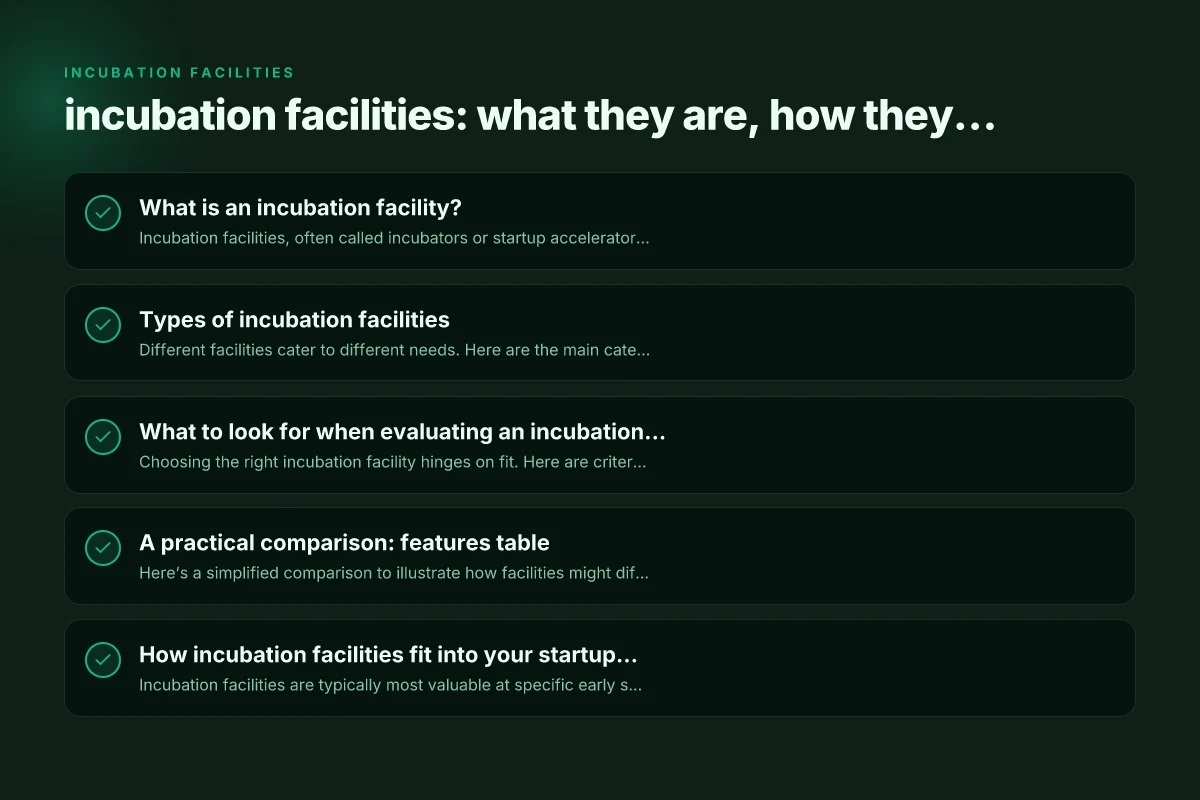
Types of incubation facilities
Different facilities cater to different needs. Here are the main categories:
University-affiliated incubators
- Located within or connected to universities.
- Strengths: access to research facilities, student and faculty talent, academic networks, and often grant opportunities.
- Ideal for: deep tech, life sciences, agriculture, and engineering ventures that can leverage academic research.
Corporate or campus-based incubators
- Run by corporations or municipal innovation campuses.
- Strengths: strategic partnerships, potential pilots with the parent company, access to enterprise customers.
- Ideal for: B2B software, hardware, energy, and industrial tech startups seeking enterprise validation.
Independent or nonprofit incubators
- Operated by standalone organizations with diverse mentors and funding channels.
- Strengths: broader industry reach, focused mentorship, and flexible program structures.
- Ideal for: consumer tech, fintech, and social impact ventures seeking broad networks.
Tech-focused accelerators
- Programs centered on software, AI, cybersecurity, fintech, or hardware-enabled software.
- Strengths: intensive cohorts, direct investor connections, and demo-day opportunities.
- Ideal for: startups aiming for rapid validation and traction within a year or less.
Biotech and life sciences incubators
- Specialized facilities with wet labs, clean rooms, and regulatory guidance.
- Strengths: access to lab space, compliance expertise, and grant pathways.
- Ideal for: biotech, pharma, diagnostics, and medical devices companies.
What to look for when evaluating an incubation facility
Choosing the right incubation facility hinges on fit. Here are criteria to guide your assessment: Incubator facilities: what they are, how they work, and how to choose the right one
Program design and milestones
- What is the program length and intensity?
- Are there explicit milestones, such as a minimum viable product, customer pilots, or fundraising goals?
- Is there a structured curriculum or more flexible, mentorship-led support?
Mentorship and leadership
- Who are the mentors and advisors? What are their track records?
- Are mentors industry-specific, product-based, or domain-agnostic?
- How accessible are mentors during and after the program?
Resources and facilities
- Do you need lab space, prototyping tools, or software development resources?
- Are there shared labs, equipment access, or manufacturing capabilities?
- What is the quality of office space, conference rooms, and IT support?
Network and partnership opportunities
- What corporate, academic, or investor connections exist?
- Are there partner customers or pilot programs readily accessible?
- Does the facility host regular events, pitch days, or demo showcases?
Funding and equity expectations
- Is there seed funding, grants, or equity terms required to participate?
- Are there follow-on funding opportunities or alumni networks with capital access?
Location and ecosystem
- Is proximity to talent pools, universities, or potential customers important for you?
- Does the location align with your go-to-market strategy or regulatory considerations?
Success metrics and outcomes
- What success metrics are tracked (revenue, pilots, partnerships, funding)?
- What are typical outcomes for companies that complete the program?
A practical comparison: features table
Here’s a simplified comparison to illustrate how facilities might differ. Note: specifics vary by program and location.
| Feature | University-affiliated | Corporate incubator | Independent nonprofit | Biotech incubator |
|---|---|---|---|---|
| Space type | Labs, offices, coworking | Flexible offices, some labs | Office space, shared labs | Wet labs, clean rooms, biology hardware |
| Mentors | Academic and industry | Industry partners, executives | Diverse entrepreneurs | Scientists, regulatory experts |
| Funding | Grants, seed connections | Corporate-backed funds, pilots | Grants, angel networks | Grants, venture funds, licenses |
| Length of program | 6–24 months | 3–12 months | 6–24 months or ongoing | 12–36 months, ongoing |
| Industry focus | Broad tech and sciences | Enterprise software, hardware | Social impact, broad tech | Life sciences, diagnostics, devices |
| Access to facilities | Research labs, equipment | Prototyping spaces, testing | Shared maker spaces | Full lab access, specialized equipment |
| Outcomes | Product validation, academic partnerships | Customer pilots, revenue milestones | Traction, investments | Regulatory-ready, partnerships, licenses |
This table is a snapshot. The best choice for you depends on your stage, industry, and goals. Always request a sample schedule, a tour, and references from alumni.
How incubation facilities fit into your startup journey
Incubation facilities are typically most valuable at specific early stages:
- Idea-to-concept phase: validation, market research, and initial product concept refinement.
- Early product development: building a minimum viable product, securing pilot customers, and proving technical feasibility.
- Market validation: running pilots, collecting customer feedback, and refining the business model.
- Fundraising readiness: preparing a compelling pitch, understanding capital needs, and connecting with investors.
A facility can also help with operations: access to shared services (legal, HR, accounting), procurement channels, and standard operating procedures that de-risk early growth. Icl advanced additives: a comprehensive guide to performance and applications
What to look for when evaluating incubation facilities
| Criterion | Description | Example indicator | Priority (High/Med/Low) |
|---|---|---|---|
| Proven outcomes | Track record of startups | Graduation rate; exits | High |
| Mentorship quality | Access to seasoned mentors | Mentor-to-founder ratio | High |
| Resources offered | Equipment, admin, legal | Lab space, legal clinic | High |
| Community & culture | Peer support, events | Networking events per month | Medium |
| Location & access | Proximity to talent | Commute time, transit | Medium |
| Cost transparency | Clear pricing | Fee schedule online | High |
| Customization | Tailored programs | Industry tracks | Medium |
| Alumni support | Ongoing opportunities | Alumni events | Low |
| Application ease | Process simplicity | Avg days to decision | Medium |
| Environmental fit | Alignment with goals | Sector focus compatibility | High |
Compiled November 2026; check the provider's site for current details.
Common programs and services you’ll typically encounter
- Mentorship programs with scheduled office hours and on-demand coaching.
- Workshops and speaker series covering product, marketing, sales, and fundraising.
- Access to demo days or investor showcases.
- Funding opportunities, grants, and grant-writing assistance.
- Shared facilities, including labs, prototyping equipment, and software resources.
- Networking events with potential customers, partners, and peers.
- Business services: legal templates, accounting software, IP counsel, and regulatory guidance (especially for biotech and healthcare).
How to apply and what to expect in the process
- Application: Most facilities require an application that outlines your problem, solution, stage, team, and traction. Some programs are selective, with a multi-round evaluation.
- Interview: Expect founder interviews, team dynamics discussions, and a product demo or pitch.
- due diligence: Some programs review IP, regulatory considerations, and market potential.
- Acceptance and onboarding: You’ll receive a program plan, milestone schedule, and expectations for participation.
- During the program: You’ll engage in sprints, mentor sessions, workshops, and pilot activity. Regular progress reviews help you stay on track.
A practical comparison: features table (quick drill-down)
| Feature | Essential | Nice-to-have | Winner Notes |
|---|---|---|---|
| Studio/desk space | Yes | Hot desks | Facility C |
| Lab facilities | Yes if needed | Shared lab | Facility A / D |
| Legal & IP support | Yes | Optional | Facility B |
| Funding access | Yes | Demo days | Facility B / D |
| Mentorship density | Yes | Flexible | Facility A |
| Community events | Yes | Monthly | Facility D |
| Workspace flexibility | Yes | Part-time | Facility C |
| Virtual resources | Yes | Global network | Facility D |
| Demo day readiness | Yes | Investor prep | Facility B |
| Success metrics reported | Yes | Case studies | Facility A |
Compiled November 2026; check the provider's site for current details. High performance computing hpc center
Case study snapshots (illustrative)
- A software startup joins a tech-focused accelerator hosted in a metropolitan innovation hub. They gain access to enterprise clients for pilots, participate in weekly sprints, and secure seed funding through a demo day.
- A biotech venture uses a university-affiliated incubator to access a wet lab, regulatory consultants, and collaboration with a university lab partner. They validate assay performance and prepare for an investor pitch grounded in preclinical data.
- A hardware startup leverages an independent nonprofit incubator’s prototyping workshop and maker space. They build a functional prototype, secure a pilot with a small manufacturer, and position for Series A after customer validation.
How to choose the right incubation facility for you
- Clarify your stage and goals: Are you seeking mentorship, lab space, pilot customers, or funding?
- Align industry needs: Do you require wet lab capacity, software development resources, or hardware prototyping?
- Assess the network: Is there meaningful access to mentors, customers, or investors in your sector?
- Consider location and ecosystem: Is proximity to your target market or regulatory environment important?
- Review success stories: Talk to alumni about what they achieved and what they wished they had known at the start.
- Visit in person if possible: A tour can reveal cultural fit, responsiveness, and the practicality of facilities.
Process and expectations: applying to incubation facilities
| Phase | What happens | Timeframe | Outcome indicators |
|---|---|---|---|
| Inquiry | Send overview & goals | 1–2 weeks | Acknowledgment |
| Application | Submit form & documents | 2–4 weeks | Complete review |
| Interview | Founder pitch | 1–2 weeks | Interest level |
| Due diligence | References & model check | 2–3 weeks | Feasibility clear |
| Decision | Offer or waitlist | 1 week | Acceptance |
| Onboarding | Welcome, space, mentors | 1–2 weeks | Active enrollment |
Compiled November 2026; check the provider's site for current details.
Practical tips for getting the most from an incubation facility
- Define clear milestones before joining and map them to program milestones.
- Prepare a crisp pitch and a one-page concept note to quickly convey your idea.
- Build a strong team narrative. Mentors invest in teams as much as in ideas.
- Be proactive about leveraging mentors’ networks for pilots, customers, and potential co-founders.
- Use the shared resources early and document outcomes to demonstrate traction.
Final recommendation
If you are an early-stage venture seeking to accelerate growth, an incubation facility can be a strategic partner. Look for a program with a track record in your sector, a clear milestone-driven path, and mentors who understand your regulatory and market realities. Prioritize access to the resources that matter most to you, lab space for biotech, prototyping tools for hardware, or enterprise connections for software, and choose a facility where the culture and network feel like a good fit for your team. With the right fit, an incubation facility can shorten your time to market, help you build a strong network, and sharpen your fundraising posture.