Ite leasing: everything you need to know about this finance option
A practical guide to ite leasing, how it works, benefits, drawbacks, and tips for choosing the right plan.
Ite leasing, often simply referred to as equipment leasing, is a method of acquiring tools, machinery, or technology without paying the full purchase price upfront. Instead, you enter into a contract with a leasing company (or lender) to use the asset over a defined period. At the end of the term, you may have options like returning the asset, renewing the lease, or purchasing the asset at a residual price. This approach can be especially attractive for businesses that need up-to-date equipment but want to manage cash flow or avoid tying up capital.
Comparison of lease types at a glance
| Lease type | Ownership at end | Monthly payment predictability | Tax treatment | Maintenance responsibility | Typical term (months) |
|---|---|---|---|---|---|
| Operating lease | No | High predictability | Taxed as expense | Lessor (often) | 24–60 |
| Finance lease | Yes | Moderate predictability | Taxed as depreciation/interest | Lessee | 36–84 |
| Sale-and-leaseback | No | Moderate predictability | Taxed as expense | Lessor (often) | 36–72 |
| CapEx lease | No | Variable | Taxed as expense | Mixed | 24–60 |
| Full-service lease | No | Very predictable | Taxed as expense | Lessor; service included | 24–60 |
Compiled November 2026; check the provider's site for current details.
How ite leasing works
The basics
- You select the asset you need (e.g., manufacturing robots, printing presses, IT hardware, vehicles).
- A leasing company purchases the asset and grants you the right to use it.
- You make regular payments over the lease term, which could be monthly, quarterly, or annually.
- At the end of the term, you choose your exit path: return, renew, or buy.
Common lease structures
- Operating leases: Typically off-balance-sheet in risk terms, with lower monthly payments and the option to return the asset.
- Finance leases (capital leases): Closer to a loan. You may own the asset at the end if you exercise a purchase option.
- Closed-end vs. open-end leases: Closed-end generally means less risk of additional charges if the asset’s value drops. Open-end can expose you to more residual risk.
What controls the cost
- Asset price and residual value: Higher upfront price or higher expected residual value affects payments.
- Lease term length: Longer terms usually lower monthly payments but can increase total cost.
- Interest rate and fees: Administrative fees, maintenance, insurance, and purchase options add to cost.
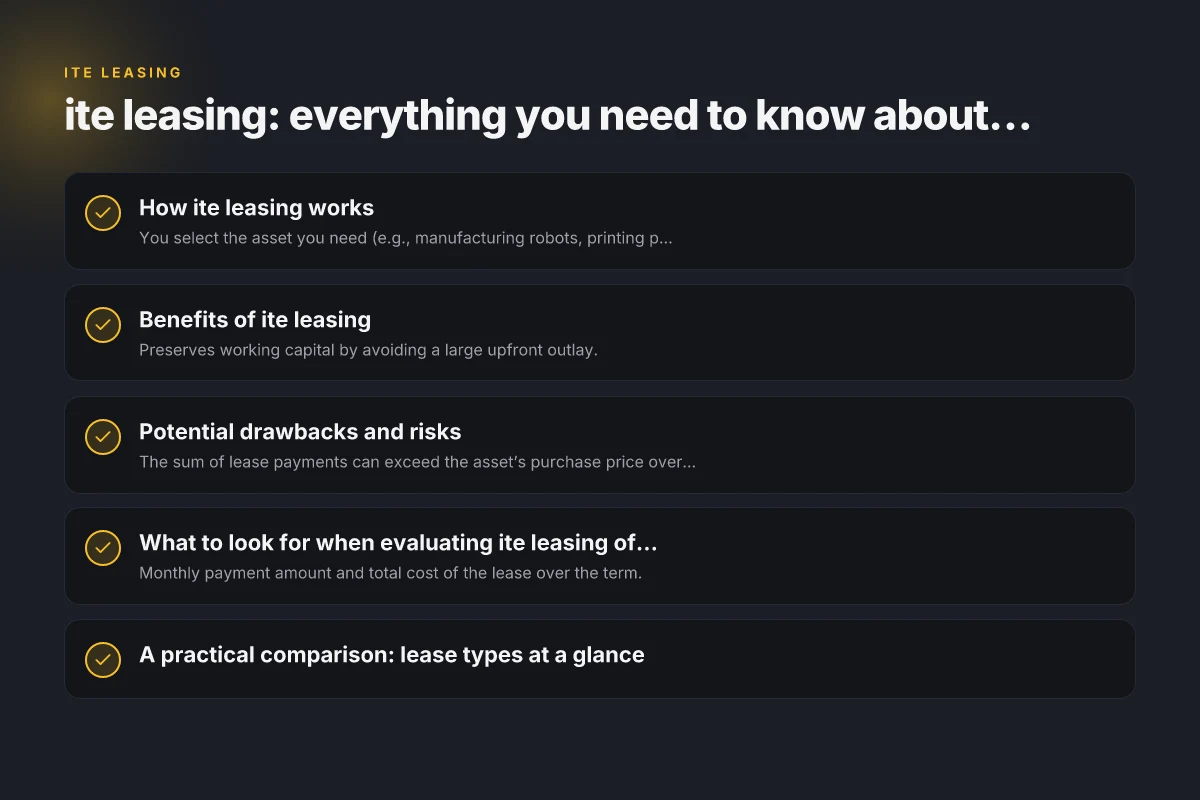
Benefits of ite leasing
Cash flow protection
- Preserves working capital by avoiding a large upfront outlay.
- Predictable budgeting through fixed lease payments.
Access to better or newer equipment
- Easier to upgrade to the latest technology as leases end.
- Avoids obsolescence risk tied to owning aging machinery.
Tax and accounting considerations
- Some leases may offer tax deductions for lease payments or depreciation advantages (depending on jurisdiction and lease type).
- Off-balance-sheet treatment can improve certain financial metrics under specific standards, though this has evolved with new accounting rules.
Maintenance and services
- Many leases bundle maintenance, installation, or support.
- Service-level agreements (SLAs) can simplify management and uptime.
Flexibility and scalability
- Easy to scale up or down as business needs change.
- Easy to add additional assets under the same leasing relationship.
Potential drawbacks and risks
Total cost of ownership
- The sum of lease payments can exceed the asset’s purchase price over time, especially on long contracts.
- End-of-lease charges for excessive wear, non-returned accessories, or missed conditions may apply.
Less control and ownership
- You don’t own the asset during the term, so you may have restrictions on modifications or use.
- End-of-lease options require careful timing and decision-making.
Dependence on lessor stability
- The provider’s financial health matters. A lease could be disrupted if the lessor faces insolvency or policy changes.
Residual risk
- Open-end or vehicle-style leases may expose you to market risk if the asset’s value fluctuates.
Hidden fees and terms
- Early termination fees, processing charges, or mandatory insurance can raise the total cost.
End-of-lease considerations and actions
| Consideration | What to check | Possible outcomes | Action if unfavorable | Typical documents needed |
|---|---|---|---|---|
| Residual value risk | Estimated value accuracy | High/low risk | Negotiate buyout or extension | Valuation report, appraisal |
| Wear and tear | Defined in contract | Extra charges possible | Negotiate limits | Inspection report |
| End-of-lease options | Buy, renew, or return | Must choose | Decide early; plan cash flow | Lease agreement, option notice |
| Return condition | Standards | Charges for excess wear | Schedule maintenance | Return guide, photos |
| Early termination | Fees | High penalty | Plan ahead; avoid | Termination clause |
Compiled November 2026; check the provider's site for current details.
What to look for when evaluating ite leasing offers
Key terms to compare
- Monthly payment amount and total cost of the lease over the term.
- Lease duration and flexibility to renew or upgrade.
- End-of-lease options: buyout price, return conditions, and any penalties.
- Maintenance, insurance, and service inclusions or options.
- Payment structure: fixed vs. variable payments, escalation clauses, and caps on fees.
Practical checks
- Lease vs. buy analysis: Run a side-by-side comparison to understand true cost of leasing versus purchasing.
- Residual value assumptions: Confirm how the lessor estimates the asset’s end-value.
- Maintenance responsibilities: Verify who handles repairs and replacements.
- Upgrade paths: Clarify whether you can upgrade before term ends and under what conditions.
- Exit conditions: Understand what happens if you need to terminate early.
A practical comparison: lease types at a glance
| Feature | Operating lease | Finance (capital) lease | Summary |
|---|---|---|---|
| Ownership at end | Usually no | Often yes (with buy option) | Impacts total cost and balance sheet treatment |
| Risk of asset value loss | Less risk to lessee | Lessee bears more risk | Affects total cost and depreciation handling |
| Monthly payments | Lower, often fixed | Higher, reflecting asset value | Compare cash flow impact |
| Maintenance and service | Often included | Usually for cost | Service expectations differ |
| On-balance-sheet impact | Often off-balance-sheet (depending on regime) | On-balance-sheet in many cases | Affects financial metrics |
End-of-lease considerations
Returning the asset
- Ensure asset condition meets the contract terms.
- Be aware of wear-and-tear policies and related charges.
Exercising an option to buy
- Check the purchase price and any required steps or fees.
- Weigh buy vs. lease renewal based on asset performance and current needs.
Renewing or upgrading
- Understand upgrade windows, eligible assets, and any costs to transition.
- Consider whether a new lease offers better terms due to improved rates or asset availability.
How to negotiate a better ite lease
- bundle assets: If you’re leasing multiple items, negotiate a bundled package for better rates.
- lock in maintenance: If uptime is critical, include maintenance and service at a fixed rate.
- clarify end-of-term terms: Seek favorable buyout options or low penalties for returning assets.
- seek performance covenants: If uptime or performance is critical, add SLAs that protect you.
- compare multiple lenders: Get quotes from several providers to leverage competitive terms.
The decision framework: when is ite leasing a good fit?
- Capital preservation is a priority: Leasing helps you keep cash for operations.
- Asset obsolescence risk is high: Leases enable regular upgrades to newer tech.
- Predictable budgeting matters: Fixed lease payments simplify forecasting.
- Operating needs exceed ownership benefits: If you don’t need long-term ownership, leasing can be optimal.
- Tax and accounting alignment supports your strategy: See how lease treatment aligns with your financial goals.
Decision framework: when ite leasing is a good fit
| Scenario | Indicator | Yes/No | Rationale | Data to gather |
|---|---|---|---|---|
| Need for asset uptime | Downtime penalty high | Yes | Leasing shifts risk to lessor | MTBF, downtime costs |
| Cash flow sensitivity | Tight cash flow | Yes | Opex over Capex improves liquidity | P&L projections, cash flow |
| Obsolescence risk | Fast tech change | Yes | Leases can upgrade assets | Tech roadmap, upgrade timing |
| Maintenance burden | Limited internal team | Yes | Full-service options available | Maintenance history, service levels |
| Balance sheet impact | Off-balance-shelf preference | Yes | Some leases off-balance | Lease type, accounting treatment |
Compiled November 2026; check the provider's site for current details. Ite innovative technology enterprises logo
A short case study: manufacturing line upgrade
A mid-sized manufacturer planned to upgrade its bottleneck line with a new automated assembly system. They faced a high upfront cost and the desire to remain flexible as demand fluctuated. They opted for a 5-year finance lease with a modest buyout option and included maintenance support. The arrangement allowed:
- Regular, predictable cash outflows instead of a large lump sum.
- Access to the latest automation without tying up capital.
- An eventual decision point at year five to buy, renew, or return the asset.
Over the term, the company maintained production uptime, avoided the obsolescence risk of owning aging equipment, and preserved liquidity for other growth initiatives. The total cost was higher than buying outright, but the strategic benefits and cash flow management justified the choice.
Final recommendation
If you’re evaluating ite leasing as a financing route, start with a clear map of your asset needs, desired ownership posture, and cash flow priorities. Gather quotes from multiple lessors, and run a thorough cost comparison that includes maintenance, insurance, and potential end-of-lease charges. Pay close attention to end-of-lease options, upgrade paths, and any hidden fees. In many cases, a well-structured operating lease can deliver the flexibility and stability modern businesses value, especially when technology cycles are rapid, or capital is precious. If ownership isn’t essential and uptime matters, ite leasing warrants careful consideration as part of a broader procurement and financing strategy.