Information services request form
A practical guide to understanding, using, and optimizing an information services request form for fast, accurate results.
An information services request form is a structured tool designed to capture everything needed to fulfill a data or information request efficiently. Whether you are a library, an IT department, a research institute, or a corporate information desk, a well-designed form helps you collect precise details, assign responsibilities, and track progress. In this article, you’ll learn what an information services request form is, what it should include, how to use it effectively, and how to optimize it for speed and accuracy.
Comparison of information services request form vs. tickets vs. chats
| Criterion | Information Services Request Form | Ticketing System | Live Chat |
|---|---|---|---|
| Primary use case | Structured requests | Issue tracking | Real-time aid |
| Required fields | Yes (form fields) | Optional/required (depends) | No (free text) |
| Turnaround visibility | Yes (status field) | Yes (status) | Limited (live) |
| Reusability of requests | Yes (templates) | Yes (history) | No (one-off) |
| Ownership / audit trail | Clear ownership | Clear ownership | Conversation-based |
| Typical integration | CRM/KB/BI | ITSM/CRM | Chat platform |
| Data capture quality | High (controls) | Medium | Variable |
| Speed for simple tasks | Slow to moderate | Moderate | Fast |
| Best for complex scopes | No / limited | Yes | No / limited |
Compiled November 2026; check the provider's site for current details.
What an information services request form is and why it matters
An information services request form is a standardized document or online form used to solicit data, documents, or other information from an information service provider. The form typically guides requesters to specify:
- The type of information needed (data, reports, documents, digital assets, etc.)
- The purpose of the request and intended use
- Timeframe for delivery and any deadline constraints
- Access requirements, confidentiality, and security considerations
- Any constraints on data formats or delivery methods
Why it matters:
- Reduces back-and-forth: Clear fields minimize the need for follow-up questions.
- Improves accuracy: Required fields ensure key details are not overlooked.
- Enables workload planning: Operators can estimate effort, prioritize requests, and schedule delivery.
- Supports compliance: Helps enforce retention, privacy, and licensing obligations.
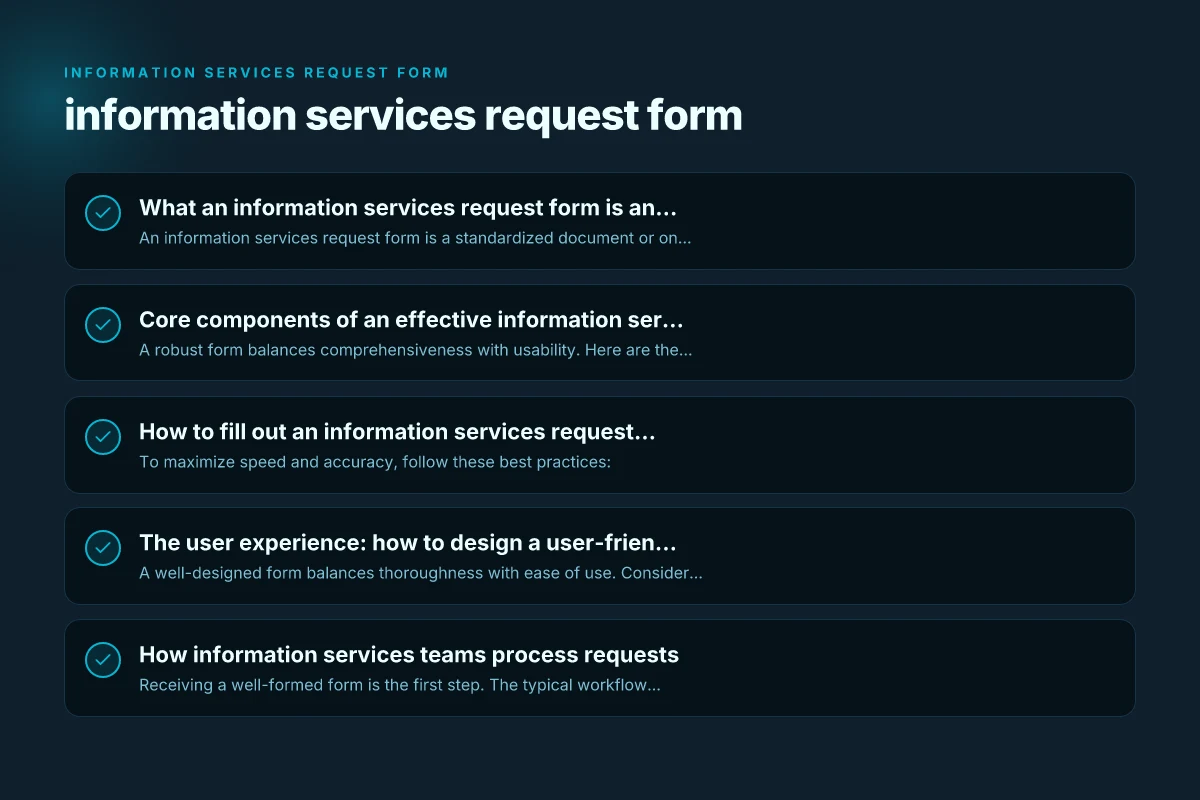
Core components of an effective information services request form
A robust form balances comprehensiveness with usability. Here are the core components you should include, along with practical examples:
- Requestor details:
- Name, department, contact email, phone number
- Organization or client ID if applicable
- Request type:
- Data extraction, full report, archival material, citation list, etc.
- Description of the request:
- A concise overview plus key specifics
- Example: “Please provide a dataset of customer purchases, 2019–2024, including order date, product category, and total value.”
- Scope and filters:
- Time range, geographic scope, product categories, customer segments
- Deliverables:
- File formats (CSV, XLSX, PDF), data fields, metadata requirements
- Delivery method:
- Secure email, download link, secure FTP, or on-site delivery
- Security and compliance:
- Data sensitivity, encryption needs, NDA or data-use agreement, de-identification requirements
- Compliance notes:
- Licensing, copyright, embargo periods
- Due date and urgency:
- Target date, required by date, priority level
- Usage intent:
- Research, internal analysis, publication, sharing with third parties
- Attachments:
- Rough sketches, sample reports, supporting documents
- Approval workflow:
- Signatures or confirmed approvals from stakeholders if required
- Cost estimation and approvals:
- Budget line, estimated hours or cost, approval status
How to fill out an information services request form effectively
To maximize speed and accuracy, follow these best practices: Incubation facilities: what they are, how they work, and why they matter
- Be specific, not vague:
- Instead of “data about sales,” specify fields, timeframes, and filters.
- Use predefined drop-downs and checkboxes:
- They reduce ambiguity and standardize responses.
- Provide a mockup or sample:
- If possible, attach a sample of the desired output format.
- State assumptions explicitly:
- Clarify any assumptions about fields, units, or classifications.
- Prioritize and set a realistic deadline:
- Align the due date with operational capacity and the request’s urgency.
- Include security and privacy requirements up front:
- This prevents later rework if data must be anonymized or restricted.
- Attach supporting documents:
- Contracts, data-use agreements, or prior reports that set expectations.
- Confirm metadata requirements:
- Include data lineage, definitions, and glossary if needed.
The user experience: how to design a user-friendly form
A well-designed form balances thoroughness with ease of use. Consider these UX tips:
- Progressive disclosure:
- Show basic fields first. Reveal advanced options only if selected.
- Clear labeling:
- Use plain language and avoid jargon that might confuse non-experts.
- Validation and helpful hints:
- Real-time validation prevents errors. Tooltips explain terms.
- Consistent formatting:
- Use the same date formats, units, and capitalization throughout.
- Mobile-friendly layout:
- Ensure the form is easy to complete on phones and tablets.
- Save and resume:
- Allow users to save progress and return later, especially for complex requests.
Core components vs. outcomes
| Component | What it delivers | Example indicator | Beneficiary | Notes |
|---|---|---|---|---|
| Form fields | Structured data capture | Completion rate | Requester | Use dropdowns to reduce error |
| Validation rules | Data quality | Error rate | Ops | Real-time checks |
| Routing logic | Proper assignment | % routed correctly | Team | Based on category/priority |
| Attachments | Contextual info | Attachment count | Requester/Agent | Keep size limits |
| Status tracking | Transparency | SLA adherence | Requester | Visible in portal |
| Templates | Speed and consistency | Reuse rate | Requester/Team | Pre-fill common requests |
Compiled November 2026; check the provider's site for current details.
How information services teams process requests
Receiving a well-formed form is the first step. The typical workflow includes: Incubator facilities: what they are, how they work, and how to choose the right one
- Intake and validation:
- Check for completeness, identify missing fields, and validate dates or IDs.
- Scope confirmation:
- If the request is ambiguous, contact the requester for clarification.
- Feasibility assessment:
- Determine whether the request can be fulfilled within the requested time and budget.
- Data preparation and security review:
- Extract data, apply de-identification or masking if needed, and ensure compliance.
- Deliverable creation:
- Generate the output in the requested format, with metadata and documentation.
- Quality check:
- Verify accuracy, completeness, and that the output matches the request.
- Delivery and confirmation:
- Send the deliverable through the specified channel and confirm receipt.
- Archiving and logging:
- Record the request and outcome for future auditing and reference.
A practical comparison: forms vs. tickets vs. chats
When you’re deciding how to handle information requests, you might consider three common approaches: formal forms, ticket-based systems, or chat-driven requests. The following table highlights typical differences and use cases.
| Approach | Strengths | Common Use Case | Potential Drawbacks |
|---|---|---|---|
| Information services request form | Standardized data, clear scope, reproducible workflows | Routine data pulls, regular reporting, predictable requests | May feel rigid for unusual requests; requires upfront design |
| Ticketing system (support tickets) | Great for tracking, prioritization, escalation | Urgent issues, incidents, ad-hoc requests with SLA needs | May lack structured data fields; can become chaotic without disciplined workflows |
| Chat-driven requests | Fast, flexible, conversational | Quick clarifications, small data pulls, informal requests | Hard to capture requirements; risk of scope creep without a form |
If your organization handles a mix of straightforward data pulls and more complex analyses, a hybrid approach often works best: use an information services request form for initial intake and a ticketing system or chat for clarifications and updates.
How to fill out effectively vs. common pitfalls
| Practice | In practice | Common pitfall | Mitigation | Benefit |
|---|---|---|---|---|
| Use drop-downs | Reduces errors | Free-form drift | Limit options | Faster, cleaner data |
| Provide examples | Clarifies intent | Missing guidance | Add sample text | Higher completion accuracy |
| Require critical fields | Ensures data | Over-reliance on required | Progressive disclosure | Balanced data capture |
| Include validation | Immediate feedback | Wait for review | Real-time checks | Fewer back-and-forths |
| Clear success criteria | Sets expectation | Ambiguous outcomes | Define SLA/accept criteria | Quicker closure |
Compiled November 2026; check the provider's site for current details. Icl advanced additives: a comprehensive guide to performance and applications
Common pitfalls and how to avoid them
Even with a good form, issues can arise. Here are frequent pitfalls and practical fixes:
- Missing critical fields:
- Solution: Make key fields mandatory and include contextual help text.
- Vague descriptions:
- Solution: Provide examples and a field for “objective of the request.”
- Unclear data formats:
- Solution: Offer format presets (CSV, JSON, PDF) and specify encoding and delimiter standards.
- Inadequate security controls:
- Solution: Include a data sensitivity field and require approvals for sensitive data.
- Poor follow-up:
- Solution: Set automated reminders and provide a status tracker visible to the requester.
Measuring value: KPIs for information services request forms
To demonstrate value and continually improve, track these indicators:
- Time to intake: how long it takes to acknowledge and validate a request.
- Time to deliver: total cycle time from intake to delivery.
- Request completeness rate: percentage of forms submitted without missing fields.
- Rework rate: proportion of requests requiring clarification or corrections.
- User satisfaction: post-delivery surveys or feedback scores.
- Compliance incidents: number of requests requiring post-delivery data-use adjustments.
How to implement or optimize an information services request form
If you’re implementing a new form or improving an existing one, follow a structured plan:
- Assess needs:
- Interview stakeholders to understand types of requests, typical turnaround times, and compliance requirements.
- Design with the user in mind:
- Create intuitive sections, use helpful defaults, and offer example inputs.
- Pilot and iterate:
- Run a 2–4 week pilot with select users, gather feedback, and refine fields.
- Integrate with workflows:
- Connect the form to your ticketing system, CRM, or data catalog so requests flow smoothly.
- Document and train:
- Provide a concise user guide and quick training sessions for requesters and processors.
- Monitor and improve:
- Regularly review KPIs and user feedback, and update the form as needs evolve.
A practical sample: a minimal but effective information services request form
You can start with a lean template and scale as needed. Here is a simple example of fields that cover essential information: High performance computing hpc center
- Requestor name
- Department
- Request type: data extraction, report, document, other
- Description: objective, questions to answer
- Timeframe: required by date, urgency level
- Data scope: start date, end date, geography, product categories
- Deliverables: format (CSV, XLSX, PDF), required fields, metadata
- Usage intent: internal, publication, third-party sharing
- Security: data sensitivity, de-identification needed
- Attachments: file upload option for samples or contracts
- Approvals: checkbox for required approver signatures
- Notes: any additional information or constraints
This starter form can be deployed as a web form, a PDF fillable document, or a simple email template that is converted into a ticket.
KPIs to measure form effectiveness vs. alternatives
| KPI | Information Services Form | Ticketing | Live Chat |
|---|---|---|---|
| Completion rate | High | Moderate | High (immediacy) |
| Data accuracy | High | Medium | Medium |
| Time to first response | Moderate | Short | Instant |
| Average handling time | Moderate | Moderate | Short |
| Rework rate | Low | Medium | Low |
| User satisfaction | High | Medium | High |
| SLA compliance | Yes | Yes | Yes (soft) |
| Reuse of templates | High | Low | Low |
| Conversion of requests to outcomes | High | Moderate | Low |
Compiled November 2026; check the provider's site for current details.
The recommendation
If you’re seeking a clear path to faster, more accurate information service outcomes, start with a well-designed information services request form as the backbone of your process. Prioritize clarity and completeness, automate as much of the intake and validation as possible, and tie the form into your broader workflow with a ticketing or case-management tool. Complement the form with a short, user-friendly guide and quick-training resources for requesters. Finally, implement a simple, repeatable KPI framework to monitor performance and drive continuous improvement. Hexagrid: What It Is, How It Works, and Why It Matters
By investing in a thoughtfully crafted information services request form, organizations reduce miscommunication, accelerate deliverables, and improve satisfaction for both requesters and providers. The form becomes more than a document. It’s the cornerstone of an efficient, compliant, and scalable information services operation.