Medicinal and synthetic chemistry services
An in-depth guide to medicinal and synthetic chemistry services, how they differ, and how to choose the right partner for your project.
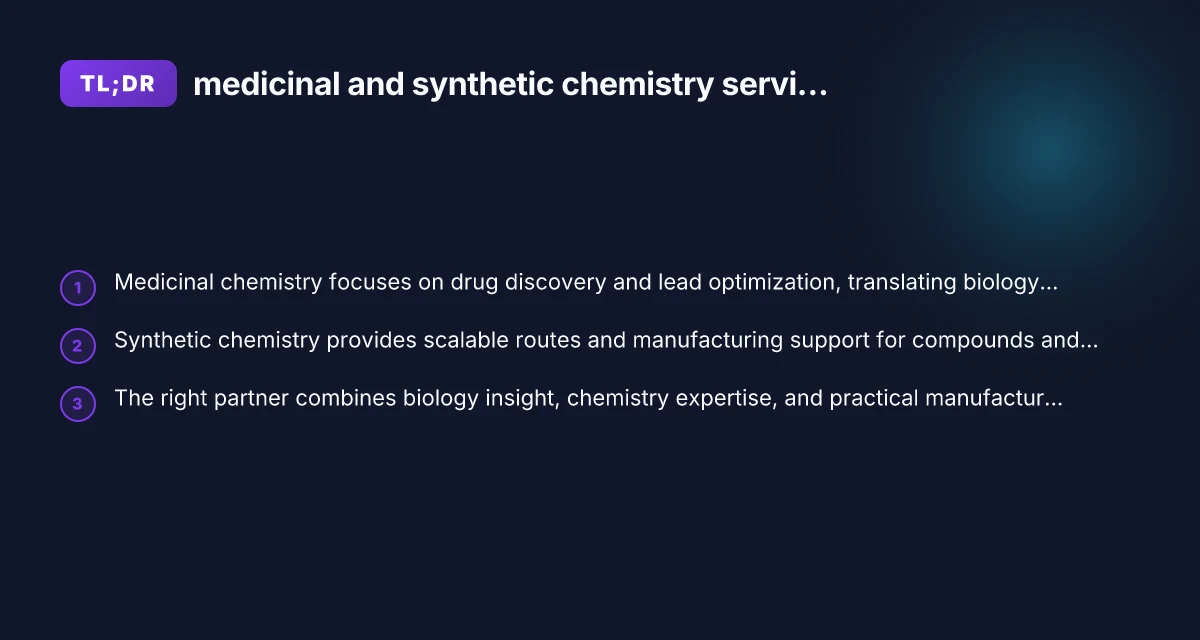
The field of medicinal and synthetic chemistry services sits at the core of modern drug discovery and chemical manufacturing. If you’re a biotech, pharmaceutical, or life sciences company seeking to bring a new molecule from concept to clinic or market, understanding what each service line offers, and how they complement one another, can save time, reduce risk, and improve outcomes. This article breaks down the key distinctions, typical workflows, and practical considerations to help you choose the right collaborators for your project.
Comparison at a glance — Medicinal vs. synthetic chemistry services
| Service area | Typical deliverables | Timeframe (startup to first molecule) | Key decision factors | Typical costs (relative) |
|---|---|---|---|---|
| Medicinal chemistry | Lead compounds, SAR data, optimization plans | weeks to months | Target profile, assay compatibility | Moderate to high |
| Synthetic chemistry | Scalable routes, GMP-ready steps | weeks to months | Route feasibility, purification needs | Moderate |
| Complementarity | Integrated programs, joint milestones | 2–6 months to first milestone | Collaboration scope, IP terms | Moderate to high |
Compiled November 2026; check the provider's site for current details.
What medicinal chemistry services cover
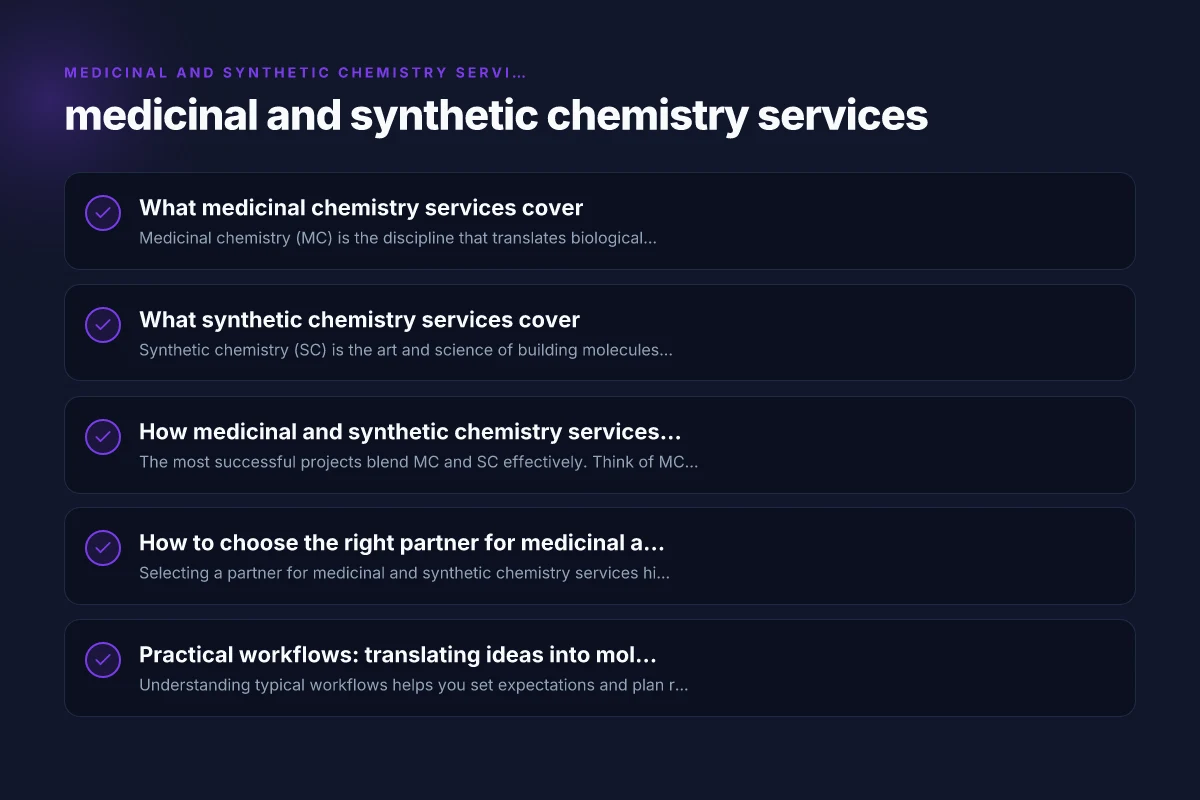
Medicinal chemistry (MC) is the discipline that translates biological hypotheses into chemically actionable candidates. Its output is the design, synthesis, and optimization of small molecules with desirable pharmacological properties. Typical activities include:
- Hit identification and hit-to-lead optimization: converting initial biological hits into more potent, selective, and drug-like molecules.
- Structure-activity relationship (SAR) studies: iterative modification of chemical structures to understand how changes affect activity, selectivity, and ADME properties.
- Lead optimization: balancing potency, selectivity, solubility, stability, metabolism, and safety concerns.
- Early ADME/Tox assessment: in vitro and in silico evaluation of absorption, distribution, metabolism, excretion, and potential toxicity risks.
- Custom library design: creating focused or diverse chemical libraries for screening campaigns.
- Collaboration with biology and pharmacology teams: translating assay data into viable chemical series.
Key outputs from MC partners typically include a pipeline of lead compounds, annotated SAR data, synthetic routes for new molecules, and a plan for preclinical studies. Success metrics center on potency improvements, drug-like properties, and an increasing probability of clinical success.
What synthetic chemistry services cover
Synthetic chemistry (SC) is the art and science of building molecules at scale. It provides the practical routes, scalable processes, and process development needed to produce compounds for preclinical studies, clinical trials, and, ultimately, commercial manufacture. Typical activities include:
- Route scouting and optimization: identifying the most practical, economical, and scalable chemical pathways.
- Process development: refining reaction conditions, workup, purification, and isolation to maximize yield and purity.
- Scale-up from milligrams to grams, kilograms, or beyond: ensuring reproducibility and safety at larger scales.
- Good Laboratory Practice (GLP) style or GMP readiness: aligning with regulatory expectations for preclinical and manufacturing contexts.
- Impurity profiling and control strategies: identifying and mitigating process-related impurities.
- Analytical support: developing and validating analytical methods (HPLC, LC-MS, NMR) for quality control.
- Technology transfer and manufacturing support: documenting procedures to hand off to a production facility.
For clients, SC partners deliver reliable, scalable routes, robust documentation, and predictable supply for testing, PK studies, and early-stage clinical programs. Media Kit: What It Is, Why You Need It, and How to Create a Standout One
Practical decision factors table
| Factor | Medicinal chemistry strength | Synthetic chemistry strength | Risk indicators | What to confirm with partner |
|---|---|---|---|---|
| Core focus | Lead discovery, SAR | Scale-up, process development | IP, timeline gaps | Expertise fit, past programs |
| Output format | Data-rich reports, chemistry matrices | Scale-ready procedures | Compatibility of data formats | Documentation standards |
| Regulatory readiness | Moderate (initial filings) | High (GMP, cGMP) | Compliance gaps | Quality systems, audits |
| Collaboration model | Milestone-driven | Milestone-driven | Misaligned milestones | Collaboration terms |
Compiled November 2026; check the provider's site for current details.
How medicinal and synthetic chemistry services complement each other
The most successful projects blend MC and SC effectively. Think of MC as the ideation and optimization engine, and SC as the engine that makes the ideas producible, compliant, and scalable. Typical collaboration patterns include:
- Early-stage program defines a target product profile (TPP) with potency, selectivity, pharmacokinetics, and safety benchmarks.
- MC generates leads and SAR data while advising on synthetic feasibility and preferred functional group handles to enable rapid iteration.
- SC develops scalable routes in parallel, preparing samples for in vivo testing and later-stage studies as MC narrows the candidate list.
- Regular joint reviews ensure changes in biology are reflected in chemistry strategy and that manufacturing constraints are considered from the outset.
In practice, successful partnerships align incentives, communication cadence, and data sharing so that every SAR iteration is accompanied by a matching, scalable synthetic plan. Media kit: how to craft a compelling media kit that attracts partners
How to choose the right partner for medicinal and synthetic chemistry
Selecting a partner for medicinal and synthetic chemistry services hinges on several criteria. Here’s a practical checklist:
- Expertise and track record:
- Do they have successful case studies in your therapeutic area?
- Can they demonstrate SAR mastery and synthetic versatility across multiple scaffolds?
- Regulatory readiness:
- Are they versed in GLP/GMP environments and able to produce data suitable for regulatory submissions?
- Do they offer impurity profiling, method development, and validation support?
- Project flexibility:
- Can they operate in a fast-paced, iterative discovery mode?
- Are they comfortable with outsourcing models, such as true partnership or milestone-based engagements?
- Manufacturing readiness:
- Do they provide early scale-up capability and technology transfer support?
- Can they supply material suitable for pharmacology, toxicology, and early clinical studies?
- Collaboration and communication:
- Are they proactive in sharing data, limitations, and risk assessments?
- Do they use integrated data platforms and collaborative project management tools?
- Quality and compliance:
- Do they have ISO certifications or equivalent quality systems?
- What are their QA processes, change control, and deviation management practices?
- Cost and timeline transparency:
- Is there a clear budgeting model with contingencies for unforeseen synthetic challenges?
- Do they provide realistic timelines aligned with your project milestones?
Workflows comparison table
| Phase | Medicinal chemistry activity | Synthetic chemistry activity | Collaboration touchpoints | Typical handoffs |
|---|---|---|---|---|
| Idea to hit list | Target selection, assay plan | N/A | Intake meeting | Research plan |
| Hit to lead | SAR exploration | Route feasibility | Data review | Decision memo |
| Lead optimization | Chemical series design | Scale-down to lab synthesis | Cross-team reviews | Synthesis route choice |
| Preclinical prep | In vitro, in vivo concepts | Scale-up preparation | Joint risk assessment | Dossier inputs |
Compiled November 2026; check the provider's site for current details.
Practical workflows: translating ideas into molecules
Understanding typical workflows helps you set expectations and plan resources. A common discovery-to-manufacturing pathway looks like this: Lockerdome reps st louis
- Discovery phase:
- MC screens libraries or designs focused on your target biology.
- Lead compounds are identified and subjected to initial SAR analysis.
- Early ADME/Tox assessments guide prioritization.
- Optimization phase:
- MC refines chemical scaffolds based on SAR and pharmacology feedback.
- In parallel, SC explores feasible synthetic routes for promising candidates.
- Iterative rounds of synthesis and testing converge on a robust lead.
- Preclinical preparation:
- Compounds with optimized profiles are produced in higher purity and larger quantities.
- Impurity profiling and analytical method development ensure readiness for preclinical studies.
- Regulatory-minded documentation is prepared to support GLP-like studies.
- Manufacturing readiness:
- A scalable route is locked in, with process controls and impurity limits defined.
- Documentation for tech transfer is created to enable production at the desired scale.
A practical comparison: medicinal vs synthetic chemistry services
Here is a quick table to contrast core goals, outputs, and success metrics. (Note: this is a plain-text table for readability.)
- Goal
- Outputs
- Primary Metrics
- Typical Deliverables
Medicinal Chemistry (MC)
- Design and optimize drug-like molecules with biological activity
- Lead compounds, SAR data, and optimized pharmacokinetic properties
- Potency, selectivity, ADME/Tox indicators, and predicted clinical success
- Annotated SAR reports, compound libraries, and decision frameworks
Synthetic Chemistry (SC)
- Develop scalable, robust, and compliant synthesis routes
- Scalable routes, process development data, and impurity control plans
- Yield, purity, scalability, cost of goods, and regulatory readiness
- Process development reports, analytical method transfers, and manufacturing-ready SOPs
Practical comparison — Key capabilities by service Leasing Information Packet
| Capability | Medicinal chemistry | Synthetic chemistry | Both needed | Notes on decision |
|---|---|---|---|---|
| Lead identification | yes | no | Yes | Start with medicinal |
| Route development | yes (concept) | yes (practical) | Yes | Early alignment essential |
| Scale-up processes | no | yes | Yes | Ensure transfer plan |
| Analytical support | yes | yes | Yes | Integrated data packages |
Compiled November 2026; check the provider's site for current details.
Quality, regulatory, and safety considerations
When moving from bench to clinic, chemistry work must align with regulatory expectations and safety standards. Key considerations include:
- Documentation and traceability: maintain comprehensive records of synthetic procedures, characterizations, and data analyses.
- Impurity management: identify potential impurities early and establish control strategies to meet strict purity criteria for clinical materials.
- Reproducibility: demonstrate robust processes with well-defined critical process parameters (CPPs) and critical quality attributes (CQAs).
- Safety and environmental responsibility: apply green chemistry principles where feasible, manage waste streams, and comply with safety regulations for handling hazardous reagents.
- Regulatory liaison: ensure scientists can generate data packages suitable for regulatory submissions, including GMP-like documentation where required.
Case study: why the right pairing matters
Consider a biotech startup targeting a novel enzyme with a challenging pharmacology profile. An MC-focused partner identifies a series of chemotypes with potency in the low nanomolar range but discovers access to the most potent scaffolds is synthetically impractical. By engaging a SC partner with advanced route-science expertise, the team can:
- Propose alternative, more accessible synthetic routes that maintain essential pharmacophores.
- Simultaneously run parallel SAR campaigns on different scaffolds to diversify risk.
- Prepare scalable batches early to support in vivo PK studies and GLP-grade toxicology material.
- Accelerate the transition from discovery to preclinical readiness without sacrificing data integrity.
This kind of integrated approach demonstrates how combining medicinal and synthetic chemistry services creates a smoother, faster path to a viable drug candidate. Join US: why and how to say yes to opportunities and communities
Final recommendations
- Start with a joint discovery brief: clearly outline your target biology, desired pharmacokinetic and safety benchmarks, timelines, and scale milestones.
- Look for true collaboration: seek teams that provide integrated MC and SC services or have established, well-spaced interfaces for rapid interaction and data exchange.
- Validate with a pilot project: consider a small, time-bound project to test chemistry creativity, communication style, data quality, and scalability before committing to a larger program.
- Prioritize quality and compliance: ensure partner capabilities align with your regulatory roadmap, including GLP-like data packages and GMP-ready manufacturing planning when appropriate.
- Plan for the long term: successful programs often evolve from lead optimization to scalable manufacturing. Choose partners who can grow with you through clinical development and potential commercial manufacturing.
If you’re evaluating medicinal and synthetic chemistry services for your program, the right partner should feel like a seamless extension of your own team, someone who can think strategically about biology, chemistry, and manufacturing as an integrated whole. With the right collaboration, you can reduce risk, accelerate timelines, and move closer to delivering meaningful therapies to patients.