Leasing Information Packet
A comprehensive guide to what a leasing information packet is, what it should include, and how to use it effectively.
A leasing information packet is more than a bundle of forms. It’s a structured resource that outlines the terms of a rental agreement, the information a landlord needs from a prospective tenant, and the steps both sides will take before, during, and after signing a lease. Whether you’re a landlord assembling one for marketing a property, or a tenant collecting the documents you’ll need to apply, a well-crafted packet saves time, reduces confusion, and helps prevent disputes down the line.
Comparison of Key Components to Include in a Leasing Information Packet
| Component | Purpose | Essential? | Notes |
|---|---|---|---|
| Cover page & table of contents | Organizes packet | yes | Quick navigation for readers |
| Property details | Context about unit | yes | Include address, unit type, sq ft |
| Lease terms overview | Primary commitment terms | yes | Length, renewal options |
| Pricing summary | Cost overview | yes | Rent, deposits, fees hints |
| Legal disclosures | Compliance baseline | yes | Landlord obligations, tenant rights |
| Rules & policies | Expectations set | yes | Pet, occupancy, maintenance |
| Application process | Next steps | yes | Steps, timelines, documents |
| Contact information | Access points | yes | Agent or property manager details |
| Supporting documents list | Required paperwork | maybe | Examples: ID, pay stubs |
| FAQ & glossary | Clarity | maybe | Definitions of terms |
Compiled November 2026; check the provider's site for current details.
What is a leasing information packet?
A leasing information packet is a prepared set of materials that accompanies a rental listing or is provided upon inquiry. It typically includes:
- Property details: address, unit type, square footage, amenities, and parking.
- Lease terms: price, duration, renewal options, and any rent increase policies.
- Applicant requirements: income verification, credit checks, and rental history.
- Required documents: IDs, proof of income, references, and rental history records.
- Application instructions: how to apply, where to submit, and associated fees.
- Move-in/move-out information: procedures, condition reports, and keys/ access details.
- Legal disclosures: local regulations, pet policies, and fair housing statements.
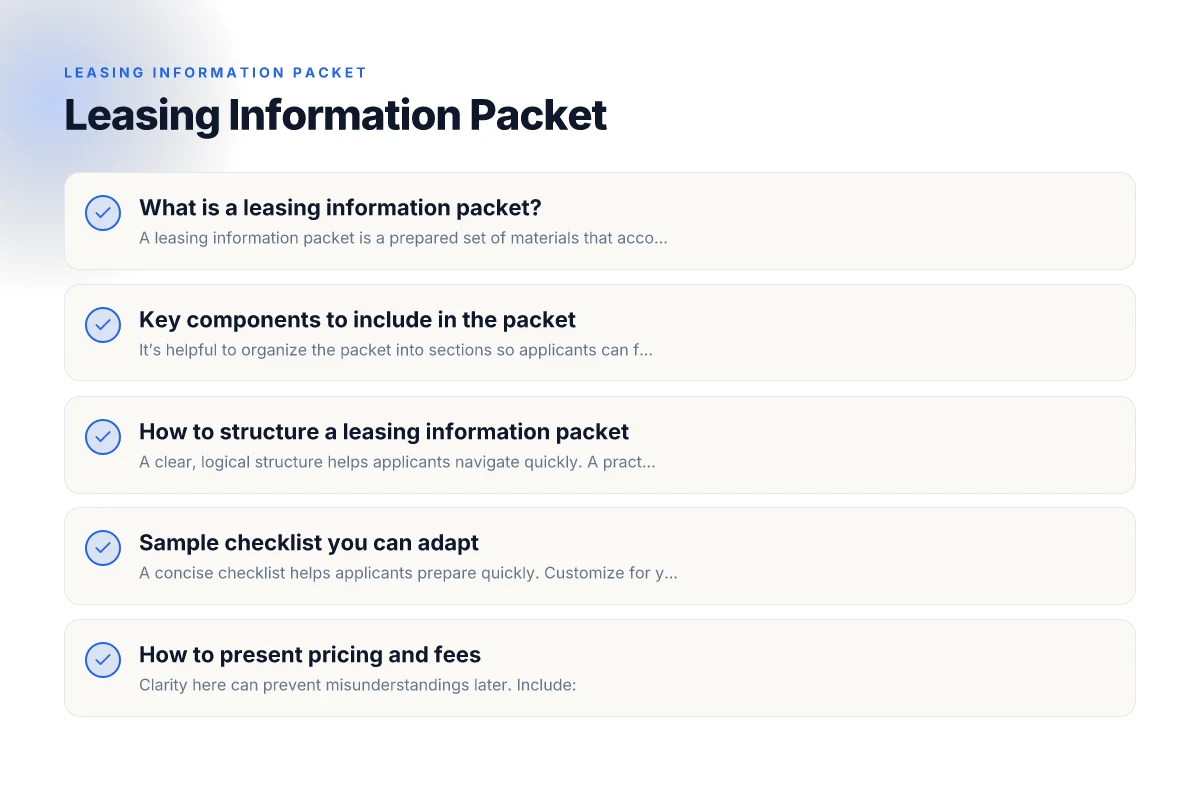
Key components to include in the packet
It’s helpful to organize the packet into sections so applicants can find everything quickly. Consider including:
- A property overview: a short description of the unit and neighborhood highlights.
- A sample lease agreement: a redlined or summarized version showing key terms.
- A checklist: items the applicant must provide (income, ID, consent to a background check, etc.).
- Fee schedule: application fees, security deposits, pet deposits, hold fees, and what they cover.
- Timeline: expected steps from inquiry to move-in.
- Contact information: property manager, leasing agent, and after-hours support.
- FAQs: common questions about parking, utilities, maintenance, and policy exceptions.
Comparison of How to Structure a Leasing Information Packet for Different Audiences
| Audience | Preferred organization | Visual emphasis | Level of detail | Recommended supplements |
|---|---|---|---|---|
| First-time tenants | Clear sections first, simple language | High readability, bullets | High | Glossary, sample forms |
| Property investors | Summary upfront, data-driven | Tables and charts | Moderate | Market comparisons, ROI notes |
| Seasonal/short-term renters | Quick-read overview | Highlights and icons | Low to moderate | Quick-start checklist, teaser pricing |
| Multilingual audiences | Bilingual sections | Clear headings per language | Medium | Translated summaries, glossary |
| Property managers team | Internal notes | Internal comments, checklists | Detailed | Checklist templates, process flow |
Compiled November 2026; check the provider's site for current details. Join US: why and how to say yes to opportunities and communities
How to structure a leasing information packet
A clear, logical structure helps applicants navigate quickly. A practical structure might be:
- Front matter: title, property name, and date.
- Quick summary: the most important lease terms (rent, deposit, lease length).
- Section 1, Property details: address, unit number, floor plan, features.
- Section 2, Financials: rent, deposits, utilities, late fees, and payment methods.
- Section 3, Lease terms: term length, renewal, rent increases, subletting, and pet policies.
- Section 4, Applicant requirements: income ratios, credit score expectations, rental history, references.
- Section 5, Documents to provide: list and format (PDF, screenshots, etc.).
- Section 6, Application process: steps, timelines, and where to submit.
- Section 7, Move-in logistics: inspection, move-in date, access, and keys.
- Section 8, Legal disclosures: fair housing, smoke-free status, lock policy, and local laws.
- Section 9, FAQ and contact: quick answers and who to reach.
Sample checklist you can adapt
A concise checklist helps applicants prepare quickly. Customize for your property and jurisdiction.
- Government-issued photo ID for each adult applicant
- Recent pay stubs or proof of income (last 30–60 days)
- Employer contact information or verification letter
- Current landlord reference or rental history verification
- Consent to run a credit/background check
- Recent bank statements (if required for income verification)
- Pet information (type, breed, weight) and pet deposit if applicable
- Completed rental application form
- Move-in date and contact details for scheduling
- Security deposit payment method and disclosure of any non-refundable fees
How to present pricing and fees
Clarity here can prevent misunderstandings later. Include:
- Rent: amount, due date, and payment methods.
- Security deposit: amount, filing, and refund timing.
- Non-refundable fees: application, administrative, or amenity fees.
- Move-in charges: first month’s rent, last month’s rent (if applicable), and prorations.
- Hold fees: whether a non-refundable hold holds the unit, and for how long.
- Pet fees/deposits: amount, refundable status, and any monthly pet rent.
- Utilities: which utilities the tenant is responsible for, and how they’ll be billed.
A Markdown table: typical leasing information vs. tenant expectations
| Item | Landlord perspective | Tenant expectation | Tips to align |
|---|---|---|---|
| Rent | Stable, predictable income | Affordable, justified by unit features | Provide a breakdown of value in listing |
| Deposits | Security against damages | Fair amount, return condition | State deposit policy in writing |
| Fees | Cover processing, admin costs | Transparent, reason-based | List all fees up front with reasons |
| Term length | Stability and planning | Flexible to fit life events | Offer 12-month and 6-month options if possible |
| Pet policy | Manage risk and compliance | Clear rules, deposits for pets | Specify pet weight, breed, and deposits |
| Maintenance | Timely repairs, clear process | Prompt fixes, clear contact | Provide maintenance SLA for common issues |
How to share the packet effectively
Dissemination is as important as content. Consider: Iten expands
- Digital delivery: PDF download link, atrial video tour, or a property website page.
- Version control: keep a dated version and track changes.
- Accessibility: ensure text is readable, alt text for images, and translations if you serve multilingual tenants.
- Follow-up plan: a checklist or automated email sequence outlining next steps.
- Security: protect sensitive information with secure forms and data collection methods.
Comparison of Pricing and Fees Presentation Options
| Option | Clarity | Transparency | Granularity | Best use case | Notes |
|---|---|---|---|---|---|
| Monthly rent display | High | Yes | Per unit | Standard listings | Include due date |
| Deposit details | Clear | Yes | Amounts by category | Tenant planning | Name deposits clearly |
| One-time fees list | Transparent | Yes | Itemized | New leases | Avoid hidden fees |
| Fee waivers/promotions | Transparent | Yes | Conditions | Marketing | Document expiration |
| Total cost estimator | Helpful | Yes | Per scenarios | Budgeting | Include sample months |
| Tabulated comparisons vs. market | Insightful | Yes | Comparative | Client briefing | Add sources |
Compiled November 2026; check the provider's site for current details.
Legal and compliance considerations
Leasing information packets must respect local laws and fair housing standards. Important areas include:
- Non-discrimination: avoid language that excludes protected classes.
- Clear disclosures: lead-based paint, asbestos, mold, or other known hazards when required.
- Privacy: limit the collection of sensitive data to what’s legally necessary.
- Signatures: include a legally compliant method for electronic or physical signatures.
- Record keeping: store applicant materials securely and in compliance with data protection laws.
- Accessibility: ensure the packet is usable by people with disabilities.
Practical tips for landlords and property managers
- Personalize the packet but keep core terms consistent across units to avoid confusion.
- Include a short, friendly note about why your property is a good fit and what makes it stand out.
- Create a templated packet that you can customize for each listing, reducing prep time.
- Use branded design: consistent fonts, colors, and logo to increase trust and recognition.
- Collect feedback: ask tenants what information was helpful or missing after they apply.
How to tailor a leasing information packet for different audiences
- First-time renters: emphasize guidance, explain terms simply, and provide a glossary.
- Students or roommates: highlight flexible terms, roommates’ responsibilities, subletting rules.
- Professionals: emphasize quick approvals, convenient payments, and move-in convenience.
- Pet owners: be explicit about pet policies, deposits, and any breed restrictions.
Final section: recommendation
If you’re a landlord, a well-structured leasing information packet is a smart investment. It reduces administrative time, speeds up approvals, and creates a professional impression that can lead to higher-quality applicants. If you’re a tenant, using a packet helps you gather everything you need in one place, demonstrates preparedness, and can improve your chances of securing a favorable lease. Ite virtual tour
To get started, create a master template that covers the core sections outlined above. Adapt it to each property by updating details like rent, deposits, and move-in dates. Keep the language clear and free of jargon, and present terms in a way that’s easy to compare with other listings. Finally, share the packet early in the inquiry process to set expectations and build trust with the landlord or property manager.