Media Kit: What It Is, Why You Need It, and How to Create a Standout One
A practical guide to understanding and building an effective media kit for brands, creators, and businesses.
The media kit is a compact, polished package that brands, publishers, and creators share with potential partners. It’s not just a PDF you send once. It’s a living document that communicates your value, audience, and capabilities at a glance. Whether you’re a influencer, podcaster, photographer, small business, or agency, a strong media kit can make the difference between a cold pitch and a warm conversation. Below is a practical framework to understand, assemble, and optimize your media kit so it works as a powerful business development tool.
What a media kit is vs. isn’t
| Feature | Is a media kit | Isn’t a media kit | Key takeaway | Examples |
|---|---|---|---|---|
| Purpose | Information hub for media/partners | Personal resume for job apps | Clarify goals | Press requests, sponsor inquiries |
| Core audience | Journalists, brands, venues | General public | Targeted outreach | Editors, marketers |
| Deliverables | Media kit assets, overview | Full website bio page | Focused assets | One-pagers, PDFs |
| Update frequency | Regular refresh | One-time doc | Stay current | Quarterly updates |
| Accessibility | Centralized file + contact | Unlinked PDFs | Easy to find | Shared drive link |
| Format | Downloadable pack + pages | Long email thread | Consistency | PDF + web page |
Compiled November 2026; check the provider's site for current details.
What a media kit is and isn’t
Definition and purpose
A media kit, sometimes called a press kit or media deck, is a curated collection of information about you or your brand that helps potential partners assess fit and impact quickly. It typically includes audience data, sample work, past partnerships, pricing, and contact details. Its core function is to answer “Why you?” and “What’s in it for them?” in a concise, visually appealing format.
Scope and formats
Media kits come in many shapes:
- PDF flipbook or one-pager for emailed pitches
- Slide deck (PowerPoint/Keynote) for presentations
- Web-based media kit (landing page or media section on your site)
- Hybrid formats (PDF with a password-protected link to a media hub)
Keep in mind: the format should match your audience and distribution method. A publisher may prefer a polished PDF, while a brand meeting might benefit from a slide deck.
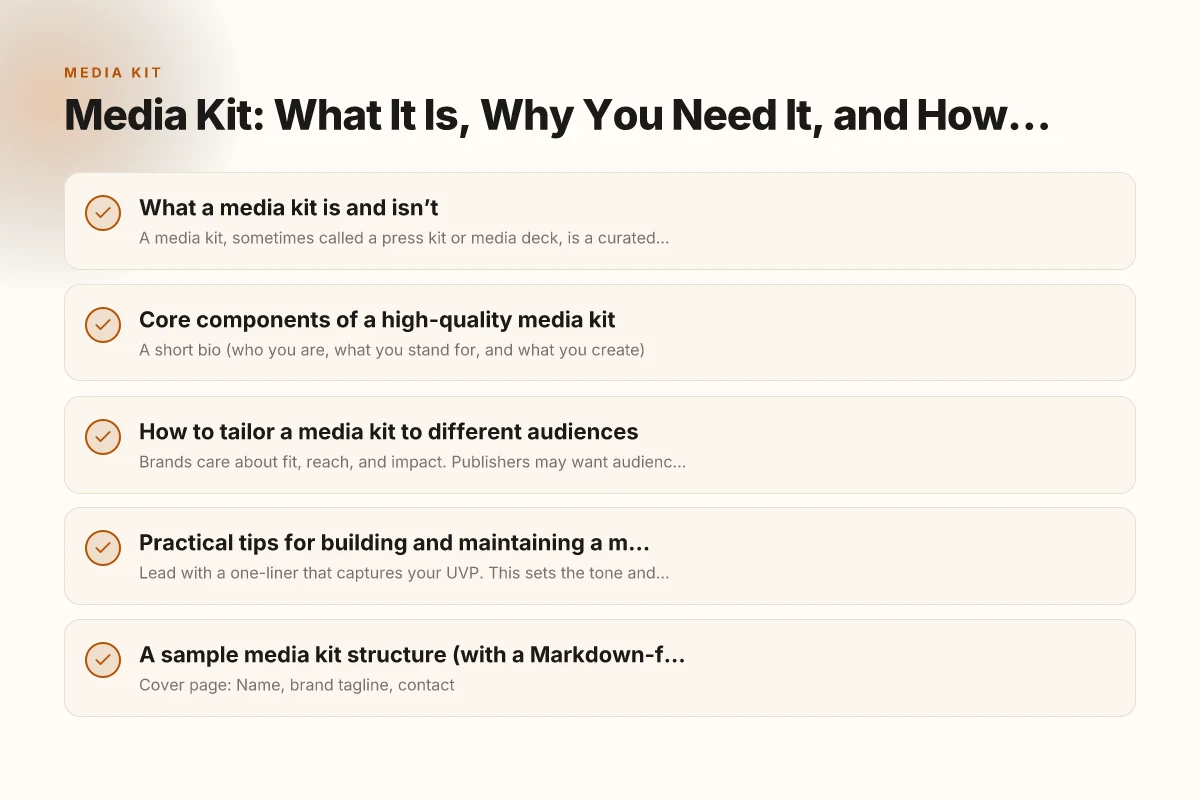
Core components of a high-quality media kit
About you and your mission
- A short bio (who you are, what you stand for, and what you create)
- Your unique value proposition (UVP) in one or two sentences
- A high-quality headshot or logo and brand visuals
Audience and reach
- Demographics and psychographics (age, location, interests)
- Key metrics (follows, subscribers, downloads, average engagement rate)
- Platform breakdown (where your audience lives: Instagram, YouTube, TikTok, podcast, newsletter, etc.)
- Realistic, recent data with sources and dates
Content and portfolio samples
- 3–6 representative pieces that show your style and quality
- Case studies or examples of past collaborations
- Media-ready assets (photos, logos, templates) or links to live work
Partnerships and pricing
- Example collaboration types (sponsored posts, product reviews, events, affiliate programs, exclusive launches)
- Typical deliverables for each type (number of posts, story frames, duration, usage rights)
- Pricing guidance or ranges, if you’re comfortable sharing
- Availability and response times
Proof of impact
- Case studies with metrics (reach, impressions, engagement, clicks, sign-ups, sales)
- Testimonials from past partners or collaborators
- Media mentions, awards, or certifications
Logistics and terms
- How to contact you (email, phone, booking form)
- Turnaround times and preferred collaboration windows
- Usage rights and ownership outline
- Disclosure and compliance notes (advertising guidelines, COI)
Visuals and branding
- A clean, consistent design that aligns with your persona
- Brand colors, typography, and logo usage guidelines
- A media kit cover and table of contents for easy navigation
How to tailor a media kit to different audiences
Creator-to-brand vs. publisher pitches
Brands care about fit, reach, and impact. Publishers may want audience alignment, media rights, and distribution plans. Customize per recipient by adjusting metrics, case studies, and proposed deliverables. Media kit: how to craft a compelling media kit that attracts partners
Niche audiences and specificity
If you serve a niche (e.g., sustainable fashion, indie game development, personal finance for Gen Z), highlight niche metrics, partnerships, and content examples. Demonstrate authority and sector-specific insights.
Seasonal and campaign-specific kits
For peak times (holiday campaigns, product launches), create a targeted mini-kit focusing on relevant formats, pricing, and case studies. Keep the master kit evergreen and supplement with campaign-specific pages.
Practical tips for building and maintaining a media kit
Start with a strong hook
Lead with a one-liner that captures your UVP. This sets the tone and helps busy reviewers understand your value instantly.
Use data you can back up
Always source metrics and date stamps. When possible, provide a 30-60-90 day snapshot to show momentum. Lockerdome reps st louis
Keep it scannable
Most readers skim. Use short paragraphs, bullet lists, and bold headings. A clear hierarchy helps decision-makers find what they need quickly.
Design for readability
- Use a clean grid layout
- Limit fonts to 2–3 that align with your brand
- Use high-quality visuals and consistent image treatment
- Include alt text and accessible color contrast
Include a compelling call to action
End with a clear next step: “Email me at X to discuss partnerships,” or “Book a 15-minute intro call.” Make it easy to respond.
Update regularly
Set a quarterly reminder to refresh metrics, update work samples, and adjust pricing if needed. An outdated kit weakens credibility.
Core components of a high-quality media kit Leasing Information Packet
| Component | Purpose | Typical format | Essential fields | Notes | Example presence |
|---|---|---|---|---|---|
| About section | Brand story | Short bio + mission | Brand voice, values | Keep concise | Yes |
| Audience reach | Demonstrate exposure | Metrics card | Audience size, channels | Update often | Yes |
| Sample work | Proof of quality | Portfolio thumbnails | 3–5 items | Curate, not overwhelm | Yes |
| Testimonials | Social proof | Quote block | Names, affiliations | Prefer recent | Yes |
| Contact info | Facilitate outreach | Contact card | email, phone, scheduling link | Keep current | Yes |
| Media guidelines | Usage rules | Quick reference | Logo usage, tone | Clear, not verbose | Yes |
Compiled November 2026; check the provider's site for current details.
A sample media kit structure (with a Markdown-friendly outline)
- Cover page: Name, brand tagline, contact
- About: Short bio, UVP, mission
- Audience and reach: Platform breakdown, demographic snapshot, engagement
- Work samples: 3–6 pieces with brief notes on impact
- Past partnerships: 3–5 case studies or logos with outcomes
- Services and pricing: Deliverables, tiers, terms
- Proof of impact: Case study numbers, testimonials
- Logistics: Availability, response times, rights, disclosure
- Contact: Email, booking form, social handles
Table: Sample pricing framework (illustrative)
| Package | Deliverables | Estimated Reach | Price range |
|---|---|---|---|
| Starter | 1 post + 1 story, 1 mention | 10k–25k impressions | $250–$750 |
| Growth | 2 posts, 3 stories, 1 reel, 1 blog | 25k–100k impressions | $1,000–$2,500 |
| Premium | 3–4 posts, 5–7 stories, 1 video, cross-promo | 100k+ impressions | $3,000–$8,000 |
| Notes: Prices vary by niche, exclusivity, usage rights, and length of campaign. Always align on deliverables and expectations before finalizing. |
Common pitfalls to avoid
- Overloading with too much data: Be selective and relevant.
- Vague pricing: Where possible, provide ranges or a starter package to reduce back-and-forth.
- Inconsistent branding: A mismatched visual language undermines credibility.
- Missing contact details: Ensure a prominent, easy-to-find CTA.
- Ignoring disclosure rules: Always include compliance notes to avoid misrepresentation.
Tailoring a media kit to different audiences
| Audience | What to highlight | Metrics to show | Tone/style | Format preference | Example content |
|---|---|---|---|---|---|
| Journalists | Newsworthiness, timeliness | Reach, engagement | Neutral, factual | Short PDF, press-ready | 2–3 latest stories |
| Brands/advertisers | ROI, demographics | CTR, conversion lift | Confident, benefits-led | Slide deck, media kit site | Case study snapshots |
| Event organizers | Speaker relevance | Speaking slots, audience fit | Professional, warm | One-pager, media kit page | Availability, topics |
| Investors | Growth, alignment | ARR, users | Data-driven | Investor one-pager | Traction highlights |
| Partners | Collaboration potential | Co-marketing metrics | Collaborative tone | Shared doc | Partnership briefs |
Compiled November 2026; check the provider's site for current details. Join US: why and how to say yes to opportunities and communities
How to distribute and present your media kit
- Email pitches: Attach a PDF and include a concise summary in the email body.
- Live pitches: Bring a slide deck version to a meeting with talking points.
- Website hosting: A dedicated media kit page can serve as a hub. Include a downloadable version.
- Networking events: Have a digital business card with a link to your media kit.
Measuring effectiveness and iterating
- Track engagement: Open rates, click-throughs, and download counts help you gauge interest.
- Monitor partner feedback: Note questions and objections to refine sections.
- Update after wins: Add new case studies when you secure notable collaborations.
- A/B test formats: Try different headlines, layouts, or metric highlights to see what resonates.
The final recommendation
Invest in a media kit that reflects your brand personality and professional rigor. Start with a strong hook, a concise audience snapshot, and a few high-impact samples. Pair it with transparent pricing or a clear path to pricing, and provide a straightforward way to initiate a conversation. Treat your media kit as a living asset: refresh quarterly, align with your latest metrics and partnerships, and tailor it for your audience. When you present a polished, data-backed, easy-to-navigate kit, you reduce friction in pitches and increase your chances of turning opportunities into ongoing collaborations.