Iten expands
A clear guide to what “iten expands” means, common uses, and practical steps to implement or explore it in tech and language contexts.
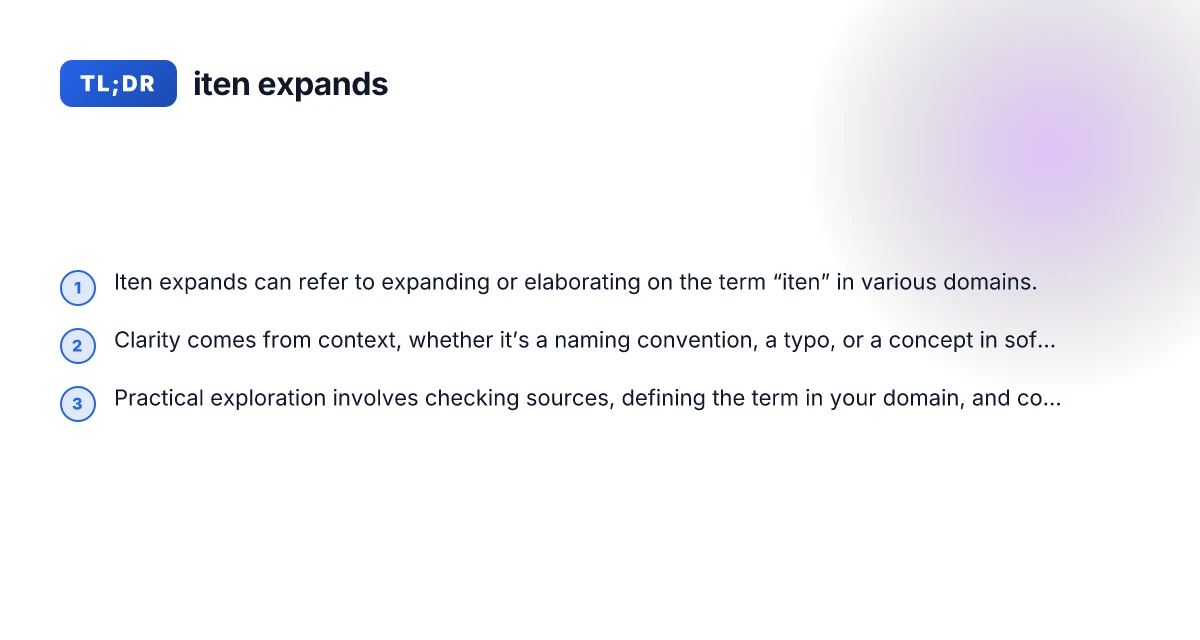
I’ll start by addressing the core question head-on: what does “iten expands” mean? As written, the phrase isn’t a standard technical term or widely recognized concept. In many cases, it appears to be a misspelling, a shorthand, or a domain-specific label. Below, I’ll cover several plausible interpretations and give you practical paths to explore each one. If you have a particular field in mind (software, linguistics, marketing, or another area), you can jump to the section that matches your context.
Expanded item behaviors in UI design
| Scenario | Interaction | State after expansion | Accessibility notes | Pros | Cons |
|---|---|---|---|---|---|
| Click to expand item | Click on item header | Item reveals details | ARIA expanded state true/false; focus remains | Intuitive; quick access | Can be mis-tapped on small screens |
| Tap to expand on mobile | Tap header or caret | Details shown | Screen reader announces expanded | Mobile-friendly | Space pressure on small screens |
| Keyboard expand | Press Enter or Space | Details appear | Keyboard operable; proper focus trap | Accessible without mouse | Requires proper coding conventions |
| Hover to preview (non-ambient) | Hover header | Preview content shows briefly | Not always accessible | Fast glance | Not reliable for touch; may flicker |
| Inline expand within list | Expand inline within list item | Subitems revealed inline | Maintains context | Keeps list flow | Scrollable content growth |
Compiled November 2026; check the provider's site for current details.
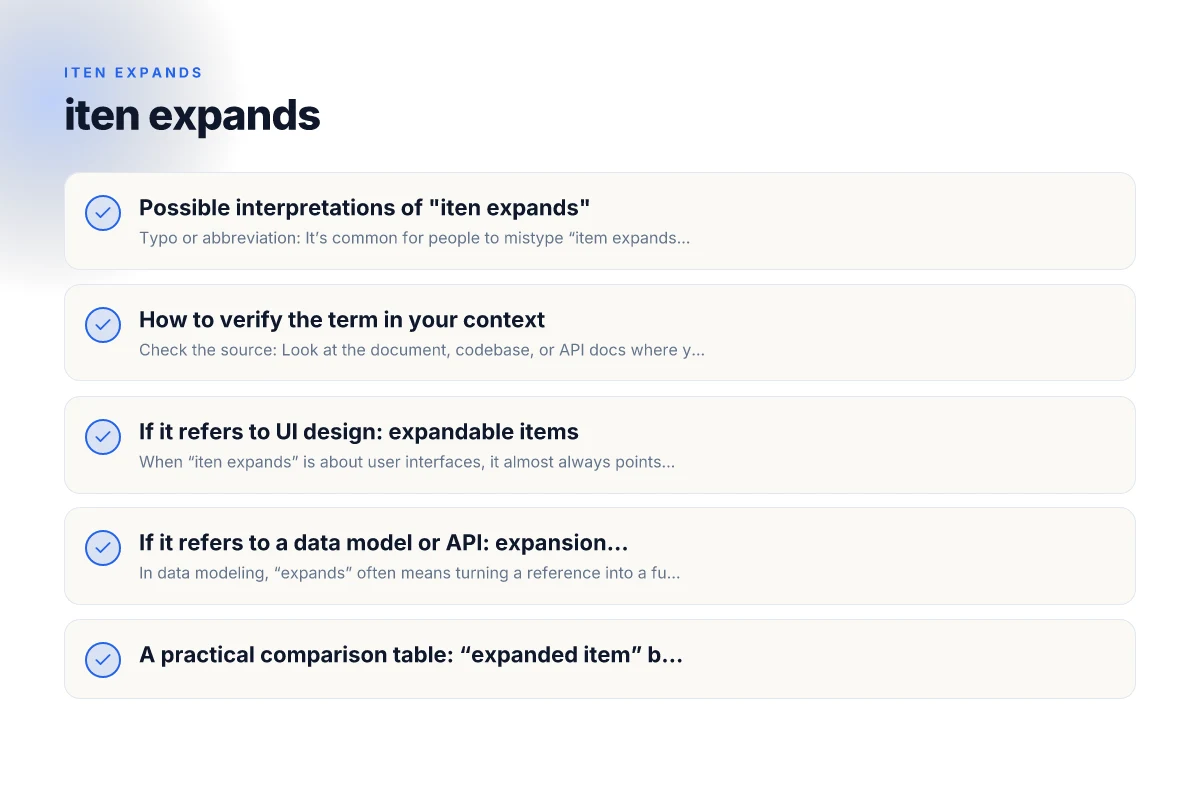
Possible interpretations of "iten expands"
- Typo or abbreviation: It’s common for people to mistype “item expands” or “item expansion,” especially when discussing user interfaces with expandable lists or accordions.
- Product or feature name: Some teams use low-profile or internal codenames. “iten expands” could be an internal term for a feature that expands items, sections, or data views.
- Linguistic concept: In language or computational linguistics, “iten” might be a root, affix, or a constructed term, with “expands” indicating morphological expansion or semantic broadening.
- Software pattern: In software design, “expands” often relates to expandable UI components, dynamic fields, or data structures that grow as constraints or user input change.
- Data modeling: In data schemas, expands could describe how a shorthand reference expands into a fuller object (expansion of an entity, expansion of a relation).
If you’re trying to resolve confusion around a term you encountered, the quickest route is to identify the context. Ask: where did I see this? what problem was being solved? who used it? The answers guide which interpretation is correct.
How to verify the term in your context
- Check the source: Look at the document, codebase, or API docs where you saw the phrase. Note surrounding terms like “expand,” “enumeration,” “item,” or “expandable.”
- Search for variants: Try “item expands,” “iten expansion,” “expand items,” or “expandable item” to locate related concepts.
- Ask colleagues: If it’s internal jargon, a quick chat with a teammate or the author can clarify whether it’s a label, a feature, or a miscommunication.
- Look for patterns: In UI, “expands” often pairs with accordions, trees, or modals. In data models, “expansion” often means materializing or embedding related data.
If it refers to UI design: expandable items
When “iten expands” is about user interfaces, it almost always points to expandable items or sections. Here are practical best practices:
Use clear affordances: A chevron, plus sign, or label should signal expandability.
Maintain consistent behavior: All expandable items should react the same way to clicks or taps. Ite virtual tour
Preserve context: Expanding should not hide essential information. Use progressive disclosure to show details without losing context.
Optimize performance: Lazy-load content when expanding to avoid heavy initial load times.
Accessibility tips:
Ensure focusable elements have keyboard access (Tab, Enter/Space). Ite training flipzone
Announce state via ARIA attributes (aria-expanded, aria-controls).
Provide visible focus indicators.
If it refers to a data model or API: expansion of an item
In data modeling, “expands” often means turning a reference into a full object or embedding related data. Practical approaches:
- Expansion vs. embedding: Decide whether to fetch and include related data eagerly (embedding) or on demand (expansion).
- Use stable identifiers: Keep a primary key for expansion to avoid data duplication.
- Guard against explosion: Expanding too much data in a single call can hurt performance. Implement pagination or selective fields.
- Versioning: When expanding a model, consider API versioning to avoid breaking changes for clients.
Example scenario: Ite tenant profiles traxxsson
- A product API returns a product with basic fields. When the client requests expansion, the API includes related categories, reviews, and supplier details. A table could represent when expansions are loaded.
Data model / API expansion concepts
| Term | Means | Required fields | Optional fields | Typical payload | Notes |
|---|---|---|---|---|---|
| Expanded item | A single item gains more fields | id, type | details, children | GET/POST for expansion | Backend dependent |
| Expand/contract action | Trigger to load/unload fields | action, item_id | limit, depth | PATCH/POST | Idempotent if designed |
| Partial expansion | Only some fields expanded | fields list | partial data | GET with fields param | Reduces payload |
| Full expansion | All fields expanded | include_all=true | none | GET with include_all | Heavy payload |
| Lazy expansion | Load on demand | item_id | fields_loaded flag | GET on demand | Saves bandwidth |
| Expansion depth | How deep to expand | depth | max_depth | GET with depth | Controls recursion |
Compiled November 2026; check the provider's site for current details.
A practical comparison table: “expanded item” behaviors
| Behavior | When to use | Pros | Cons |
|---|---|---|---|
| Lazy expansion | On user click, on demand | Faster initial loads; lower memory | Requires additional requests; potential delay on expand |
| Eager expansion | Always expand related data | Instant access to details | Higher payload; slower initial response |
| Partial expansion | Expand only essential fields | Balanced payload and detail | Complexity in selecting fields |
| Conditional expansion | Expand based on user role or state | Tailored experience; security considerations | Requires robust access checks |
How to implement “expansion” in code or workflows
Frontend implementations:
Use components that render children when a state variable (expanded) is true. Ite synthetic medicinal chemistry services
Manage state at the appropriate level (component vs. global).
Debounce expansion for expensive operations to avoid jank.
Backend considerations:
Provide query parameters to request expansions, like?expand=categories,reviews. Ite services: what they are, how they work, and why they matter
Implement field filtering to minimize over-fetching.
Cache expanded results when appropriate to reduce repeated work.
Data integrity:
Keep formats consistent between expanded and non-expanded payloads. Ite partners: What They Are, How They Work, and Why They Matter
Include metadata to indicate the state and source of expanded data.
Common pitfalls and how to avoid them
- Ambiguity: If “iten expands” is unclear, define it explicitly in documentation or comments.
- Inconsistent naming: Use consistent terminology across UI, API, and data models to prevent confusion.
- Performance drift: Expansion can transform a lightweight object into a heavy one. Profile and test under typical usage.
- Accessibility gaps: Don’t rely on color or icon alone. Ensure screen readers announce expansion state.
Practical comparison table: expanded item behaviors
| Behavior | Suitable for | Real-time update | Persistence | Complexity | Best practice |
|---|---|---|---|---|---|
| Simple expand on click | Small items, quick details | No live update | Stateful in UI | Low | Use clear caret |
| Accordion style | Mutually exclusive items | Yes, when data changes | Persisted in session | Medium | Prevents scrolling chaos |
| Infinite scroll expansion | Large datasets | Yes if content updates | Session stored | High | Debounce loading |
| Nested expansion | Hierarchical data | Yes with proper keys | URL/state sync possible | Medium | Flatten structure if possible |
| Expandable cards | Rich media | Yes for live metrics | Persist in user session | Medium-High | Provide collapse affordance |
| Lazy expansion | Bandwidth-sensitive | Yes | Cache in memory | Medium | Prefetch sparingly |
Compiled November 2026; check the provider's site for current details.
When to choose expansion versus alternative approaches
- Choose expansion when:
- Users frequently need deeper data after a quick glance.
- You want to keep initial payload lean.
- Prefer alternative approaches when:
- The expanded data is almost always required, or
- The expansion adds minimal user value but complicates the system.
In short, the right approach depends on user needs, performance goals, and the broader architecture. If “iten expands” is a term you’ve seen in a library, framework, or product you’re working with, align with that ecosystem’s conventions to avoid divergence. Join US: why and how to say yes to opportunities and communities
The recommendation
Start by clarifying the term in your specific context. If you’re documenting a project or building a feature, define what “iten expands” means for your team and users. Then decide where expansion belongs: UI, data modeling, or API design. Use a consistent naming scheme to avoid future confusion, and ensure accessibility and performance considerations are baked in from the outset. If you provide the exact domain or a snippet of where you encountered the term, I can tailor this guidance with code examples or a concrete implementation plan.