Ite virtual tour
A clear guide to ite virtual tour: what it is, how it works, and how to use it effectively.
The ite virtual tour is a powerful tool for showcasing spaces online. Whether you’re marketing a real estate listing, a university campus, or a commercial facility, a well-crafted ite virtual tour can convey layout, scale, and ambience more effectively than photos alone. In this article, you’ll find a practical overview of what an ite virtual tour is, how it works, and how to get the best results from it.
Comparison of ite virtual tour features by platform
| Platform | 3D walkthrough | Hotspots / info points | Guided narration | VR/AR compatibility | Pricing model |
|---|---|---|---|---|---|
| Platform A | yes | 20+ | supported | yes | subscription |
| Platform B | yes | 15 | no | limited | pay-per-tour |
| Platform C | yes | 30+ | supported | yes | tiered |
| Platform D | yes | 10 | no | no | free trial |
| Platform E | yes | 25 | yes | yes | subscription |
Compiled November 2026; check the provider's site for current details.
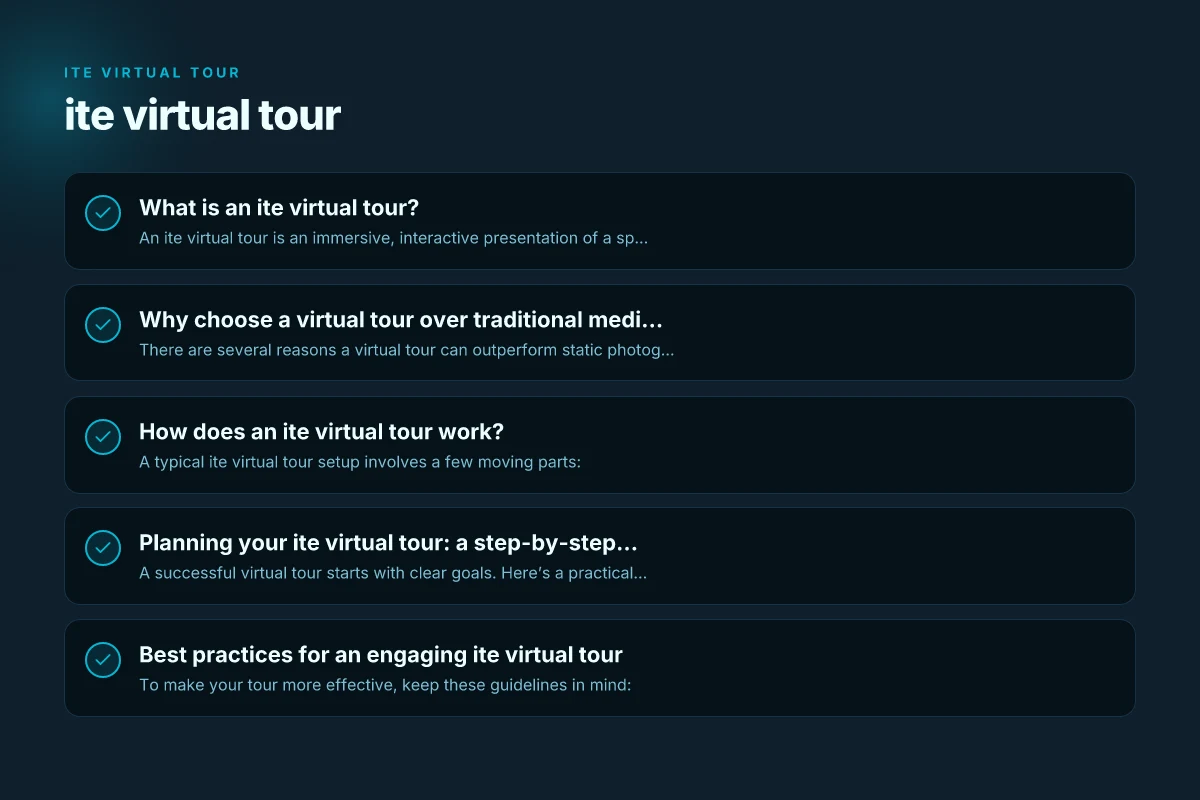
What is an ite virtual tour?
An ite virtual tour is an immersive, interactive presentation of a space that users can navigate as if they were walking through it. It combines panoramic images or 360-degree photos, hotspot navigation, and sometimes video, audio, and text overlays. The goal is to let potential buyers, students, tenants, or visitors explore rooms, floors, and campuses from anywhere in the world.
Key components often include:
- 360-degree panoramas positioned at strategic points
- Interactive hotspots to move between spaces
- Aerial or floor plan overlays for orientation
- Multimedia elements like videos, audio guides, or captions
- Analytics to track user engagement and drop-off points
The result is a more engaging, self-guided tour that can be embedded on a website, shared via a link, or integrated into a CRM or marketing platform.
Why choose a virtual tour over traditional media?
There are several reasons a virtual tour can outperform static photography or floor plans: Ite training flipzone
- Engagement: Interactive navigation invites users to spend more time exploring.
- Context: Viewers understand flow and spatial relationships more clearly.
- Accessibility: People can view from anywhere, on any device, at any time.
- Conversion: Immersive experiences can lead to higher inquiry rates, virtual visits, or in-person appointments.
- Reuse: A single tour can be repurposed across listings, campuses, and marketing materials.
If you’re marketing spaces that change with time (like a staged model unit or a campus with ongoing construction), a virtual tour can also be updated more efficiently than re-shooting photos.
Planning checklist for ite virtual tour projects
| Step | Action | Responsibility | Timeline | Notes |
|---|---|---|---|---|
| 1 | Define objective | Project Lead | Week 1 | align with goals |
| 2 | Gather assets | Content Lead | Week 1–2 | photos, floorplans |
| 3 | Choose platform | Tech Lead | Week 2 | based on needs |
| 4 | Create storyboard | UX Designer | Week 2–3 | user flow |
| 5 | Produce tour | Photographer/Cameraman | Week 3–5 | tours & hotspots |
| 6 | Review & test | QA | Week 5 | usability checks |
| 7 | Publish | Marketing | Week 6 | shareable link |
| 8 | Evaluate metrics | Analyst | Week 7+ | engagement data |
Compiled November 2026; check the provider's site for current details.
How does an ite virtual tour work?
A typical ite virtual tour setup involves a few moving parts: Ite tenant profiles traxxsson
- Capture: Photographers or technicians capture high-quality 360-degree images at key locations. In some cases, cameras are mounted on a stabilizer or used with a rig that blends multiple images for a seamless sphere.
- Stitching and hosting: The images are stitched into immersive panoramas. A tour authoring tool or platform organizes these panoramas, adds hotspots, and defines navigation paths.
- Interaction: Viewers click or tap hotspots to move to adjacent spaces, read labels, watch embedded videos, or listen to audio guides.
- Playback and access: Tours can be embedded on a website, shared via direct links, or accessed through mobile apps. Branding, language options, and accessibility features are typically configurable.
- Analytics: Platforms deliver data on views, dwell time, exits, click paths, and device breakdowns, helping you optimize the tour over time.
A well-implemented ite virtual tour should be responsive, fast to load, and intuitive to navigate. It should also support accessibility features like keyboard navigation and alternative text for images.
Planning your ite virtual tour: a step-by-step guide
A successful virtual tour starts with clear goals. Here’s a practical framework to plan yours:
- Define objectives
- What action do you want viewers to take (inquiry, schedule a visit, request a brochure)?
- Which spaces are essential to feature first?
- Who is the primary audience (homebuyers, students, tenants, investors)?
- Map the space
- Create a floor plan or site map with logical navigation routes.
- Decide on the order of rooms or areas to maximize storytelling.
- Choose capture and production standards
- Decide on image quality, resolution, and camera setup.
- Consider lighting plans to avoid dark corners and ensure consistent exposure.
- Plan for audio narration or captions if helpful for context.
- Select a tour platform
- Compare platforms on ease of use, customization, embedding options, mobile experience, and analytics.
- Check for accessibility features (alt text, keyboard navigation) and multilingual support if needed.
- Create the tour
- Upload panoramas, set hotspots, add navigation labels, and embed media.
- Ensure the tour scales across devices and works offline if possible.
- Test and optimize
- Run internal reviews for usability and accuracy.
- Gather feedback from a sample of potential viewers.
- Monitor analytics after launch and adjust hotspots or content as needed.
Best practices for an engaging ite virtual tour
To make your tour more effective, keep these guidelines in mind:
- Start with a strong landing scene: Use a welcoming entrance or lobby as the opening panorama to set context.
- Use intuitive navigation: Keep paths logical and consistent. Avoid dead ends that frustrate users.
- Tell a story with hotspots: Use hotspots to highlight unique features, room functions, or design details. Include short captions for context.
- Maintain visual consistency: Balance lighting, color temperature, and image sharpness across all panoramas.
- Balance media types: A mix of panoramas, floor plan overlays, and short videos can enhance understanding without overwhelming viewers.
- Use accessibility features: Provide alternative text for images, transcripts for audio, and screen-reader friendly labels.
- Optimize load times: Compress images appropriately and leverage lazy loading so the tour loads quickly on mobile networks.
- Include a call to action: Each section or major space should guide viewers to the next step (inquiry form, scheduling, download brochure).
A practical comparison: ite virtual tour platforms
If you’re evaluating options, here’s a simple side-by-side table to consider. Note that features and pricing vary, so use this as a quick framework for your decision. Ite synthetic medicinal chemistry services
| Feature | Platform A | Platform B | Platform C |
|---|---|---|---|
| 360° panorama support | Yes | Yes | Yes |
| Hotspot navigation | Yes | Yes | Yes |
| Multimedia overlays (video/audio) | Optional | Built-in | Built-in |
| Floor plan overlays | Available | Limited | Yes |
| Mobile responsive | Yes | Yes | Yes |
| analytics (views, dwell time) | Basic | Advanced | Basic + conversion events |
| Accessibility features | Basic | Advanced | Basic |
| Multilingual support | No | Yes | Yes |
| Pricing model | Per-tour | Per-seat | Flat monthly |
| Ease of use for non-tech users | High | Moderate | High |
This table is a starting point. For a concrete decision, map your must-have features against your budget, and request demos or trial access to test usability and performance with real content.
Accessibility and ethics considerations across ite virtual tours
| Issue | Check | Yes/No / Note | Best practice |
|---|---|---|---|
| Alt text for assets | Provided | yes | descriptive alt text |
| Keyboard navigation | Supported | yes | focusable controls |
| Color contrast | Adequate | yes | high contrast UI |
| Data collection | Transparent | yes | clear privacy policy |
| Consent for images | Obtained | yes | model release where needed |
| Inclusive design | Considered | yes | multi-language captions |
Compiled November 2026; check the provider's site for current details.
Implementing ite virtual tours for different use cases
Different industries benefit in distinct ways from virtual tours. Here are a few common use cases and tips: Ite services: what they are, how they work, and why they matter
- Real estate and property development
- Highlight floor plans, view angles, and exterior context.
- Integrate with contact forms and scheduling tools for property visits.
- Higher education campuses
- Include campus landmarks, dorm rooms, labs, and student centers.
- Use language options and campus-specific videos to enrich the experience.
- Hospitality and venues
- Showcase event spaces, dining areas, and guest rooms.
- Pair tours with 3D floor plans to help planners visualize layouts.
- Corporate offices and manufacturing facilities
- Provide factory or office tours with safety notes and process explanations.
- Use hotspots to explain equipment, workflows, and compliance features.
Accessibility and ethics
As with any online media, consider accessibility and ethical presentation:
- Make sure tours are navigable with keyboard controls and screen readers where possible.
- Provide transcripts or captions for video content.
- Be mindful of privacy: blur or omit areas with sensitive information or private spaces.
- Ensure representation is accurate and transparent about what is shown (e.g., staged vs. current state).
Final recommendation
If your goal is to increase engagement, improve understanding of spatial layouts, and drive inquiries or visits, an ite virtual tour is a strong investment. Start with clear objectives, map your space for logical navigation, and choose a platform that fits your workflow and analytics needs. Prioritize user-friendly design, accessibility, and performance across devices. Regularly review viewer data to refine hotspots, add new content, and keep the tour current with space changes. With thoughtful planning and execution, an ite virtual tour can become a central pillar of your marketing, recruitment, or tenant outreach strategy.