Ite tenant profiles traxxsson
A practical guide to understanding ite tenant profiles and how Traxxsson can help manage them effectively.
Tenant profiling is a cornerstone of modern property management. When you understand the profiles of ite tenants, you can tailor communications, set appropriate lease terms, forecast turnover, and optimize rent collection. This article breaks down the concept of ite tenant profiles and explains how Traxxsson, a platform designed to streamline tenant data, helps property managers, landlords, and real estate teams work with this information more effectively.
Comparison of ite tenant profile concepts
| Aspect | What it is | How Traxxsson supports | Key benefit |
|---|---|---|---|
| Definition | A set of attributes describing a tenant | Profiles stored and updated in Traxxsson | Clear target for actions |
| Data sources | Internal data, external signals | Integrated connectors | Richer context |
| Granularity | High-level or granular | Adjustable levels | Flexible precision |
| Privacy focus | Varies by policy | Built-in controls | Safer data use |
| Update cadence | Static or dynamic | Real-time or scheduled | Fresh insights |
Compiled November 2026; check the provider's site for current details.
What are ite tenant profiles?
Defining the concept
Ite tenant profiles refer to structured groupings of tenants based on shared characteristics, behaviors, and needs. These profiles might include:
- Demographics (age, household size, employment status)
- Financial behavior (payment history, credit risk, income stability)
- Rental preferences (lease length, pet policies, amenities)
- Engagement patterns (communication style, responsiveness)
- Tenancy outcomes (length of stay, renewal likelihood, churn risk)
Why profiles matter
- Personalization: Tailor rent reminders, welcome messages, and amenity recommendations.
- Risk management: Identify late-payers or high-turnover tenants early.
- Operational efficiency: Standardize processes for common tenant types (students, families, professionals).
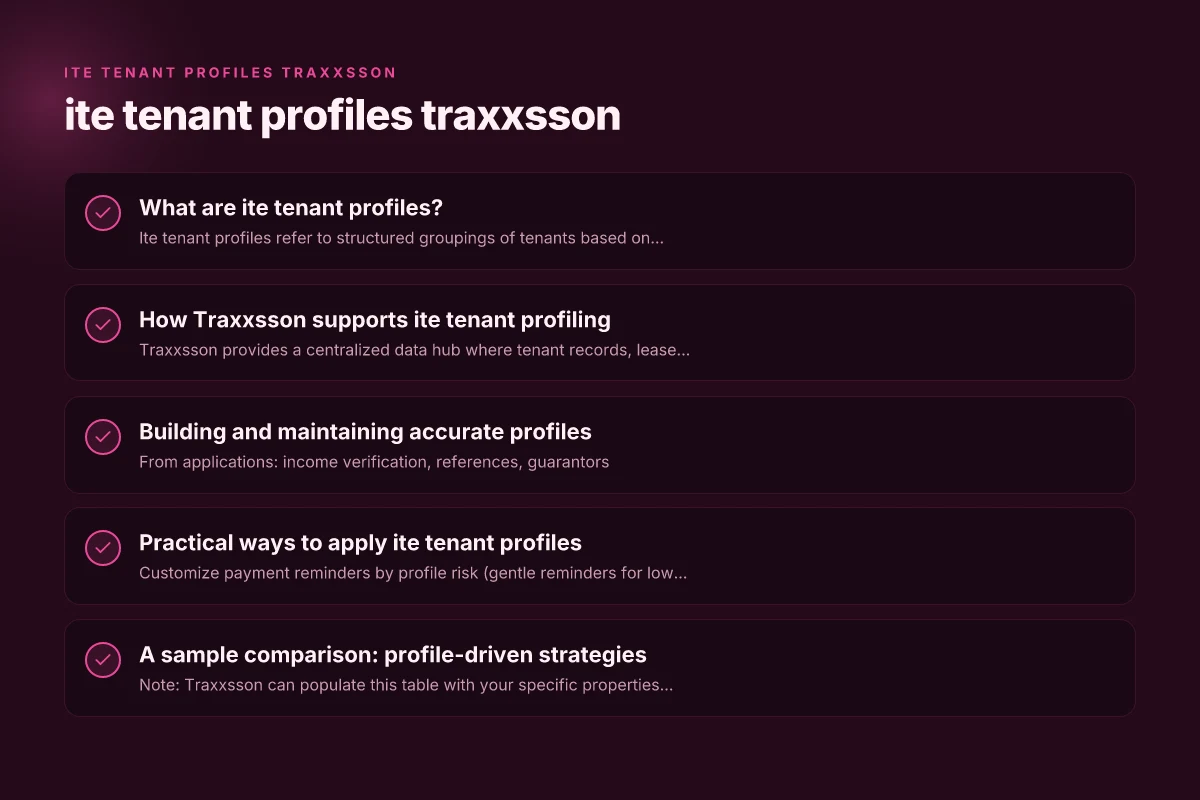
How Traxxsson supports ite tenant profiling
Data organization and centralization
Traxxsson provides a centralized data hub where tenant records, lease terms, payment histories, and communication notes live in one place. This reduces data silos and ensures consistency across teams.
- Unified tenant profiles
- Custom fields for profile attributes
- Real-time syncing with payment gateways and leasing software
Segmentation and tagging
The platform lets you create tags and segments to reflect ite profiles. For example:
- Segment: Students, Young Professionals, Families
- Tag: Reliable payer, High renewal potential, Late payer
Analytics and insights
Traxxsson offers dashboards and reports that reveal insights such as: Ite synthetic medicinal chemistry services
- Renewal probability by profile
- Average time to lease renewal per segment
- Late payment trends by tenant type
These insights help you prioritize outreach and personalize retention strategies.
Building and maintaining accurate profiles
Collecting the right data
- From applications: income verification, references, guarantors
- Onboarding: preferred communication channels, move-in date, pet information
- Ongoing: payment behavior, maintenance requests, feedback
Ensuring data quality
- Use standardized fields for consistency (e.g., lease terms, rent amount, payment date)
- Regularly audit for outdated or duplicate records
- Obtain consent for data usage and clearly outline privacy practices
Keeping profiles current
- Automate status updates when a tenant’s situation changes (e.g., job change, relocation)
- Schedule quarterly reviews of key attributes
- Incorporate tenant feedback to refine the profile
Practical decision matrix: applying ite tenant profiles
| Use Case | Recommended profile depth | Data sources to leverage | Privacy/compliance note | Expected outcome |
|---|---|---|---|---|
| Marketing segmentation | Moderate depth | CRM, event data | Opt-in required | Targeted campaigns |
| Service personalization | High depth | Usage, telemetry | Pseudonymize, consent | Improved UX |
| Access control | Core attributes | Identity, role, device | Least privilege | Reduced risk |
| Risk assessment | Risk signals only | Abuse flags, history | Do not overfit | Early warnings |
| Reporting & analytics | Summary profiles | Aggregated metrics | Anonymized when possible | Actionable insights |
Compiled November 2026; check the provider's site for current details.
Practical ways to apply ite tenant profiles
Personalization at scale
- Customize payment reminders by profile risk (gentle reminders for low-risk, firmer notices for higher-risk segments)
- Tailor lease renewal offers (longer-term leases for stable segments, flexible terms for students)
Proactive risk management
- Set thresholds for action (e.g., if a profile shows increasing late payments over two consecutive cycles, trigger outreach)
- Combine payment data with engagement data to identify disengaged tenants early
Marketing and occupancy optimization
- Align marketing messages with the dominant profiles in a property
- Predict demand for unit types by profile (e.g., studios for singles, 2-bedroom units for families)
A sample comparison: profile-driven strategies
| Profile | Typical Needs | Proactive Strategies | KPIs to watch |
|---|---|---|---|
| Young professionals | Convenience, speed, fairness | Online payments, quick maintenance, flexible leases | Renewal rate, on-time payments, satisfaction scores |
| Students | Budget-friendly, short-term stability | Seasonal promos, roommate-friendly terms, furnished units | Occupancy rate, average stay length, move-in/move-out cycles |
| Families | Space, safety, long-term stability | Family-friendly amenities, predictable schedules, multi-year leases | Vacancy duration, renewal rate, dispute frequency |
| Freelancers/contract workers | Flexible terms, communication clarity | Short-term options, transparent invoicing, clear renewal paths | Late-payment rate, occupancy volatility, request response time |
Note: Traxxsson can populate this table with your specific properties and tenant data, making it easy to compare profiles side-by-side. Ite services: what they are, how they work, and why they matter
Compliance, privacy, and ethics in profiling
Respecting tenant rights
- Be transparent about what data you collect and why
- Limit sensitive data to what is necessary for tenancy decision-making
- Offer opt-outs or data access requests where applicable
Data security best practices
- Use role-based access control so only authorized staff can see sensitive information
- Encrypt data at rest and in transit
- Maintain an audit log of changes to profiles and data access
Fair housing considerations
- Ensure profiling practices do not discriminate or bias screening decisions
- Regularly review profiles for unintended disparities
- Document decision-making criteria to support fairness and accountability
Implementation steps with Traxxsson
| Step | Action | Data handling | Outcome | Time estimate |
|---|---|---|---|---|
| 1 | Define profile schema | Privacy-by-design | Clear data map | 1–2 days |
| 2 | Connect data sources | Verify access | Data inflow | 2–4 days |
| 3 | Set access policies | Roles, permissions | Safe access | 1 day |
| 4 | Build profiles | Normalize attributes | Usable profiles | 2–5 days |
| 5 | Validate quality | Hygiene checks | Trusted data | Ongoing |
| 6 | deploy usage | Integrations | Active profiling | Continuous |
Compiled November 2026; check the provider's site for current details.
Implementation steps for ite tenant profiles with Traxxsson
Step 1: Define your profile taxonomy
- List the key attributes that matter for your portfolio
- Decide on standard fields and optional tags
- Create a governance plan for how profiles will be created and updated
Step 2: Import and harmonize data
- Import existing tenant data from your property management system
- Clean duplicates and normalize fields
- Map data to your profile taxonomy
Step 3: Build dashboards and alerts
- Create profile-based dashboards (e.g., risk by profile, renewal probability)
- Set alerts for indicators that require action (e.g., missed payments, upcoming lease expirations)
Step 4: Train your team
- Run onboarding sessions on how to read profiles
- Establish procedures for using profiles in communication, leasing, and collections
Step 5: Monitor, iterate, and improve
- Schedule regular reviews of profile effectiveness
- Adjust segments and strategies as market conditions change
- Gather tenant feedback to refine profiling accuracy
Final recommendation
If you manage a diversified portfolio, ite tenant profiling is not optional, it’s a strategic capability. Traxxsson provides a practical way to structure, analyze, and act on tenant data, turning raw information into actionable strategies. Start by defining a clear profile taxonomy, centralize data, and build profile-driven workflows. Over time, you’ll see improvements in renewal rates, on-time payments, and overall tenant satisfaction. For property managers aiming to optimize occupancy and financial performance, investing in robust ite tenant profiles with Traxxsson is a prudent path.