Training at ite

A practical guide to training at ITE, including programs, paths, and tips for success.
Training at ITE: An Overview Training at ITE is designed to prepare learners for the workforce with practical skills, industry-aligned curricula, and hands-on experience. Whether you’re fresh from school, changing careers, or seeking to upgrade your skills, ITE’s programs aim to be accessible, flexible, and outcome-focused. In this guide, you’ll find an overview of what to expect, how programs are structured, and tips to maximize your time at ITE.
Comparison of training pathways and programs at ITE
| Pathway / Program | Duration | Typical pace | Focus | Entry requirements | Outcome / credential |
|---|---|---|---|---|---|
| Diploma pathway | 18–24 months | Full-time or part-time | Broad technical foundation | High school completion | Diploma issued, career-ready skills |
| Certification courses | 1–6 months | Flexible | Targeted skills, bite-sized | None or basic prerequisites | Certificate awarded |
| Apprenticeship programs | 12–24 months | On-the-job + learning | Hands-on with industry | Employer sponsorship | Trade credential, work-ready |
| Micro-credentials | 4–12 weeks | Short bursts | Specific tools or tech | Basic literacy | Digital badge / certificate |
| Advanced/specialist tracks | 3–9 months | Part-time or full-time | Niche tech areas | Prior related experience | Specialist certificate |
Compiled November 2026; check the provider's site for current details.
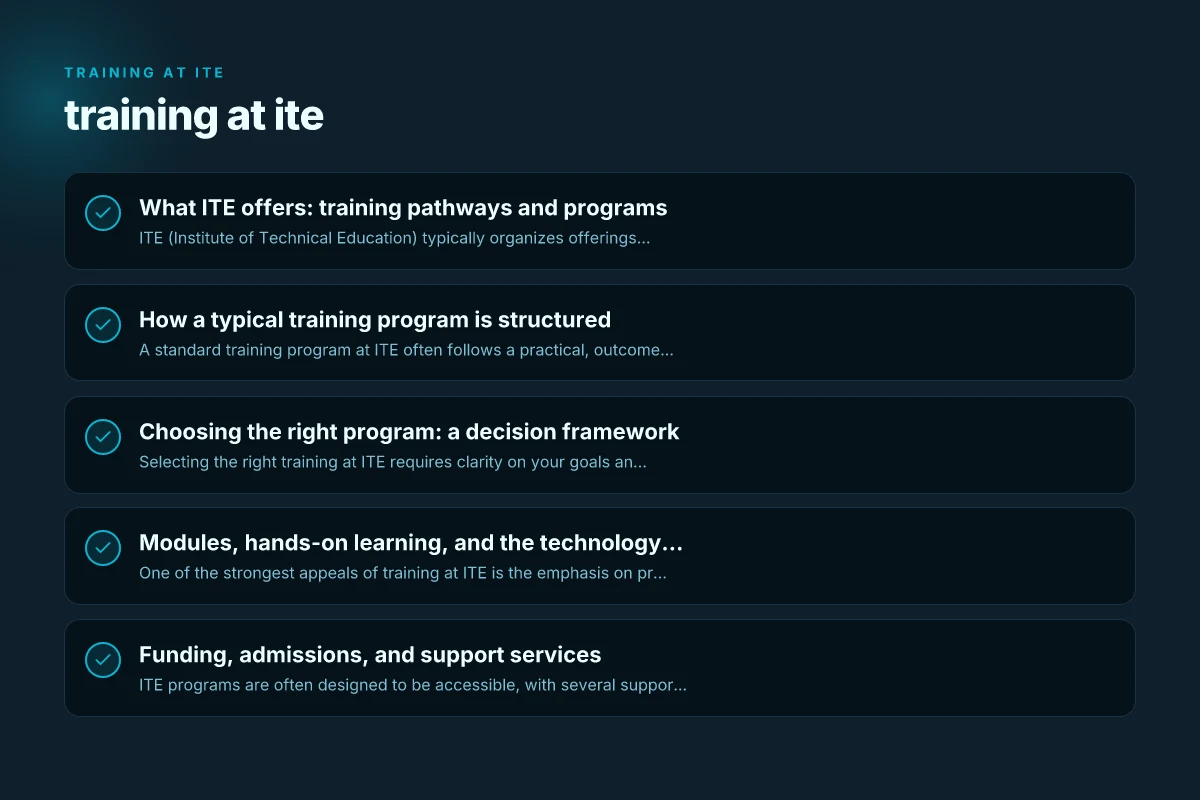
What ITE offers: training pathways and programs
ITE (Institute of Technical Education) typically organizes offerings around several core pathways designed to align with industry needs. Exact programs can vary by region and campus. Common categories include:
- Vocational and technical diplomas
- Specialist diplomas and advanced diplomas
- Industry-based certificates and modules
- Apprenticeships and work-integrated learning
- Continuing education and professional development
Key features across programs:
- Hands-on labs, workshops, and simulation environments
- Lectures and interactive tutorials for foundational knowledge
- Project-based assessments and industry-focused capstone projects
- Industry partnerships for internships, apprenticeships, and job placements
- Flexible learning options, including part-time study and bite-sized modules
If you’re unsure which pathway fits you best, start with a career or industry mapping exercise offered by ITE counselors or program advisors.
How a typical training program is structured
A standard training program at ITE often follows a practical, outcomes-focused structure. Specifics vary by program. You can expect: Startup connection prepares best event yet
- Orientation and setup: campus facilities, lab safety, and program expectations
- Foundational modules: core theory and concepts necessary for the field
- Practical labs and workshops: hands-on practice with equipment, tools, and software
- Projects and assessments: real-world tasks that demonstrate competence
- Industry exposure: site visits, internships, or mentorship programs
- Capstone or job-ready project: a culminating deliverable that showcases your skills
Flexibility is a hallmark of many ITE programs. Some components may be delivered online or in a hybrid format, while lab-based components remain in-person to ensure you gain practical proficiency.
Choosing the right program: a decision framework
Selecting the right training at ITE requires clarity on your goals and constraints. Consider these factors:
- Career objective: What job roles or industries are you aiming for?
- Prior experience: Do you need foundational skills or advanced specialization?
- Time commitment: Are you planning full-time study or part-time learning?
- Budget and funding: What financing options are available (scholarships, grants, employer sponsorship)?
- Location and schedule: Which campus options and class times align with your life?
A practical approach is to list the top five job roles you’re targeting, then map each role to the required skills and the ITE program that covers those skills. Talk to an ITE advisor to validate your map and to understand prerequisites or bridging modules if you’re transitioning from another field.
Structure and delivery of a typical ITE training program St louis startup connection: your guide to thriving in the Gateway City ecosystem
| Element | Description | Typical duration | Format | Assessment method |
|---|---|---|---|---|
| Orientation | Overview, goals, logistics | 1–2 days | In-person / online | Participation, onboarding tasks |
| Core modules | Core topics and labs | 6–12 weeks | Mix of lectures and labs | Quizzes, projects |
| Hands-on labs | Practical application | Throughout | Simulated or real equipment | Practical tests |
| Projects / capstone | Integrative work | 4–8 weeks | Team or solo | Project deliverable, presentation |
| Assessments | Progress checks | Ongoing | Online / in-person | Tests, rubrics |
| Milestones | Key checkpoints | Variable | Digital tracking | Pass/fail gates |
Compiled November 2026; check the provider's site for current details.
Modules, hands-on learning, and the technology you’ll use
One of the strongest appeals of training at ITE is the emphasis on practice. Expect:
- State-of-the-art labs and equipment: from CNC machines and robotics to electronics test rigs and software development environments
- Industry-grade software: CAD/CAM, BIM, programming IDEs, data analysis tools, and more
- Realistic simulations: virtual labs or simulated environments for safe practice
- Team-based projects: collaboration to mimic real workplace dynamics
- Assessment through performance: practical demonstrations and project-quality criteria
If you’re unsure about the tools or software in a given program, request a syllabus or sample module to review the learning outcomes and software requirements before enrolling.
Funding, admissions, and support services
ITE programs are often designed to be accessible, with several support avenues: St louis medical devices
- Scholarships and grants: check early for available financial support
- Tuition assistance: payment plans or employer-funded training
- Admissions requirements: typically include transcripts, identification, and possibly placement tests or interview
- Student services: career guidance, counseling, tutoring, and disability services
- Alumni and industry networks: opportunities for mentorship and networking
Mercifully, many ITE campuses provide clear pathways from enrollment to graduation, with dedicated program coordinators to help you through the process.
Comparing ITE training options: a quick table
| Criterion | Diploma programs | Specialist/Advanced diplomas | Apprenticeships / Work-integrated learning |
|---|---|---|---|
| Focus | Broad: foundational theory + hands-on practice | Deepens specialization in a chosen field | On-the-job training with classroom components |
| Duration | Typically 1–3 years | Often 1–2 years beyond diploma or degree | Varies by apprenticeship, often 1–4 years |
| Industry exposure | Moderate through labs and capstone projects | High, with industry projects and partnerships | High, with real work experience and employer mentors |
| Outcomes | Entry-level technician or technician-analyst roles | Senior technician, supervisor, or technician specialist | Qualified tradesperson or specialist with work history |
| Ideal for | Those seeking broad credentialing and job-ready skills | Those targeting advanced roles or niche fields | Those who want paid hands-on experience while learning |
Note: Actual programs and structures can vary by campus and year. Always verify with the local ITE campus or official website for the most current offerings.
Tips to maximize your training experience
- Set clear goals: identify target roles and map required skills to modules in your program.
- Build a study routine: schedule regular practice in labs, coding nights, or design sessions.
- Engage with instructors: ask for feedback, request extra practice, and seek clarification early.
- Leverage labs and maker spaces: use equipment outside of class hours to deepen hands-on proficiency.
- Seek industry interactions: participate in internships, site visits, and networking events.
- Document your work: maintain a portfolio of projects, designs, and code to show prospective employers.
- Prepare for assessments: practice under exam-like conditions and seek feedback on rubrics.
Decision framework for choosing the right program
| Criterion | What it means | How to evaluate | Best-fit indicators |
|---|---|---|---|
| Career goal | What job you want | Map goal to program outcomes | Clear alignment |
| Time available | How quickly you want to start | Compare durations | Shorter vs longer paths |
| Budget | Cost of program | Tuition, fees, materials | Low-cost, scholarships |
| Prior experience | Skills you already have | Pre-assessment, prerequisites | Matches entry requirements |
| Learning style | Preference for pace | Self-paced vs cohort | Flexible pacing |
| Credential value | Type of credential | Industry recognition | Diploma / certificate / badge |
| Support services | Help during training | Availability of mentoring, tutoring | Strong guidance |
Compiled November 2026; check the provider's site for current details. Shared facility resources: what they are and why they matter
Final considerations and recommendations
If you’re evaluating training at ITE, focus on the alignment between the program’s outcomes and your career objectives. A diploma can set you on a broad path with flexibility, while a specialist or advanced diploma might fast-track you toward higher-responsibility roles. Apprenticeships are ideal if you learn best through hands-on work and you want paid experience while you study.
Strongly consider the following steps:
- Contact an ITE program advisor to discuss your goals and get a program map tailored to you.
- Review the latest program catalogs to compare modules, lab facilities, and industry partners.
- Ask about job placement rates, alumni success stories, and the availability of internships or apprenticeships.
- Visit the campus or attend an open house to see the labs and equipment firsthand.
Recommendation For most learners seeking pragmatic, employment-ready skills with immediate industry relevance, training at ITE is a solid choice. If you prefer broad foundational skills with the option to specialize later, start with a diploma and plan to transition into a specialist or advanced program as you confirm your interests. If you value paid work experience during learning, an apprenticeship pathway can be especially rewarding and practical. No matter which path you choose, actively engage with instructors, utilize campus resources, and build a project portfolio that communicates your capabilities to employers. This proactive approach will help you translate training into a successful career.