Portable Essentials: Everything You Need to Know About Being Truly Portable

A practical guide to understanding portability, from gadgets to mindset, with tips on choosing portable gear and staying organized.
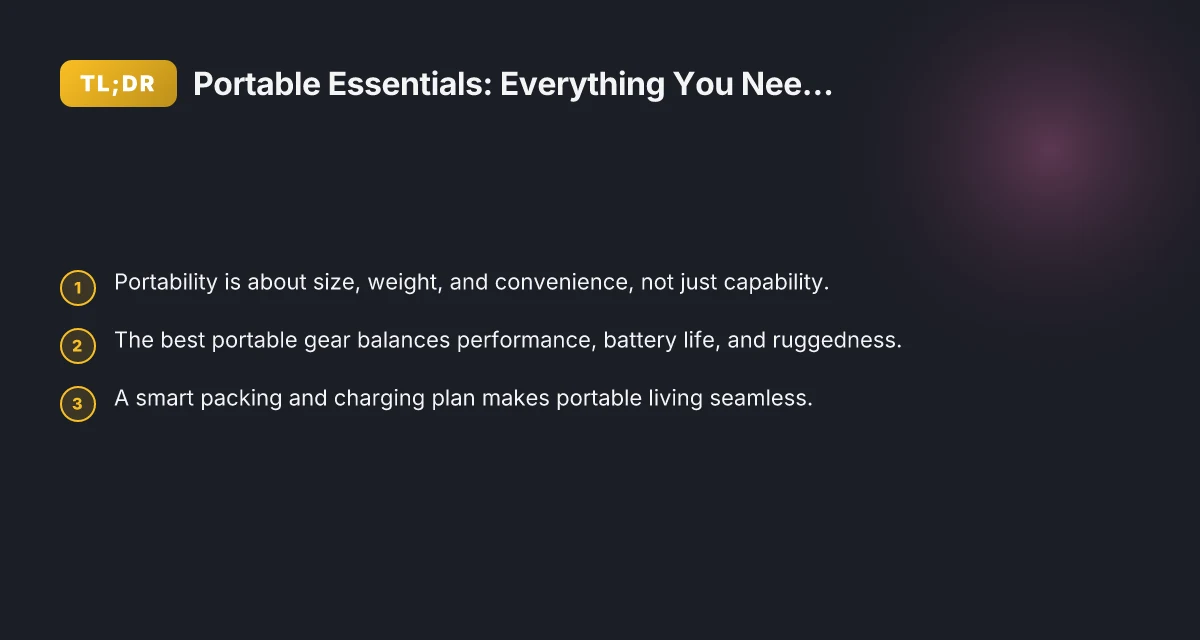
In a world that moves faster every day, portability isn’t just a feature, it's a lifestyle. Whether you’re a digital nomad, a student, a camper, or simply someone who values flexibility, understanding what makes something portable and how to optimize for it can save time, space, and stress. This guide breaks down the core ideas of portability, offers practical tips, and helps you choose gear that travels well without compromising on what you need.
Quick-reference portability criteria
| Item | Weight | Battery life / capacity | Size (folded) | Durability | Price |
|---|---|---|---|---|---|
| Smartphone-sized multi-tool | 0.2 kg | 10–20 h | Small | Durable | $$ |
| Ultra-light laptop | 1.0–1.4 kg | 6–12 h | Compact | Solid | $$$ |
| Folding bike | 12–15 kg | N/A | Medium | Strong | $$$$ |
| E-reader | 0.2 kg | weeks (standby) | Very small | Reasonable | $ |
| Solar charger (portable) | 0.3 kg | N/A | Pocket-sized | Weatherproof | $$ |
| Compact camera | 0.3–0.5 kg | 2–10 h | Small | Good | $$ |
Compiled November 2026; check the provider's site for current details.
What does “portable” really mean?
Portable is a relative term. It can describe physical size, weight, durability, or the ease with which an item can be moved from place to place. A truly portable item should meet several criteria:
- Lightweight and compact: easy to carry by hand or in a small bag.
- Durable: able to withstand travel bumps, vibrations, and varying climates.
- Convenient to deploy: quick setup, minimal accessories, and simple power needs.
- Versatile: performs well in multiple settings, not just one use case.
- Efficient power needs: long battery life or easy access to power sources.
When evaluating portability, list your actual use cases. A device that’s technically small but fragile or battery-hungry may not be truly portable for your lifestyle.
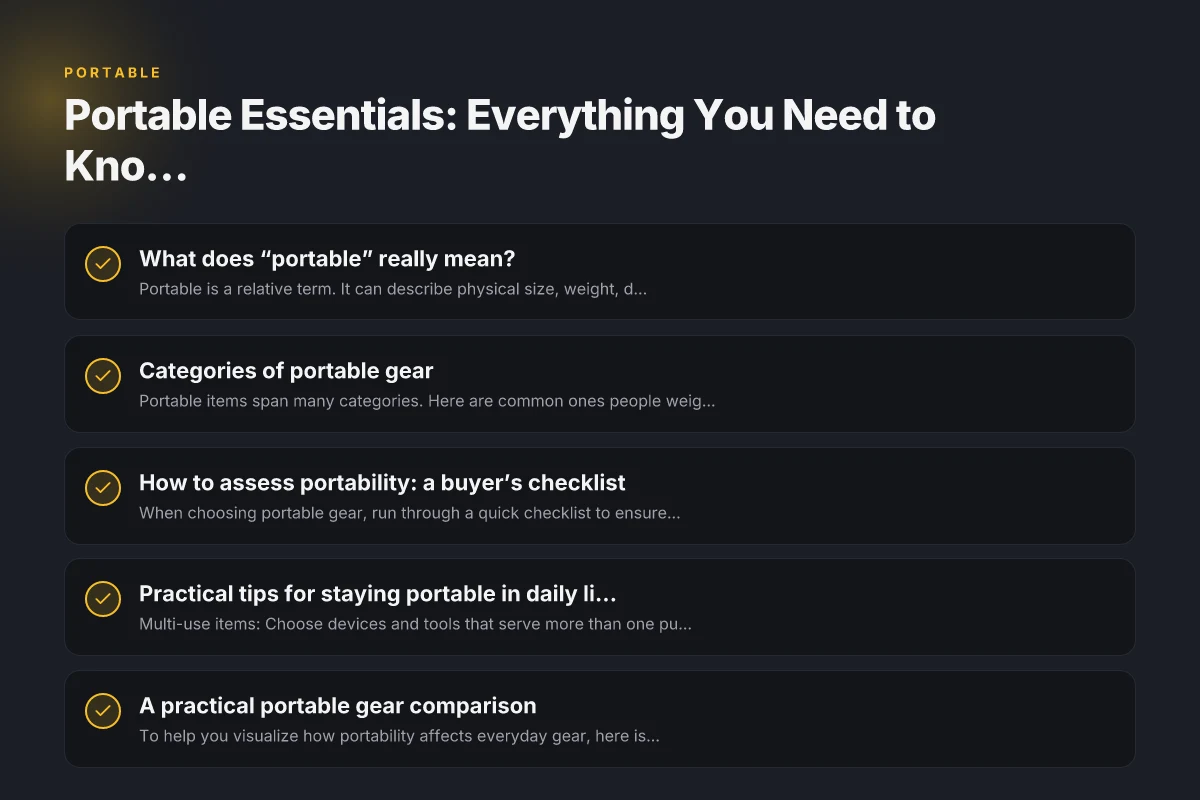
Categories of portable gear
Portable items span many categories. Here are common ones people weigh when prioritizing portability:
- Tech devices: smartphones, tablets, ultra-thin laptops, portable monitors, battery banks, USB-C hubs.
- Audio and video: compact speakers, true wireless earbuds, pocket-size projectors, action cameras.
- Home and office: foldable desks, collapsible chairs, travel routers, mini projectors.
- Outdoor and travel: compact camping gear, multi-tools, lightweight cookware, portable water purifiers.
- Personal care and health: travel-sized grooming kits, compact scales, portable exercise gear.
In each category, the key portable attributes are size, weight, and how quickly you can assemble or deploy the item. Examples that illuminate: a practical guide to using examples effectively
Categories of portable gear comparison
| Category | Typical use case | Pros | Cons | Ideal for | Example item |
|---|---|---|---|---|---|
| Personal electronics | Everyday tasks on the go | Light, compact | Limited power | Travelers | Smartphones, e-readers |
| Power and charging | Off-grid or travel days | Reduces wall dependency | Needs sun/idle time | Campers | Solar chargers, power banks |
| Transportable tools | Quick repairs, on-the-go tasks | Ready in a pinch | May limit capability | DIYers | Multi-tools, mini compressors |
| Sleeping / resting gear | Rest anywhere | Quick setup | Bulkier than gadgets | Ultra-light travelers | Travel pillows, compact mats |
| Clothing / wearable | Continuously portable | Always on-hand | Limited capacity | All lifestyles | Lightweight jackets, packable layers |
Compiled November 2026; check the provider's site for current details.
How to assess portability: a buyer’s checklist
When choosing portable gear, run through a quick checklist to ensure you get the best balance of portability and performance:
- Weight-to-use ratio: How much weight do you carry versus how much value you get?
- Ruggedness: Does it hold up to drops, dust, humidity, or rain? Is there an IP rating if water resistance matters?
- Battery life and charging: How long does it run unplugged? Are there multiple charging options (USB-C, solar, car charger)?
- Setup and teardown: Is it easy to fold, unfold, or pack away? Are magnets, clips, or hinges reliable?
- Compatibility: Will it work with your other gear or existing power banks, adapters, or software?
- Warranty and support: Is there accessible service near you? How easy is it to obtain replacements?
A practical approach is to rate each item on these criteria from 1 to 5. The best portable gear often has a strong overall score rather than the highest score in any single category. Wet Labs: What They Are, How They Work, and Why They Matter
Practical tips for staying portable in daily life
- Multi-use items: Choose devices and tools that serve more than one purpose. For example, a laptop with a touchscreen can replace a tablet in many scenarios. A portable power station can charge multiple devices at once.
- Minimalist packing: Adopt a capsule packing approach. Keep chargers, cables, and adapters in small pouches labeled by device. Use universal adapters and cable organizers to reduce bulk.
- Power planning: Keep a compact power strategy. Carry a high-capacity power bank, a fast-charging wall adapter, and a USB-C cable that can handle data and fast charging. If you travel in areas with uncertain electricity, consider solar or hand-crank options as backups.
- Protection matters: Use sleeves, pouches, or cases that protect against impacts and moisture. A single rugged carrying case can protect several devices at once.
- Maintenance: Regularly prune unused apps, wipe old data, and update firmware. A lighter device plus fewer apps translates to faster boots and longer battery life on the go.
A practical portable gear comparison
To help you visualize how portability affects everyday gear, here is a simple comparison of three popular portable device setups. The table uses a hypothetical daily-use scenario: web browsing, document editing, media consumption, and light photo editing.
| Scenario | Device A (Ultra-portable laptop) | Device B (2-in-1 tablet) | Device C (Smartphone + portable monitor) |
|---|---|---|---|
| Weight (approx) | 2.2–2.8 lb (1–1.3 kg) | 1.0–2.0 lb (0.45–0.9 kg) | 0.5–0.8 lb (0.23–0.36 kg) + 0.6–1.0 lb monitor |
| Battery life (hours) | 8–12 | 6–10 | Phone 10–20, monitor 4–6 |
| Setup time | Fast (plug in and go) | Very fast (detach/attach) | Moderate (connect cables) |
| Durability | Robust chassis, good hinges | Flexible modes, but screen hinge vulnerable | Fragile screen if not protected |
| Use-case highlights | Full workstation feel | Versatile for note-taking + media | Greatest portability with external display |
Notes:
- Your choice depends on how you work. If you frequently edit large documents or run power-hungry apps, the ultra-portable laptop may win. If you value versatility in a tablet-first workflow, the 2-in-1 could be best. If daily commuting is your primary concern, smartphone plus compact monitor can minimize weight while preserving screen real estate.
- Real-world values vary. Always check the latest specs for your exact model.
Buyer’s checklist for assessing portability
| Criterion | Yes / No / N/A | Details / notes | Priority (1–5) | Suggested test | Typical decision trigger |
|---|---|---|---|---|---|
| Weight under 1 kg | Yes | For small gadgets | 5 | Compare specs | If you carry all day, yes |
| Folded size fits bag | Yes / No | Check bag dimensions | 4 | Mock bag pack | Must fit your daily bag |
| Battery life adequate | Yes / No | Real-world use | 4 | Day-long test | Needs all-day use without recharge |
| Durability for travel | Yes / No | Drop/water resistance | 3 | Outdoor test | Travel rough routes |
| Quick setup / teardown | Yes / No | Time to deploy | 3 | Time a setup | Less than 2 minutes ideal |
| Price within budget | Yes / No | Relative value | 2 | Compare 3 options | Within budget threshold |
Compiled November 2026; check the provider's site for current details. Wet lab facilities: everything you need to know to choose and use them
The mindset of portable living
Portability isn’t only hardware. It’s a habit. Shaping routines around portable gear reduces friction and increases consistency.
- Plan-ahead routines: Each week, review the gear you carry and remove anything that isn’t used. Create a “go bag” for common tasks, work, travel, or outdoor days.
- Digital minimalism: Keep essential apps and files offline or synced to a single cloud account. Regularly back up data to a small external drive or secure cloud to prevent data loss when devices are swapped.
- Environment awareness: When you know you’ll be in varied climates, choose gear with appropriate IP ratings or temperature tolerance. Pack desiccants or moisture protection if you’ll be in humid or rainy environments.
- Security on the move: Use a security cable for your laptop, enable biometric unlock, and keep devices updated. For sensitive data, consider encryption and separate work and personal devices.
How to tailor portability to your lifestyle
- For students: Focus on a lightweight laptop with good keyboard comfort and long battery life. A compact power bank and a rugged backpack with dedicated gadget sleeves can dramatically improve daily portability.
- For remote workers: A reliable 2-in-1 or a laptop plus a portable monitor setup can replicate a full workstation anywhere. Prioritize productivity software compatibility and a charging plan that covers long days in cafes or libraries.
- For travelers: Prioritize universal adapters, robust charging options, and compact imaging or audio gear. A travel-ready kit should fit in a small carry-on and revive quickly after delays.
- For outdoor enthusiasts: Durability and weather resistance trump raw performance. Look for gear with water resistance, rugged shells, and battery life that can survive long expeditions.
Final section: recommendation If you want a strong, all-around portable setup, start with two anchors: a compact, capable computer and a flexible power strategy. A high-quality ultra-portable laptop (think 2-in-1 or a slim ultrabook) paired with a high-capacity, fast-charging USB-C power bank covers most day-to-day needs. Add a small protective sleeve, a universal charging hub, and a compact external storage option for safety and expandability. For moments when you need the lightest possible load, carry a smartphone with a portable monitor that can extend display real estate when you’re working or watching media on the go. The essence of portability is reducing friction: fewer items, quicker setup, and gear that travels as easily as you do. Start with a clear assessment of your daily tasks, then curate a small, efficient toolkit. With the right balance, portable living becomes not just possible, but genuinely enjoyable.