Wet lab facilities: everything you need to know to choose and use them
A practical guide to wet lab facilities, from what they are to how to assess and utilize them safely and effectively.
Wet lab facilities are specialized spaces designed to support experiments and activities that involve biological samples, chemical reagents, and potentially hazardous processes. They provide the infrastructure, equipment, and safety systems required to protect people, data, and the environment. Whether you’re a researcher, a student, a startup, or a contract research organization, understanding what wet lab facilities offer, and how to choose the right one, can save time, reduce risk, and improve outcomes.
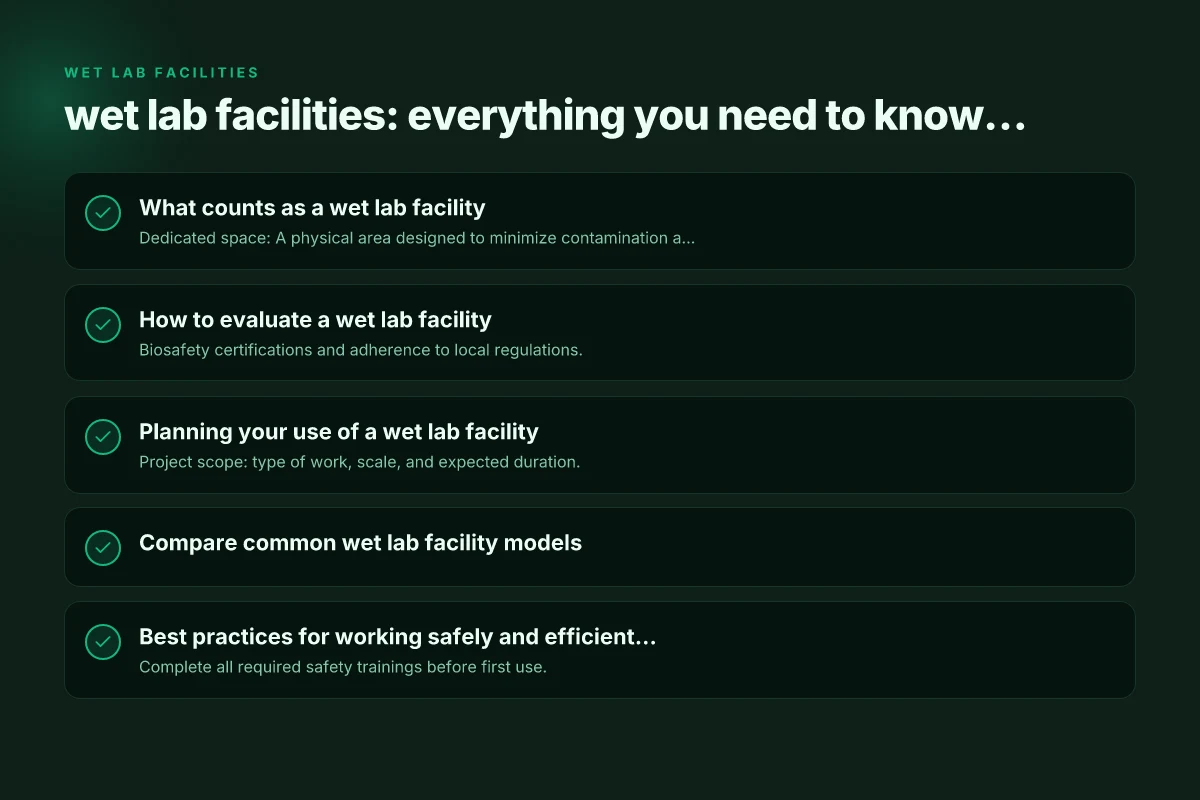
What counts as a wet lab facility
Core components
- Dedicated space: A physical area designed to minimize contamination and manage hazards.
- Containment systems: BSL (biosafety) levels, fume hoods, chemical cabinets, and waste management.
- Utilities: Reliable electricity, water supply, sink reproducibility, gas lines, and sometimes inert gas options.
- Equipment: Pipettes, incubators, centrifuges, freezers, microplate readers, incubators, and cell culture hoods.
- Safety features: Emergency shutoffs, eyewash stations, showers, spill kits, and clear signage.
Common types
- Core facility or shared lab: Access to equipment and expertise without owning the space.
- Academic wet labs: University or college labs that support coursework and research.
- Corporate R&D labs: Private facilities with scalable infrastructure for product development.
- Community bio labs: Nonprofit or membership-based spaces focusing on education and early-stage projects.
- CRO/CMO labs: Contract-based facilities that run experiments for external clients.
How to evaluate a wet lab facility
Safety and compliance
- Biosafety certifications and adherence to local regulations.
- Availability and training for personal protective equipment (PPE).
- Clear policies for biosafety, chemical safety, waste disposal, and incident reporting.
Space and equipment
- Adequate bench space and room layout to prevent crowding and cross-contamination.
- Access to essential equipment relevant to your work (e.g., biosafety cabinet, centrifuge, spectrophotometer).
- Modern calibration and maintenance schedules. Traceable service records.
Access and scheduling
- 24/7 access vs. business hours. Booking systems. Guest access policies.
- User limits, project review processes, and certainty about turnaround times for shared equipment.
- Security measures for sensitive projects and data integrity.
Cost and contracts
- Fee structure: hourly rates, monthly memberships, or project-based pricing.
- Hidden costs: consumables, waste disposal, maintenance, and access fees.
- Intellectual property protections, data handling, and confidentiality agreements.
Training and support
- Onsite staff availability, biosafety officers, and technical support for equipment.
- Training requirements before first use and ongoing competency checks.
- Access to expert consultation for experimental design and troubleshooting.
Planning your use of a wet lab facility
Define your needs
- Project scope: type of work, scale, and expected duration.
- Core activities: cell culture, molecular biology, chemical synthesis, or analytical assays.
- Compliance demands: biosafety level, chemical handling, and waste streams.
Create a utilization plan
- Timeline with milestones and critical experiments.
- Equipment usage schedule to avoid bottlenecks.
- Staffing plan: who will supervise, operate equipment, and manage waste.
Prepare for safety
- Identify required PPE and ensure you have it.
- Review hazard assessments for reagents and materials.
- Establish emergency procedures tailored to your activities.
Compare common wet lab facility models
| Model | Typical users | Pros | Cons | Access model examples |
|---|---|---|---|---|
| Core/shared facility | Researchers, startups, students | Cost-effective, broad equipment access, expert staff | Potential competition for time, limited exclusive use | University core facilities, community biology labs |
| Academic wet lab | Courses, internal research groups | Strong training culture, collaboration opportunities | May have heavy teaching schedules, limited after-hours access | University labs, teaching-focused spaces |
| Corporate R&D lab | Full-time teams, project-driven | High stability, advanced equipment, robust support | Higher cost, competitive access | Corporate campuses, private facilities |
| CRO/CMO lab | External clients, contract work | Flexible capacity, regulatory experience | Scheduling variability, longer lead times | Contract labs, outsourced research divisions |
| Incubator/accelerator labs | Early-stage startups | Mentorship, investor connections, shared resources | Early-stage risk, variable demand | University incubators, biotech accelerators |
Best practices for working safely and efficiently
Build a formal onboarding plan
- Complete all required safety trainings before first use.
- Get credentialed for equipment with documented competency.
- Review facility-specific policies on waste, spill response, and incident reporting.
Maintain meticulous records
- Track reagent lots, expiration dates, and storage conditions.
- Document experimental procedures clearly to aid reproducibility.
- Keep equipment logs for calibration, maintenance, and repairs.
Manage waste responsibly
- Segregate waste streams (biohazard, chemical, sharps, general).
- Follow facility protocols for autoclaving, chemical neutralization, and disposal.
- Schedule regular waste pickups and maintain disposal records.
Optimize your workflow
- Batch similar tasks to reduce setup and cleanup times.
- Pre-book peak-demand equipment to avoid delays.
- Train multiple team members to prevent single-point dependency.
A practical comparison: choosing a facility for a biology-focused project
The table below highlights what a biology-heavy project may prioritize in different facility models.
| Priority | Core/shared facility | Academic wet lab | Corporate R&D lab | CRO/CMO lab |
|---|---|---|---|---|
| Access to biosafety cabinet | High likelihood, shared | Limited after hours | Dedicated or premium access | On-demand, depending on project |
| Cell culture capabilities | Varies; common in many cores | Strong but teaching-focused | Very strong, validated SOPs | Available if within service scope |
| Equipment breadth | Broad, sometimes crowding | Adequate for coursework and research | Extensive and high-end | Project-based, scalable |
| Training depth | Foundational; ongoing support | Strong safety culture | Advanced SOPs and compliance | Client-specific training |
| Turnaround time | Moderate; depends on queue | Fixed class schedules | Fast, predictable | Variable, depends on project load |
The recommendation: how to make the right choice for your needs
If you’re starting out or piloting a new idea, a core/shared or community wet lab often provides the best entry point. They offer lower upfront costs, access to a range of essential equipment, and opportunities to learn from a community of users. For longer-term or higher-stakes work that requires robust regulatory compliance, dedicated university or corporate labs may deliver greater reliability, security, and support. For external projects or specialized services, consider a CRO/CMO lab with a clear service scope, defined deliverables, and strong data handling practices.
Key steps to decide
- List your must-have capabilities (equipment, biosafety level, waste handling).
- Compare access terms, including after-hours use and guest policies.
- Request a trial or pilot booking to test workflows and responsiveness.
- Review safety records, maintenance logs, and staff qualifications.
- Clarify IP, data ownership, and confidentiality provisions in the contract.
In short, wet lab facilities are more than spaces with benches and instruments. They are ecosystems built to enable safe, efficient, and compliant experimentation. The right facility for you aligns with your project type, your timeline, and your budget, while offering strong safety culture, solid technical support, and predictable access. With careful planning, you can leverage the strengths of wet lab facilities to push your research or product development forward confidently. Traxxsson: Unpacking the Brand, Uses, and What It Means for Your Tech Setup