Best next move
A practical guide to choosing your best next move in strategy, games, and daily decisions.
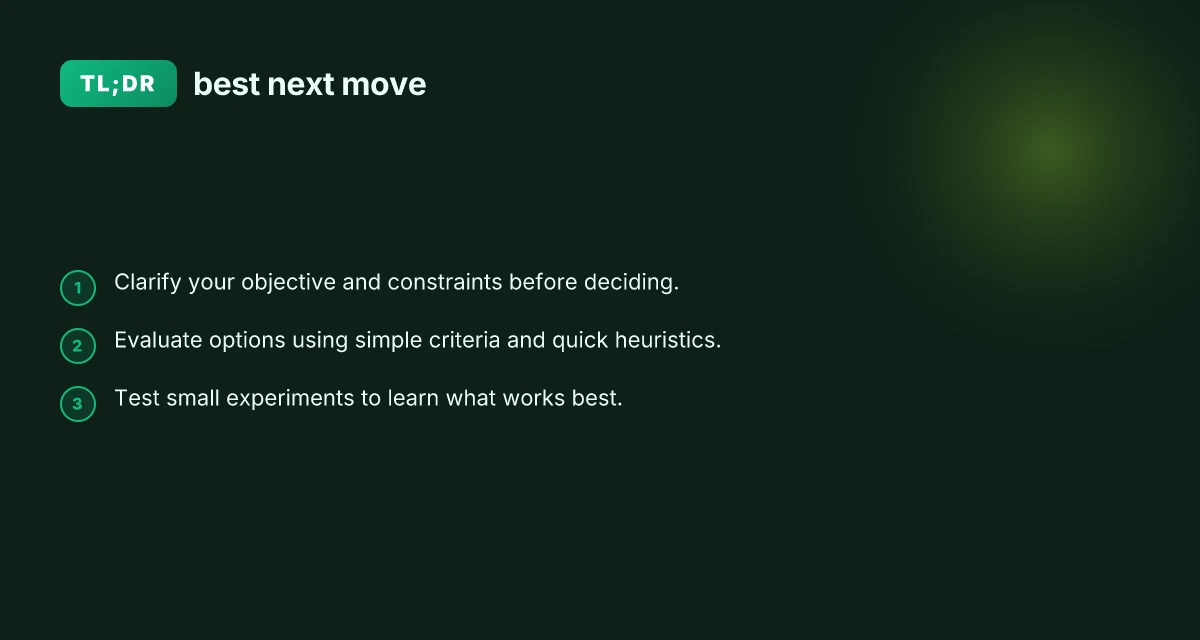
Choosing the best next move can feel like weighing a thousand possibilities. The good news is you don’t need perfect foresight to make strong choices. By anchoring your decision in clear goals, practical criteria, and a willingness to test actions, you can consistently pick moves that push you toward your desired outcome.
Goals and constraints comparison
| Option | Goal alignment | Constraints | Feasibility | Risk level | Quick verdict |
|---|---|---|---|---|---|
| A | aligns with revenue growth | time, budget | feasible | moderate | supports next move |
| B | aligns with customer satisfaction | resources | feasible | low | favorable |
| C | aligns with speed to learn | time, access | uncertain | high | needs testing |
| D | aligns with long-term strategy | budget, scope | feasible | unknown | worth exploring |
| E | aligns with regulatory compliance | legal, policy | feasible | low | safe choice |
| F | aligns with cross-functional buy-in | stakeholders | feasible | moderate | acceptable option |
Compiled November 2026; check the provider's site for current details.
Define the goal and constraints
Before you evaluate options, be explicit about what you’re aiming to achieve.
- State the objective: What does “best” mean here (win, maximize learning, minimize risk, save time, grow a skill)?
- Identify constraints: Time, resources, rules, and any deal-breakers.
- Acknowledge trade-offs: Often a move that advances one goal can slow another.
A simple framework helps: write down the objective, list 3–5 constraints, and note any non-negotiables. This becomes your decision compass and prevents scope creep.
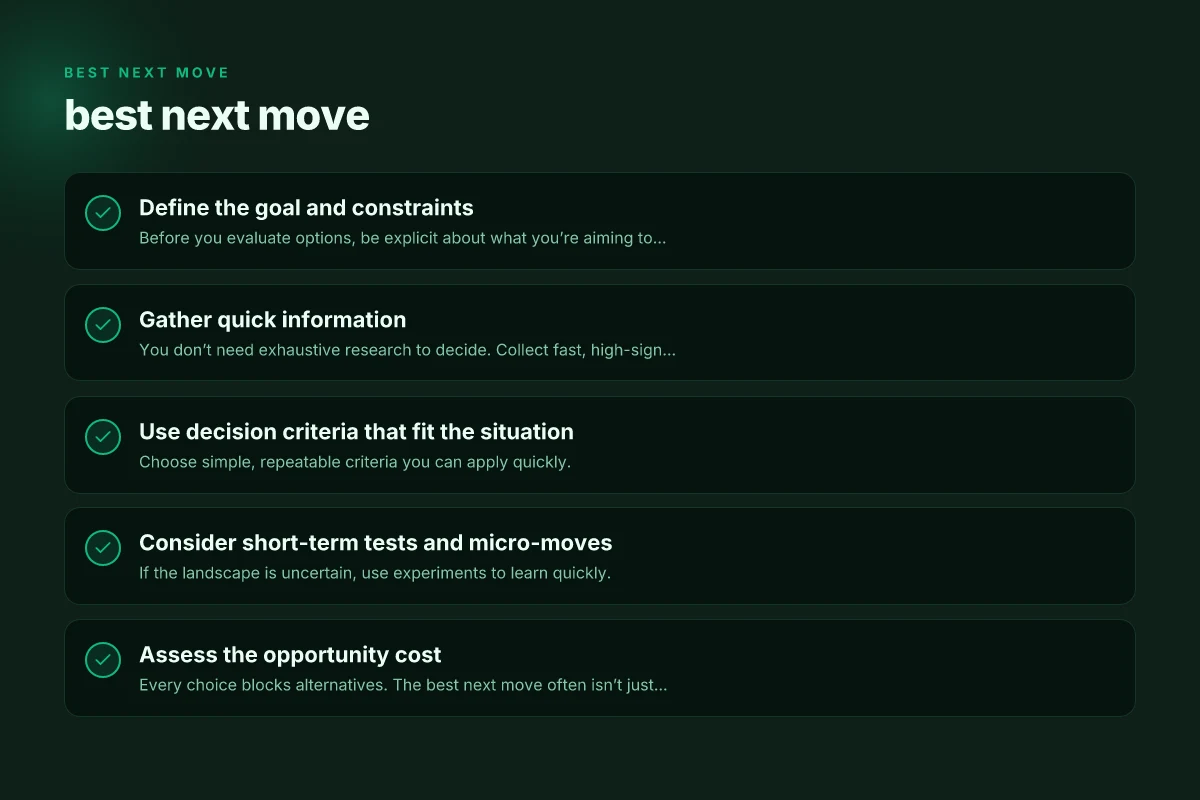
Gather quick information
You don’t need exhaustive research to decide. Collect fast, high-signal inputs that matter most.
- What are the probabilities? If uncertain, assign rough likelihoods rather than exhaustive numbers.
- What is the potential upside and downside of each option?
- Are there any hidden costs or future implications?
Use rough maps rather than perfect data. In dynamic environments, speed and adaptability often beat waiting for certainty. Itegvms protraining inaugural seminar IP law
Use decision criteria that fit the situation
Choose simple, repeatable criteria you can apply quickly.
- Impact vs. effort: Estimate whether a move yields high payoff for reasonable effort.
- Risk vs. reward: Does the potential benefit justify the risk, or should you hedge?
- Reversibility: Can you back out if it doesn’t work? Reversible moves are valuable in uncertain terrain.
- Alignment with long-term goals: Does this move move you toward your bigger objective?
A 2x2 decision matrix can be handy for visualizing trade-offs. See the table below for a quick example.
| Move | Expected Impact | Required Effort | Reversibility | Alignment with Goal |
|---|---|---|---|---|
| A | High | Medium | Moderate | Strong |
| B | Medium | Low | High | Moderate |
| C | Low | Low | High | Weak |
| D | High | High | Low | Strong |
In this example, Moves A or D stand out if impact matters, but D carries higher upfront effort and lower reversibility. Your preference for risk tolerance will tilt the choice.
Decision criteria fit by scenario Breakout year ekg
| Scenario / Criterion | Fast test viability | Impact potential | Cost to run | Data needed | Decision readiness | Next step |
|---|---|---|---|---|---|---|
| Short-term test | yes | medium | low | minimal | ready | run micro-move |
| Customer pivot | yes | high | medium | surveys, pilots | partial | design pilot |
| Profitability shift | no | high | high | financials | partial | build model |
| Compliance check | yes | low | low | policy docs | ready | verify policy |
| Brand risk | no | medium | medium | risk assessment | partial | scenario plan |
| Learn-fast loop | yes | medium | low | metrics | ready | implement loop |
Compiled November 2026; check the provider's site for current details.
Consider short-term tests and micro-moves
If the landscape is uncertain, use experiments to learn quickly.
- Run a small pilot: Try a bite-sized version of a move to observe real-world effects.
- Set a hypothesis: “If I do X, then Y will happen” and test it within a defined window.
- Measure the signal: Track a concrete metric (time saved, dollars earned, a new skill practiced) to judge success.
Micro-moves reduce downside while preserving the opportunity to course-correct. They’re especially useful in professional settings, product development, or personal growth paths.
Assess the opportunity cost
Every choice blocks alternatives. The best next move often isn’t just the best itself, but the move with the lowest opportunity cost. Basics winning sbir application
- What will you give up by choosing this path?
- Are there better uses of the same resources elsewhere?
- Could delaying the decision unlock more information or alternatives?
A simple rule: if you’re unsure, pick the option that preserves flexibility. Flexibility pays off as situations evolve.
Opportunity cost evaluation
| Option | Immediate gain | Long-term gain | Opportunity cost | Time to value | Stakeholder support | Go / No-go |
|---|---|---|---|---|---|---|
| A | medium | medium | medium | 2 weeks | high | go |
| B | low | high | medium | 1 month | medium | evaluate |
| C | high | low | high | 2 days | high | go with caution |
| D | low | medium | low | 1 week | high | go with caveats |
| E | medium | high | medium | 3 weeks | low | reconsider |
Compiled November 2026; check the provider's site for current details.
Create a decision cadence
Decision-making improves with an established rhythm. Hiring best practices: how to hire effectively in today’s market
- Set a decision horizon: How often will you choose the next move (hourly, daily, weekly)?
- Schedule quick reviews: Briefly reassess outcomes and adjust if needed.
- Build a default path: Establish a prudent default move for common scenarios to avoid decision fatigue.
A consistent cadence reduces paralysis and builds momentum. It’s especially effective in complex projects, games with evolving boards, or ongoing life plans.
When to pivot or abandon
Not every next move will prove optimal. Knowing when to pivot is as important as choosing a move.
- Sign of stagnation: You keep choosing similar moves with diminishing returns.
- New information: Fresh data contradicts your current plan.
- Resource strain: Costs rise faster than benefits.
Define a pivot condition in advance. For example: if a move’s expected value falls below a threshold after a fixed trial period, switch directions.
Quick decision checklist
Use this short checklist to validate your choice in seconds. Leadership in Small Companies: Practical Guide to High-Impact Management
- Is the goal clear? Yes/No
- Are constraints acknowledged? Yes/No
- Does the move have strong upside with acceptable risk? Yes/No
- Is there a reversible path or an easy exit if needed? Yes/No
- Does it preserve optionality for future moves? Yes/No
If you answered yes to all, you’re likely aligned with the best next move given your current information.
Adapting across contexts
The same core approach works across different domains.
- Games (chess, poker, strategy games): prioritize positions with strategic leverage, potential to force errors, and reversibility of moves.
- Work projects: pick actions that unlock subsequent tasks, reduce bottlenecks, or improve team velocity.
- Personal life: prioritize options that build habits, reduce friction, and align with values.
Context matters. For instance, in a high-stakes game with a looming clock, speed and reasonable risk management trump exhaustive analysis. In a long-running project, deliberate choices with clear long-term impacts may be worth deeper exploration.
A practical example
Suppose you’re deciding what to work on this afternoon in a software project. Your objective: deliver measurable progress without burning out. You have three potential moves: fix a critical bug, implement a small feature, or refactor a module for future speed. About ite
- Define goal: deliver visible progress today without burning out.
- Gather quick inputs: bug fix reduces risk now. Feature adds user value but takes longer. Refactor improves future velocity but has no immediate user impact.
- Criteria: impact now, time required, risk, and impact on future work.
- Decide: fix the critical bug first, as it yields immediate risk reduction and clear progress, while keeping the refactor as a later, safer, reversible task. If time remains, implement a small feature. Otherwise, schedule the feature and refactor for the next sprint.
This approach balances immediate needs with longer-term gains, illustrating how a concrete framework yields a practical “best next move.”
Recommendation If you want a reliable path to choosing your best next move in any situation, start with a clear objective and constraints. Use a simple impact-versus-effort lens augmented by reversibility and alignment with long-term goals. Test ideas with quick mini-experiments when possible, and guard your flexibility by choosing moves that keep options open for the future. Establish a regular decision cadence so you improve with practice, and build a straightforward pivot protocol to know when to switch directions. With these habits, you’ll consistently pick moves that move you forward, even when certainty is elusive.