Leadership in Small Companies: Practical Guide to High-Impact Management
A practical guide for leading small companies with actionable strategies and examples.
Lead paragraph Leading a small company is a unique leadership challenge. Resources are tight, roles overlap, and the impact of every decision is magnified. The most effective leaders in small firms blend strategic thinking with hands-on execution, cultivate a strong culture, and communicate with clarity. This article breaks down practical leadership approaches tailored to small companies, with concrete steps you can apply today.
Why leadership in small companies is different
The constraints that shape leadership
- Limited capital and time forces prioritization.
- Fewer roles mean leaders wear multiple hats.
- Decisions have visible, fast feedback loops.
- Small teams amplify both strengths and mistakes.
What works best in this environment
- Clarity over grand vision statements that never translate to action.
- Short feedback cycles and rapid experimentation.
- Strong, consistent culture-setting behavior from the top.
- Delegation aligned with clear ownership and metrics.
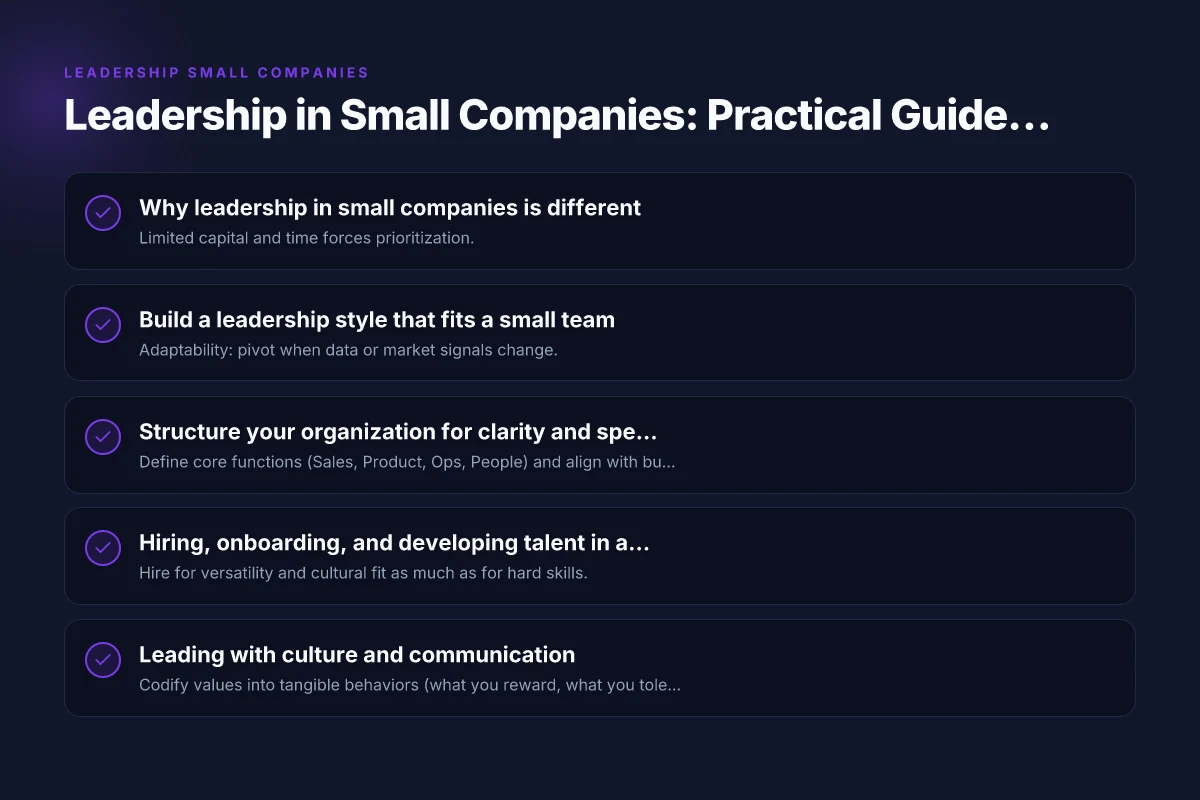
Build a leadership style that fits a small team
Key traits to cultivate
- Adaptability: pivot when data or market signals change.
- Ownership: take accountability and empower others to own outcomes.
- Communication discipline: regular, transparent updates.
- Empathy with rigor: understand team needs while driving results.
Practical style guidelines
- Lead by example in work ethic, customer focus, and integrity.
- Practice servant leadership: remove obstacles for your team.
- Create rituals that reinforce priorities (daily standups, weekly reviews, monthly strategy sessions).
Structure your organization for clarity and speed
Roles and accountability
- Define core functions (Sales, Product, Ops, People) and align with business goals.
- Map owners to outcomes rather than tasks to avoid micromanagement.
- Use lightweight RACI or ownership maps to reduce confusion.
Processes that scale with impact
- Weekly priorities: 3 strategic objectives and 3 leading indicators.
- Decision log: capture key decisions, rationale, and owners.
- Feedback loops: short, structured reviews with actionable takeaways.
Hiring, onboarding, and developing talent in a small company
Hiring mindset for small teams
- Hire for versatility and cultural fit as much as for hard skills.
- Prioritize potential. Prefer candidates who can learn fast and adapt.
- Plan for succession and backfill to reduce single points of failure.
Onboarding that sticks
- Provide a 30-60-90 day plan with measurable milestones.
- Pair new hires with a mentor, not just a supervisor.
- Share the “why” and the customer impact behind roles.
Developing leaders internally
- Identify high-potential teammates early and give stretch projects.
- Rotate responsibilities to broaden experience and confidence.
- Create a feedback-rich culture with regular one-on-ones and coaching.
Leading with culture and communication
Culture as a strategic asset
- Codify values into tangible behaviors (what you reward, what you tolerate).
- Celebrate small wins publicly to reinforce priorities.
- Build psychological safety: encourage questions, admit mistakes, and iterate.
Communication playbook for small firms
- Daily updates for transparency. Weekly summaries for direction.
- Open office hours or virtual office hours with leadership.
- Use a concise, consistent tone across all channels to reduce noise.
Decision-making frameworks that fit small companies
A simple decision matrix
| Criterion | Importance (1-5) | Data needed | Stakeholders | Decision owner | Timeframe |
|---|---|---|---|---|---|
| Customer impact | 5 | Customer interviews, usage data | Product, Sales | CEO/PM | 1-2 weeks |
| Revenue impact | 4 | Forecast, unit economics | Finance, Sales | COO | 2-3 weeks |
| Operational feasibility | 3 | Ops capacity, tech constraints | Operations, Eng | CTO/Head of Ops | 1 week |
| Strategic alignment | 5 | Plan, OKRs | Leadership | CEO | 2 weeks |
- Use the matrix to surface the top 1–2 decisions weekly.
- Document assumptions and set a clear decision deadline.
- Revisit decisions when new data arrives to avoid sunk-cost bias.
Decision rituals to build speed
- One-page decision briefs: problem, options, recommendation, risks.
- Deadlines: no-weeks-long debates. Commit or defer with a plan.
- Post-mortems: what happened, why, what to improve next time.
Metrics and focus: what to measure in a small company
Essential metrics by function
- Product: time to value, activation rate, churn of core features.
- Sales: pipeline health, close rate, average deal size.
- Ops: cycle time, defect rate, on-time delivery.
- People: engagement score, retention, time-to-productivity.
How to track without chaos
- Use a 1-page dashboard for leadership reviews.
- Limit weekly metrics to 5–7 per function to avoid analysis paralysis.
- Tie metrics to action: every metric should prompt a decision at the next meeting.
A practical example: a small tech startup
- Scenario: A 25-person software startup with tight budgets.
- Leadership focus:
- Establish a 90-day plan with three bets (core product, key enterprise customers, hiring plan).
- Create ownership maps for product features and customer success.
- Implement weekly product reviews and a quarterly culture survey.
- Outcomes to watch:
- Time to onboard new customers, NPS for core product, and retention of early hires.
- A clear decision log for every major product choice.
Table: Leadership approaches by small company stage
| Stage | Primary challenge | Leadership focus | Typical metric | Quick wins (first 90 days) |
|---|---|---|---|---|
| Seed | Validation and momentum | Vision clarity, culture, hiring pace | Activation, churn early | Define 3 bets, hire 2 versatile players, implement decision log |
| Early growth | Scaling operations | Process design, ownership, accountable teams | Revenue per user, replenishment rate | Align OKRs, establish weekly priorities, onboard mentors |
| Established small | Sustained differentiation | Leadership depth, succession planning | Net revenue retention, employee engagement | Document leadership plays, formal mentoring, refine RACI |
The leadership toolkit: practical actions you can start today
- Write a 60-second leadership statement: who you serve, what you’re changing, and why it matters.
- Create a weekly one-page update you share with every employee.
- Establish a simple ownership map for the top 5 product features.
- Implement a decision log and a 2-week review cadence for high-impact bets.
- Run a quarterly culture pulse survey and act on the top 3 changes.
Final section: recommendation
If you lead a small company, prioritize clarity, speed, and culture over attempting to mirror large firms. Your advantage lies in your proximity to customers, your ability to adapt quickly, and your capacity to align a small team around a shared purpose. Start by defining clear ownership, creating a simple decision framework, and instituting regular, transparent communication. Then invest in people: hire for versatility, onboard with purpose, and develop internal leaders who can sustain momentum as you grow. By combining practical structure with authentic leadership, small companies can outperform larger competitors through execution, cohesion, and agile vision.