Newsletter archive: how to build, organize, and leverage a successful collection
A practical guide to creating, organizing, and using a newsletter archive to boost engagement and value.
In today’s content-driven world, a well-maintained newsletter archive is more than a repository, it’s a living, searchable library that supports discovery, retention, and cross-promotion. Whether you’re a small business, a media site, or a personal creator, a thoughtful archive helps readers catch up, publishers measure impact, and teams plan future issues with confidence. Below is a practical, step-by-step guide to building and using a newsletter archive that serves both readers and creators.
Comparison of Archive Structures for Usability
| Feature | Simple Flat | Hierarchical Folders | Tag-Based Facets | Hybrid with Search |
|---|---|---|---|---|
| Depth of structure | 1 level | 2–3 levels | No hierarchy | Mix of depth |
| Quick access by topic | Yes | Somewhat | Yes via facets | Yes via search + facets |
| Easy migration of old issues | Moderate | Difficult | Easy with tagging | Moderate |
| URL stability | High | Medium | Medium | High |
| Maintenance effort | Low | Medium | Medium to High | Medium |
| Best for large archives | No | Yes | Yes | Yes |
Compiled November 2026; check the provider's site for current details.
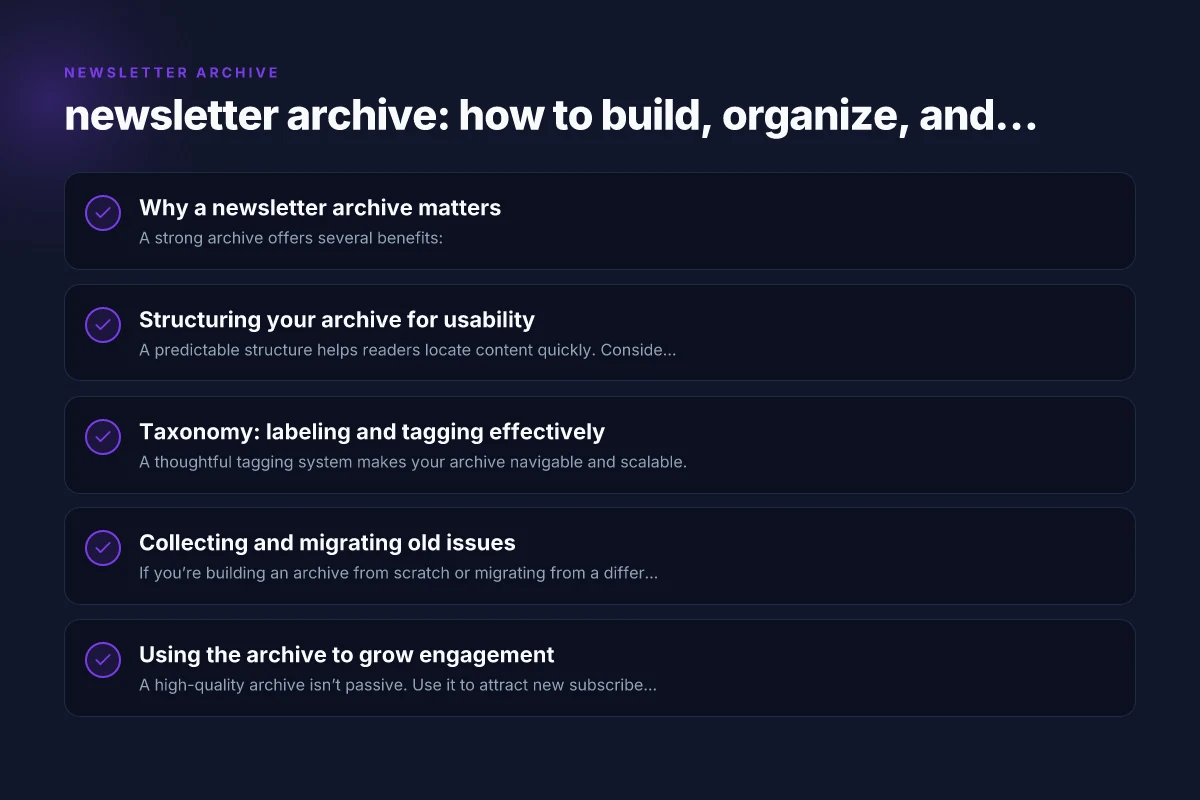
Why a newsletter archive matters
A strong archive offers several benefits:
- Discoverability: New readers can browse past issues to understand your voice and topics.
- Value for subscribers: Returning readers find related content, evergreen advice, and supplementary resources.
- Content planning: Data from past newsletters informs future topics and formats.
- Cross-linking and retention: Archive pages drive SEO and keep readers engaged longer across your site.
What counts as a good archive
- Complete, accessible back catalog: Include every issue, or at least all issues from a defined period.
- Consistent labeling: Clear titles, dates, topics, and tags.
- Searchability: Full-text search or robust filters (date, topic, author, tag).
- Easy access: A prominent archive page, well-linked from newsletters and site navigation.
- Exportability: Options to export or subscribe to individual topics or issues.
Structuring your archive for usability
A predictable structure helps readers locate content quickly. Consider the following elements:
Core fields to capture
- Issue number or date
- Title and summary
- Author or team responsible
- Topics and tags
- Key resources or links
- Download or view options (web, PDF, audio, etc.)
- Related issues (next/previous, or topical series)
Helpful archive layouts
- Timeline view: Chronological listing with years or months.
- Topic-driven view: Filters by category or tag (e.g., Marketing, Product, Personal Growth).
- Issue-first view: List by issue number with quick access to highlights.
- Series view: Group issues that belong to a recurring series (e.g., Monthly Tool Roundup).
| Layout type | Best for | Pros | Cons |
|---|---|---|---|
| Timeline | All readers | Easy orientation, chronological context | Can be long; hard to find specific topics |
| Topic filters | Topic-focused readers | Fast filtering by interest | Requires robust tagging and UI controls |
| Issue-first | New subscribers | Quick access to latest content | Might feel overwhelming with long archives |
| Series grouping | Readers following themes | Coherent learning path | Requires careful series planning |
Taxonomy Options for Labeling and Tagging
| Taxonomy Type | Granularity | Pros | Cons | Suggested Use Case |
|---|---|---|---|---|
| Flat tags only | Broad | Simple | Ambiguous | Small to medium archives |
| Hierarchical taxonomy | Multi-level | Precise; scalable | Complex to maintain | Large, diverse archives |
| Faceted taxonomy | Dynamic facets | Flexible filtering | Implementation overhead | Growing, multi-topic archives |
| Custom taxonomies per section | Semi-independent | Relevant contexts | Fragmentation risk | Cross-functional newsletters |
Compiled November 2026; check the provider's site for current details. Mtc logo vector
Taxonomy: labeling and tagging effectively
A thoughtful tagging system makes your archive navigable and scalable.
Tagging principles
- Use a controlled vocabulary: Define a set of tags and stick to them.
- Be descriptive but concise: Prefer tags like “Email marketing” over “EM.”
- Avoid over-tagging: 5–10 core tags per issue is often enough.
- Tag by intent and topic: For example, “How-to,” “Case study,” “Industry news.”
Suggested tag categories
- Topic: Marketing, Product, Growth, Design
- Format: How-to, List, Interview, Case Study
- Audience: Beginners, Intermediate, Advanced
- Intent: Tutorial, Inspiration, Resource
Collecting and migrating old issues
If you’re building an archive from scratch or migrating from a different platform, plan a careful lift-and-shift process.
Steps for a smooth migration
- Inventory: List all issues, including metadata (date, title, author, topics).
- Normalize: Harmonize formats, dates, and fields (e.g., ISO date format).
- Tag and categorize: Apply consistent tags and series labels.
- Verify accessibility: Ensure all content is readable and links work.
- Create index pages: Generate archive landing pages with search and filters.
- Test usability: Have readers navigate the archive and provide feedback.
Common migration pitfalls
- Missing resolutions for attachments or media
- Broken internal links after move
- Inconsistent date formats
- Incomplete author metadata
Using the archive to grow engagement
A high-quality archive isn’t passive. Use it to attract new subscribers, deepen engagement, and inform strategy.
Ways to leverage the archive
- Highlight in welcome flows: Point new subscribers to evergreen or popular issues.
- Curate recommended reading: Create “Best of the Archive” lists by topic.
- Enable search-driven discovery: Invest in a robust search experience with autosuggest and facet filters.
- Link from the newsletter: Include a footer or “From the archive” section with relevant issues.
- Repurpose content: Extract evergreen tips for blog posts, guides, or product docs.
- Analyze reader behavior: Track which archive pages get the most views and clicks to guide future topics.
Accessibility and performance considerations
An accessible and fast archive benefits all users, including those with disabilities and users on slower connections. Mtc logo
Accessibility checklist
- Semantic headings and landmarks for navigation
- Descriptive link text (avoid “click here”)
- Alt text for images and media
- Keyboard navigation and focus management
- Proper contrast and readable font sizes
Performance tips
- Lazy load content for long archives
- Paginate or use infinite scrolling with user preference
- Cache frequently accessed archive views
- Optimize search with efficient indexing and throttled queries
Migration and Collecting Old Issues
| Area | Approach | Tools | Risks | Best Practice |
|---|---|---|---|---|
| Inventory of issues | Manual catalog | Spreadsheet; CMS export | Missing issues | Do a full audit |
| Metadata standardization | Normalize fields | Schema, mapping | Inconsistent history | Define required fields |
| Digital asset migration | Upload assets | CMS media manager | Broken links | Validate after move |
| Redirection strategy | Preserve URLs | 301 redirects | SEO impact | Plan redirects first |
| Archival completeness | Preserve core content | Text + covers | Lost annotations | Keep a log |
Compiled November 2026; check the provider's site for current details.
Keeping the archive fresh
A stagnant archive turns readers away. Establish routines that keep the archive relevant and vibrant.
Maintenance cadence
- Monthly tagging and updates: Review newly published issues, assign tags, and refine metadata.
- Quarterly audits: Check for broken links, outdated resources, and accessibility gaps.
- Seasonal highlights: Feature timely roundups or seasonal themes to attract current readers.
- Feedback loops: Collect subscriber feedback about the archive’s usefulness and adjust accordingly.
Content strategy alignment
- Align archive topics with current campaigns, product launches, or seasonal events.
- Create evergreen “core topics” pages that remain useful over time.
- Build series that naturally generate multiple issues and easy cross-linking.
Final recommendation: start with a minimal, scalable archive
If you’re just starting, build a lean archive that covers the essentials and grows over time. Mentornet: A Practical Guide to Mentornet for Careers, Learning, and Growth
What to implement now
- A dedicated archive page on your site with a clean URL, e.g., yoursite.com/newsletter/archive
- Core fields for each issue: date, title, summary, author, tags, and links to the issue
- A robust tagging system with 5–10 core tags and 2–4 series categories
- A search-friendly interface with filters for date and topic
- Easy subscription to individual topics or series from the archive
What to plan next
- Add a “Best of the Archive” landing page to surface evergreen issues
- Create a quarterly archive audit schedule to fix links and update metadata
- Integrate analytics to learn which topics drive engagement and drive future topics
By investing in a thoughtful newsletter archive, you create a durable hub for your audience. It becomes a living resource that welcomes newcomers, rewards loyal readers, and informs your content strategy. Start with the essentials, then layer in structure, accessibility, and analytics to transform your archive into a powerful engine for growth.