Gvms profiles rey castuciano: a deep dive into the GVMS profiles and Rey Castuciano’s role

An in-depth look at gvms profiles and Rey Castuciano’s involvement, tracing background, uses, and practical insights.
GVMS profiles and Rey Castuciano: what you need to know GVMS profiles are a structured approach to managing digital identities, access controls, and permissions across systems. When you pair gvms profiles with the work of Rey Castuciano, you gain a practical lens for implementing identity governance in complex environments. This article unpacks what gvms profiles are, who Rey Castuciano is in this context, and how to apply these concepts in your organization.
GVMS Profiles comparison by scope and applicability
| Feature | Personal use | Small business | Enterprise | Compliance | Customization | Rey Castuciano approach |
|---|---|---|---|---|---|---|
| Primary focus | Individual access | Team access | Organization-wide | Regulatory alignment | Tailor-made profiles | Rey’s methodology emphasis |
| Typical granularity | Low | Medium | High | High | Variable | High |
| Access control | Basic roles | Roles + groups | Roles, groups, attributes | Policy-driven | Flexible | Structured |
| Approval workflow | Optional | Simple | Multi-step | Mandatory | Configurable | Stepwise |
| Audit readiness | Limited | Moderate | Full | Yes | Yes with mapping | Emphasized |
| Ease of deployment | Fast | Medium | Slow | Moderate | Variable | Systematic |
Compiled November 2026; check the provider's site for current details.
What are gvms profiles?
gvms profiles refer to a set of predefined configurations used to describe identities, roles, and permissions within a governance framework. They help standardize who can access what, under which conditions, and for what purpose. Key elements often include:
- Identity attributes: user ID, department, role, and tenure
- Access entitlements: read, write, delete, execute
- Contextual policies: time-based access, location-based restrictions, device compliance
- Audit and traceability: logging, alerting, and reporting
In practice, gvms profiles serve as reusable templates that can be applied across multiple systems, making onboarding faster and governance more consistent.
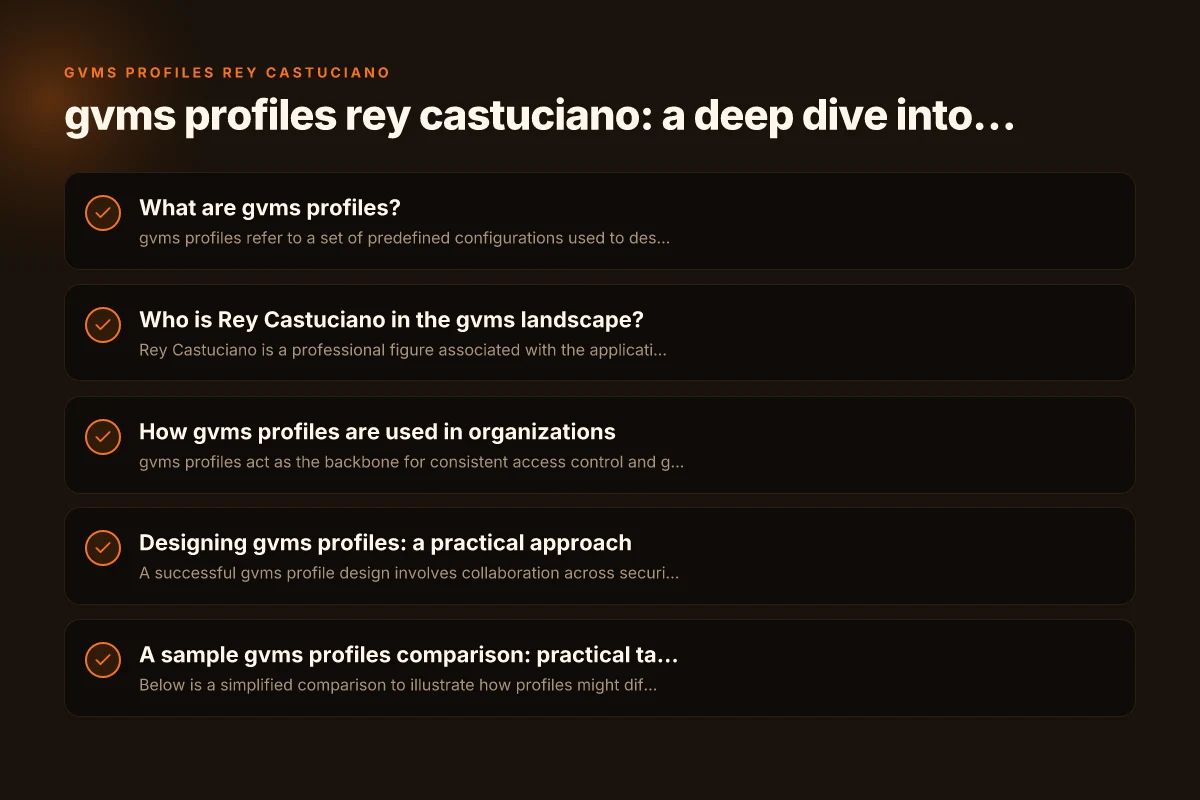
Who is Rey Castuciano in the gvms landscape?
Rey Castuciano is a professional figure associated with the application of gvms profiles in governance and identity management contexts. The exact scope of Rey Castuciano’s work can vary by organization. Typical roles might include:
- Designing and mapping gvms profile templates to business processes
- Aligning profiles with regulatory requirements (e.g., data protection, access control standards)
- Implementing tooling and automation to enforce profiles across platforms
- Coaching teams on best practices for identity governance and least-privilege access
- Performing audits and refining profiles based on risk assessments
If you’re exploring case studies or practitioner insights, look for materials where Rey Castuciano discusses real-world deployments, challenges faced during rollout, and strategies for stakeholder buy-in. Gvms profiles harvey gershensen
How gvms profiles are used in organizations
gvms profiles act as the backbone for consistent access control and governance. Typical use cases include:
- Onboarding and offboarding: automatically aligning new hires with the correct profiles and revoking access at departure
- Role-based access control (RBAC): assigning profiles by role to ensure standard permissions
- Segregation of duties (SoD): using profiles to minimize conflicts of interest by design
- Compliance reporting: generating evidence of who had what access and when
- Change management: updating profiles as business needs evolve without reconfiguring every system
By standardizing profiles, organizations reduce manual errors and improve audit readiness.
Designing gvms profiles: a practical approach
A successful gvms profile design involves collaboration across security, IT operations, and business units. Consider these steps:
- Define scope and objectives: what systems, data, and processes will be governed by the profiles?
- Create a governance model: who owns each profile, how are changes approved, and how are exceptions handled?
- Map roles to profiles: identify job families and translate them into concrete entitlements
- Establish policy controls: time windows, device posture, geo restrictions, and multi-factor authentication requirements
- Implement automation: use identity and access management (IAM) tools to enforce profiles consistently
- Test and validate: run pilots to detect gaps, misconfigurations, and unintended access
- Monitor and refine: continuous improvement through metrics and periodic reviews
PRO TIP: Start with a minimal viable set of profiles for the most critical systems, then expand. Gateway venture mentoring service and umsl ite roll out flipzone unique training program helps small businesses scale up
Rey Castuciano’s role in gvms landscape: decision points and outcomes
| Decision point | What to decide | Rey’s recommended stance | Expected outcome | Risks / mitigations | Key metric |
|---|---|---|---|---|---|
| Profile ownership | Who owns profiles | Central governance with clear owners | Clear accountability | Ownership gaps; mitigate with SLAs | Ownership clarity |
| Profile naming | Naming convention | Consistent, scalable names | Easier discovery | Drift; enforce naming policy | Discovery efficiency |
| Access approval | Who approves changes | Role-based approvals per policy | Faster but compliant changes | Bottlenecks; mitigate with auto-approval rules | Approval cycle time |
| Change management | How to roll out updates | Change windows and tests | Stable rollout | Rollback plan needed | Change success rate |
| Compliance mapping | Align with regs | Map to requirements; document | Audit-ready | Documentation gaps | Audit findings |
| Incident response | How to handle breaches | Predefined response playbooks | Rapid containment | Missteps; simulate drills | Time to containment |
Compiled November 2026; check the provider's site for current details.
A sample gvms profiles comparison: practical table
Below is a simplified comparison to illustrate how profiles might differ across common access scenarios.
| Profile name | Typical scope | Core entitlements | Contextual controls | Audit focus |
|---|---|---|---|---|
| Global Read (GR) | All customers data view | Read-only access | Location: any, device compliant | Access events, anomalous reads |
| Project Lead (PL) | Project management tools | Read, write, approve | Time-based access, project membership | Changes, approval workflows |
| Admin Full (AF) | Critical systems | Read, write, delete, override | Elevated within maintenance windows | Privilege usage, SoD conflicts |
| Data Steward (DS) | Data governance platforms | Read, annotate, export | Data sensitivity, labelling | Data lineage and policy adherence |
| Incident Responder (IR) | Security incident tools | Read, respond, quarantine | Urgency, trusted device | Incident handling, response times |
Notes: Flipzone entrepreneur training established ventures
- The exact entitlements will depend on your tooling (IAM, PAM, SCIM, etc.)
- Contextual controls are essential to reduce risk even when broad access is allowed
- Regular reviews help keep the table aligned with business needs
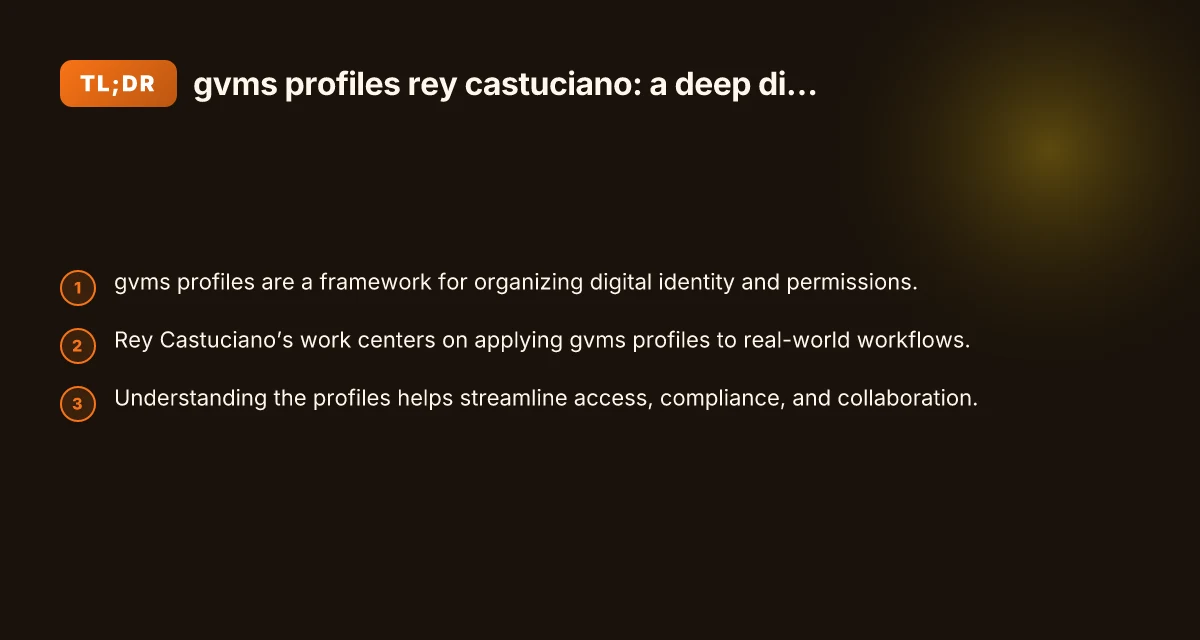
Implementing gvms profiles with Rey Castuciano’s approach
If you’re inspired by how Rey Castuciano approaches gvms profiles, you can adapt these guiding principles:
- Start with governance, then technology: ensure there is a clear policy framework before tool selection
- Emphasize risk-based prioritization: focus on the most sensitive data and critical systems first
- Align with regulatory demands: map profiles to compliance requirements you must meet
- Invest in automation: profile-based provisioning reduces time-to-accurate access
- Foster cross-functional ownership: involve security, IT, and business units in profile design
- Build a culture of continuous improvement: schedule regular reviews and update cadence
Case anecdotes often reveal that the biggest gains come from disciplined change management, clear ownership, transparent decision trails, and measurable outcomes.
Practical workflow for implementing gvms profiles from concept to operation
| Phase | Key activity | Owner | Output | Tools / artifacts | Status markers |
|---|---|---|---|---|---|
| Concept | Define goals | PM | Goals doc | Goals sheet | Drafted |
| Design | Create profiles schema | Architect | Schema blueprint | Diagram, spec | Approved |
| Build | Implement profiles | Admins | Configured profiles | IAM console, scripts | Implemented |
| Validate | Test access | QA / Sec | Test results | Test cases | Passed |
| Deploy | Roll out | ENG / Ops | Live profiles | Deployment plan | Deployed |
| Monitor | Monitor usage | Sec / IT | Usage report | Dashboards | Ongoing |
Compiled November 2026; check the provider's site for current details. Gateway venture mentoring service
Common challenges and how to address them
- Scope creep: Keep a living catalog of profiles and lifecycle owners. Lock down requests with formal approvals
- Excessive entitlements: Apply least-privilege by default. Use Just-In-Time (JIT) access for high-risk situations
- Poor data quality: Maintain clean attribute data (roles, departments) to ensure accurate mappings
- Tool fragmentation: Prefer interoperable standards (SCIM, SAML, OAuth) and automation platforms
- Compliance drift: Automate evidence collection and reporting to demonstrate ongoing adherence
Practical workflow: from concept to operation
- Discovery: catalog systems, data domains, and typical access patterns
- Policy drafting: write profiles with clear entitlements and contextual constraints
- Pilot phase: deploy a subset of profiles to a controlled group
- Feedback loop: collect input, adjust profiles and policies
- Scale-out: roll out profiles organization-wide with automation
- Continuous monitoring: dashboards, alerts, and quarterly reviews
Final recommendations for readers
- Start small but think big: implement core gvms profiles for critical systems first
- Build a governance spine: clear roles, approvals, and audit trails
- Automate as early as possible: use IAM/PAM solutions to enforce profiles and reduce manual work
- Prioritize data protection: ensure profiles align with data sensitivity and regulatory requirements
- Learn from practitioners: seek case studies or talks featuring Rey Castuciano or similar experts to gain practical insights
If you’re evaluating gvms profiles and planning a governance program, consider engaging with practitioners who emphasize both policy clarity and technical rigor. Rey Castuciano’s work underscores the value of bridging theory and real-world application, helping teams implement profiles that are both secure and scalable.