Career management seminar presenting professionally
A practical guide to delivering a career management seminar that looks polished, authoritative, and impactful.
Delivering a career management seminar professionally requires clarity, structure, and presenter presence. Whether you’re training staff, university students, or professionals in transition, the aim is to equip attendees with actionable strategies for managing their careers. This guide covers planning, delivery, engagement, materials, and follow-up so you can present with confidence and impact.
Comparison of seminar planning outcomes vs audience impact
| Aspect | Define purpose | Identify audience | Expected outcomes | Measured impact |
|---|---|---|---|---|
| Planning the seminar | clear | specific | tangible | trackable |
| Target audience | internal vs external | demographic reach | skill gains | engagement metrics |
| Learning outcomes | knowledge, skills, attitudes | behavioral change | career actions | evaluation methods |
| Success indicators | SMART goals | signups | session ratings | follow-up actions |
| Risk factors | scope creep | accessibility | budget overruns | mitigation plan |
Compiled November 2026; check the provider's site for current details.
Planning the seminar: defining purpose, audience, and outcomes
What you want attendees to achieve
- Identify at least three career management competencies (e.g., personal branding, networking, goal setting).
- Leave with an actionable 90-day plan.
- Gain confidence to pursue visible career opportunities.
Know your audience
- Experience level (early-career, mid-career, executives)
- Industry and job functions
- Typical barriers (fear of networking, resume anxiety, interview nerves)
Set measurable outcomes
- Attendance and engagement metrics
- Pre- and post-seminar assessments
- Completion of a personal action plan
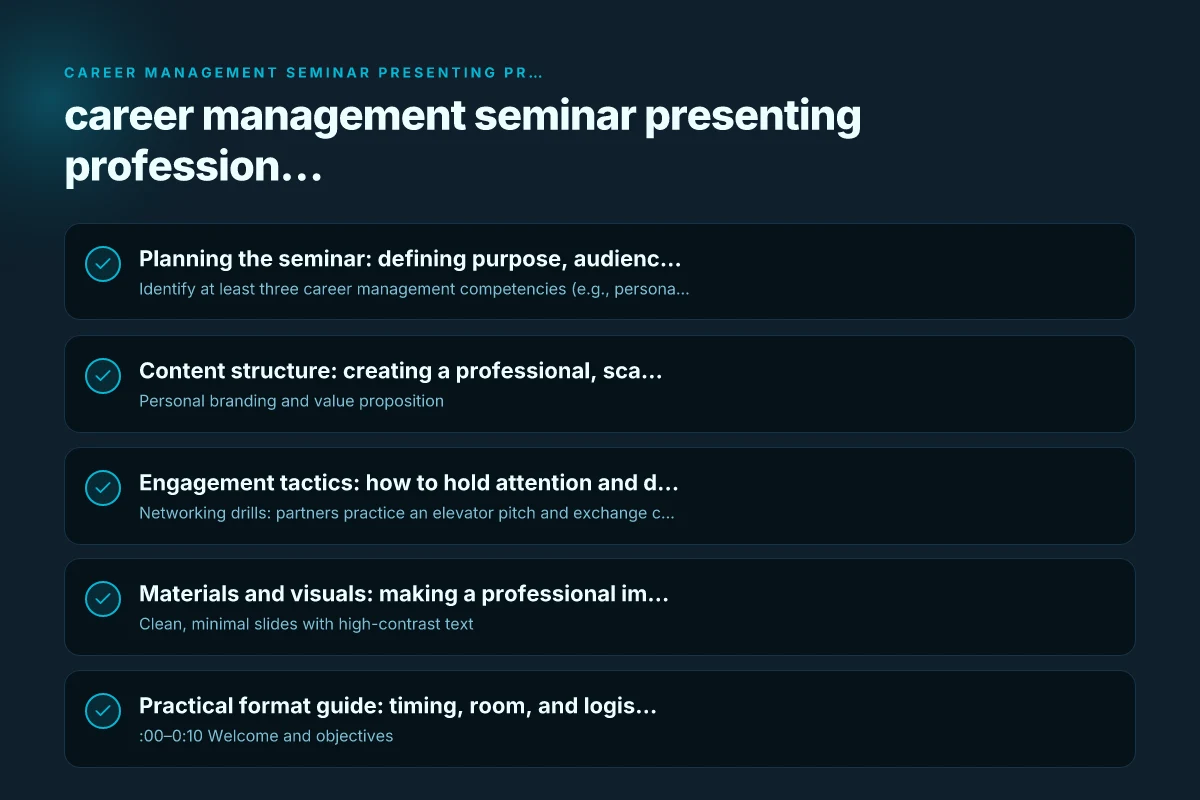
Content structure: creating a professional, scannable flow
Core modules you can adapt
- Personal branding and value proposition
- Networking strategies that work in real life
- Job search methods: discovery, outreach, and follow-through
- Resume, LinkedIn, and portfolio optimization
- Interview mastery and negotiating offers
Session format ideas
- Short lectures (10–15 minutes)
- Live demonstrations (resume edits, networking scripts)
- Breakout activities (pair or small-group work)
- Q&A segments (anticipate top questions)
Designing for clarity
- Use a consistent slide template and typography
- Include one takeaway per slide
- Add a one-page handout summarizing the plan and resources
Engagement tactics: how to hold attention and drive action
Interactive activities that add value
- Networking drills: partners practice an elevator pitch and exchange contact details
- Resume critique circles: small groups review anonymized resumes
- Career map workshop: attendees map short- and long-term goals
Communication techniques for professionalism
- Speak with purpose and pause for emphasis
- Vary your pace and tone to maintain interest
- Use inclusive language and invite questions
Handling questions gracefully
- Repeat the question to the room for clarity
- Categorize questions by topic and address them in order
- Offer follow-up resources if you don’t have an immediate answer
Materials and visuals: making a professional impression
Slide deck essentials
- Clean, minimal slides with high-contrast text
- One concept per slide
- Visuals that reinforce, not distract (graphs, icons, diagrams)
Handouts and resources
- A one-page action plan template
- A list of recommended tools (resume builders, LinkedIn tips, networking scripts)
- Access to a resource library (books, blogs, courses)
Tools you may use
- Remote clicker and presentation software
- Timer to keep sessions on track
- Microphone and sound check for larger rooms
Content structure options for a professional seminar
| Element | Flow type | Scannability | Time efficiency | Visual cues |
|---|---|---|---|---|
| Opening | hook + purpose | high | quick | slide title, agenda |
| Core sections | logical sequence | skimmable | balanced | headings, bullets |
| Transitions | signpost | clear | smooth | color blocks |
| Activities | interactive | concise | fits time | prompts, timers |
| Summary | recap + call to action | memorable | efficient | takeaway slide |
| Handouts | supplement | readable | minimal | one-page per section |
Compiled November 2026; check the provider's site for current details.
Practical format guide: timing, room, and logistics
Typical session outline (3-hour example)
- 0:00–0:10 Welcome and objectives
- 0:10–0:40 Module 1: Personal branding
- 0:40–1:00 Activity: Elevator pitch
- 1:00–1:30 Module 2: Networking
- 1:30–1:45 Break
- 1:45–2:15 Module 3: Job search tactics
- 2:15–2:45 Activity: Career map
- 2:45–3:00 Q&A and wrap-up
Room and setup considerations
- Stage visibility and seating arrangement
- Accessibility for all participants
- Tech backups (extra projector, remote, charging stations)
Catering and breaks
- Short breaks help maintain energy
- Light refreshments to support focus
Measurement and improvement: evaluating impact and refining
Pre- and post-seminar assessments
- Short surveys to gauge confidence and knowledge gains
- Short answer prompts to measure intent and plan
Feedback loops
- End-of-session reflection form
- Optional follow-up interview or check-in after 30 days
A simple evaluation table example
| Dimension | What to assess | How to measure |
|---|---|---|
| Content relevance | Are the topics aligned with attendees’ needs? | Post-seminar rating and open-ended feedback |
| Clarity | Is the material easy to understand? | Quick comprehension checks during the session |
| Practical value | Do attendees have actionable steps? | Review of completed action plans |
| Presenter proficiency | How was the delivery quality? | Observations and self-assessment |
Follow-up: turning insights into ongoing career momentum
- Distribute the action plan template and resource links
- Schedule optional 30- and 90-day check-ins
- Create a community or Slack/LinkedIn group for continued networking
How to sustain engagement
- Encourage peer accountability pairs
- Offer monthly micro-sessions on specific topics (e.g., LinkedIn optimization)
- Share success stories to motivate participants
Accessibility and inclusivity: ensuring everyone can benefit
- Use plain language and avoid jargon
- Provide captions or transcripts for audio content
- Offer materials in multiple formats (PDF, slides, audio)
- Be mindful of time zones and scheduling for remote attendees
Engagement tactics comparison by outcome
| Tactic | Attention hold | Action drive | Inclusivity | Practicality |
|---|---|---|---|---|
| Storytelling | yes | a hook | yes | easy |
| Questions | yes | prompts | yes | requires prep |
| Polls/quick wins | yes | momentum | yes | simple tools |
| Breakouts | yes | peer learning | yes | logistics required |
| Visuals | engaging | supports | accessible | design effort |
| Calls to action | clear | explicit | inclusive | implementable |
Compiled November 2026; check the provider's site for current details. Capital innovators announces lineup
Presentation style: cultivating professionalism and credibility
Voice and presence
- Speak clearly, at a measured pace
- Use confident body language: open posture, eye contact
- Manage nerves with breathing techniques and rehearsed openings
Dress and environment
- Dress professionally to establish authority
- Create a welcoming, inclusive atmosphere in the room
Script and rehearsal
- Prepare a modular script with flexible segments
- Rehearse with a timer and a test audience
- Record a practice run to review pacing and clarity
The recommendation: deliver a career management seminar that is professional, practical, and repeatable
Recommending a professional approach means combining a strong content framework with polished delivery and ongoing support. Start with clear outcomes tied to real-world career management skills. Build your seminar around practical modules, personal branding, networking, job search tactics, and interview mastery, delivered through brisk lectures, hands-on activities, and actionable takeaways. Use a clean, consistent visual design and provide attendees with a concise action-plan toolkit. Finally, implement a simple follow-up system to convert insights into ongoing momentum. This combination helps you present with authority, keep attendees engaged, and create lasting value for participants.