Arch angels says jobs act

A practical guide to understanding what the “arch angels says jobs act” refers to, its implications, and how it affects startups and investors.
Startup finance discussions frequently drift toward the intersection of policy and funding. The phrase arch angels says jobs act sits at that crossroads. It may sound like a single policy. It often represents a constellation of opinions from angel investors, sometimes framed as “the arch angels” offering views on how jobs acts or similar legislation can impact early-stage funding, tax incentives, and startup growth. This article decodes the phrase, what it commonly means in practice, and how founders and investors can respond.
Comparison of phrase meanings across contexts
| Aspect | General meaning | In arch angels context | In standard job acts | Practical takeaway |
|---|---|---|---|---|
| Core idea | Opportunity or obligation for work | Focused on equity for founders | Regulatory framework for employment | Aligns with founders’ fundraising goals |
| Typical beneficiaries | Employees, founders, investors | Founders and angels | Employees, companies, regulators | Identify primary stakeholder group |
| Legal risk | Moderate to high if misapplied | Specific to arch angels rules | Compliance required | Seek legal review |
| Time sensitivity | Often ongoing | Timed by act period | Depends on statute | Plan with milestones |
| Flexibility | Moderate | High, depending on arch angel norms | Low to moderate | Balance rigidity and agility |
| Typical documents | Contracts, filings | Arch angel policy docs | Employment contracts, disclosures | Prepare standard templates |
Compiled November 2026; check the provider's site for current details.
What the phrase usually means
Angles on policy from veteran investors
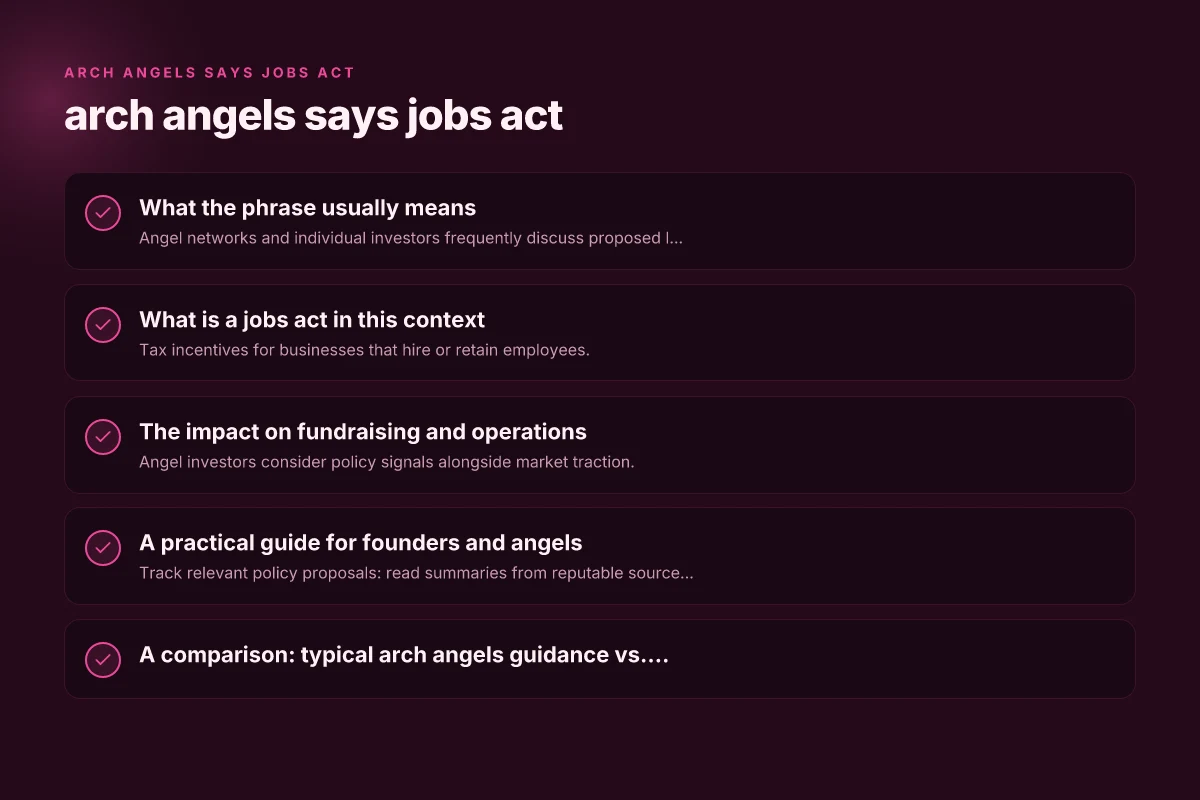
- Angel networks and individual investors frequently discuss proposed laws or amendments that affect startup funding.
- The term arch angels can be shorthand for a group of senior angel investors whose opinions carry influence in venture circles.
- “Says jobs act” suggests a stance about how a jobs-focused act would facilitate hiring, payroll relief, or capital gains treatment that benefits startups.
Why it matters to startups
- If a policy favors job creation or payroll incentives, startups may get more favorable fundraising environments.
- Tax credits, equity-friendly investment rules, or accelerated depreciation can influence cash flow.
- Clear guidance from influential angels can steer founders toward advantageous compliance and funding strategies.
What is a jobs act in this context
Common features of jobs-focused acts
- Tax incentives for businesses that hire or retain employees.
- Simplified regulatory requirements for small businesses and startups.
- Incentives such as credits for research and development, training, or local hiring.
- Provisions that make it easier for accredited investors to participate in early rounds.
How arch angels might interpret such provisions
- Favorable interpretation: the act helps startups scale by reducing upfront costs and easing compliance.
- Cautionary interpretation: some incentives may be narrow, time-bound, or require matching funds, which need planning.
- Neutral interpretation: investors may acknowledge the potential but stress due diligence and structure.
The impact on fundraising and operations
On fundraising rounds
- Angel investors consider policy signals alongside market traction.
- Jobs act-related incentives can improve unit economics, especially if payroll credits reduce burn rate.
- Clear eligibility rules help avoid later restructuring or clawbacks.
On hiring and payroll
- Payroll tax credits can lower effective payroll costs for early hires.
- People costs are a major lever for growth. Incentives can tilt hiring decisions in favor of critical roles.
- Compliance requirements may shift as policies evolve, so governance matters.
What is a jobs act in this context
| Element | General jobs act concept | Arch angels context | Standard job acts | Relevance for founders |
|---|---|---|---|---|
| Definition | Legislation easing hiring/funding rules | Arch angel-specific guidance | Legal framework governing employment | Clarifies permissible fundraising paths |
| Scope | Employment, exemptions | Founders, angels, fundraising | Hiring, compensation, reporting | Narrow vs broad scope implications |
| Compliance focus | Disclosure, limits | Policy alignment with arch angel norms | Wage, benefit, non-discrimination | Compliance checklist needed |
| Enforcement | Regulators, penalties | Arch angel oversight | Government agencies | Risk awareness |
| Typical benefits | Faster fundraising, clearer rules | Tailored to angels' ecosystem | Standard protections | Use to negotiate terms |
| Ambiguity levels | Medium to high | Medium | Low to medium | Seek clarified language |
Compiled November 2026; check the provider's site for current details.
A practical guide for founders and angels
If you’re a founder
- Track relevant policy proposals: read summaries from reputable sources and note eligibility criteria and timelines.
- Model scenarios: build cash-flow projections with and without incentives to quantify impact.
- Prepare a policy narrative: articulate how your hires, revenue, and job creation align with stated goals of the act.
If you’re an angel investor
- Share clear guidance with portfolio founders: outline which incentives are most likely to apply and what the risks are.
- Align term sheets with potential credits: consider structuring rounds to maximize eligibility, while maintaining clean governance.
- Engage with policymakers: provide feedback on practical barriers and real-world implementation issues.
A comparison: typical arch angels guidance vs. standard job acts
| Aspect | Arch angels guidance (typical stance) | Standard job acts (general expectations) |
|---|---|---|
| Focus | Job creation, ease of early hiring, cash flow impact | Broad incentives for hiring, R&D, and local investments |
| Risk emphasis | Compliance complexity, timing, eligibility pitfalls | Budget impact, sunset clauses, and administration |
| Founder concern | Access to capital, faster go-to-market, burn rate | Long-term sustainability and scalable growth |
| Investor stance | Supportive if incentives align with milestones | Pragmatic; incentives must be reliable and enduring |
Practical guide for founders and angels
| Stage / role | Action item | Documents to prepare | Decision cue | Outcome indicator |
|---|---|---|---|---|
| Early stage founder | Review act relevance | Term sheet outline, policy notes | If act benefits funding | Faster closing |
| Angel investor | Assess alignment | Investment memo, risk notes | If protections present | Confidence in investment |
| Compliance | Map requirements | Compliance checklist | If missing, pause | Reduced risk |
| Fundraising | Plan milestones | Projections, cap table | If favorable terms appear | Higher credibility |
| Operations | Align with act | Employee contracts, cap table changes | If need changes | Smoother execution |
| Risk management | Identify red flags | Legal opinions | If ambiguities exist | Informed decision |
Compiled November 2026; check the provider's site for current details. Akermin raises 10m series b
Real-world considerations and cautions
Time sensitivity and implementation
- Many incentives are time-bound or contingent on regulatory changes passing or being renewed.
- Founders should plan around possible renewal dates and have contingency plans.
Eligibility and documentation
- Incentives nearly always require documentation for hires, payroll, and training activities.
- Proper record-keeping simplifies audits and compliance reporting.
Interplay with other funding sources
- Grants, public funds, and incentives can interact with equity rounds, credits, or deductions.
- Be mindful of clawback provisions if milestones aren’t met or if activities don’t align with program requirements.
The final word: interpretation varies, plan carefully
The phrase arch angels says jobs act is not a single, universal policy. It’s a capsule that captures a sentiment: influential angel investors are weighing in on how a jobs-focused act could affect startups. The actual provisions, eligibility rules, timelines, and administrative requirements will determine the real-world impact. For founders, the prudent approach is to stay informed, model your numbers with incentives in mind, and engage both investors and policymakers with concrete data and clear plans.
RECOMMENDATION
- Start with a policy scan: identify the specific act or proposed provisions most likely to affect your business.
- Build flexible financial models: run scenarios with different incentive structures and timelines.
- Engage early with your angels: ask for their interpretation, recommended strategies, and introductions to policy conversations.
- Prepare your team: implement robust tracking and reporting processes to ensure eligibility and readiness for audits.
- Monitor for changes: incentives can evolve, so assign a point person to track regulatory updates and adjust plans accordingly.